
Introduction
A value stream operating model is an organisational design in which teams, governance, funding, architecture and performance management are aligned around long-lived flows of value to customers rather than around temporary projects or functional silos.
It connects strategy to execution through stable ownership of outcomes, clearer investment choices and coordination that does not stop at a departmental boundary.
Most large organisations do not underperform through lack of effort. They underperform because the way they are organised works against the outcomes they are trying to produce. Strategy is set in one place, money is controlled in another, delivery is managed somewhere else, and architecture is decided separately again.
A value stream operating model is the structural answer to that problem.
Here we set out how the money and the people work inside it, and how to tell whether an organisation has really adopted a value stream operating model.
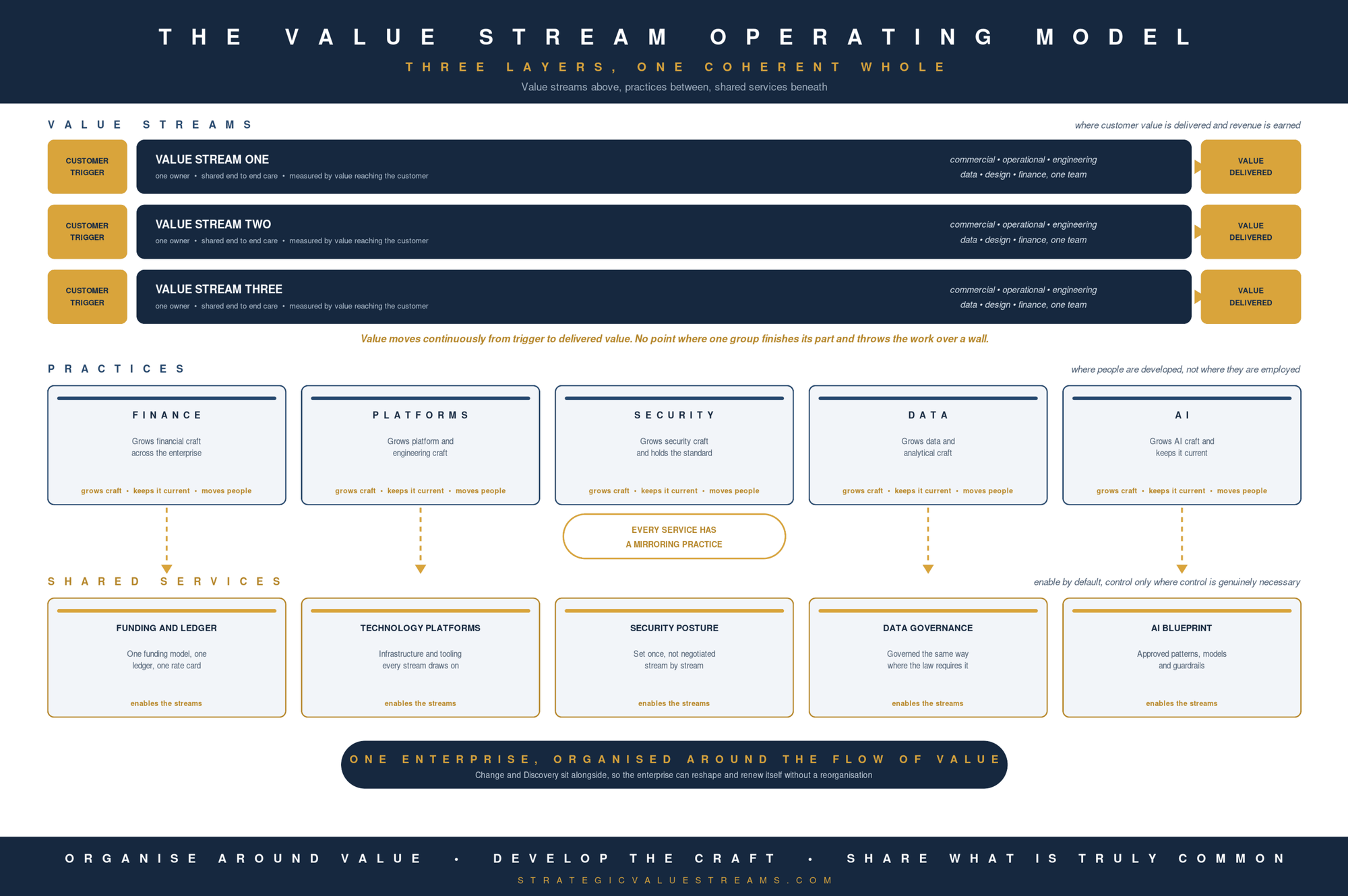 Three layers, one coherent whole. Value streams create value end to end, practices develop the people, shared services enable every stream.
What is a Value Stream Operating Model?
A value stream operating model defines how an organisation arranges people, craft, governance, investment and delivery around the value it exists to create. Instead of moving work between departments as a series of short-lived projects, it builds the enterprise around long-lived value streams that carry ongoing responsibility for the value reaching customers.
A value stream is not a diagram and not a mapping exercise. Value physically moves through an organisation, whether anyone has drawn it or not, and a value stream is the actual path it takes from the first signal of customer need to the value that reaches them. What the operating model does is make that path the thing the enterprise is organised around, with accountable leadership, stable teams, investment logic, governance rhythms and enabling architecture attached to it.
The flow has no finish line. As long as there are customers to serve, the stream keeps delivering and keeps adapting to what those customers now need. That is what makes it the right structure to build an enterprise on. Markets shift, technology moves and strategy is rewritten, and the value stream is the part of the organisation whose whole job is to keep delivering while all of that changes.
What does a value stream organisational structure look like?
Every serious conversation about organising around value streams runs into the same question. What happens to finance, then. What about security, data, architecture and the platforms everyone depends on. Two common answers are both weak. One keeps the functional organisation intact and treats value streams as a reporting overlay, which changes the language without changing anything. The other forces every function into a stream, which shreds capabilities that only work when they are coherent.
The stronger design is a layered one, three bands stacked on top of each other.
Value streams, the top layer
The value streams sit at the top because they are the part of the organisation whose job is to keep delivering value, and everything below them exists to help them do it. They run horizontally across the enterprise, from customer trigger to delivered value. Ownership sits with the flow rather than with a functional box, and the people working in a stream share one care, that value reaches the customer.
That shared care is what removes the internal boundaries a functional organisation treats as normal. Handoffs are not a feature of a value stream. They are an artefact of functional structure, found when an organisation maps how work moves today, and eliminated as it moves to flow. In a genuine value stream there is no point where one group finishes its part, throws the work over a wall and stops caring.
Practices, the middle layer
People do not belong to a value stream for life. They belong to a practice, and the practice is the professional home of a discipline. Engineering, design, finance, security and the rest each have one, and each practice does three things no single stream can do well on its own. It grows the craft, turning a beginner into an expert over a career that outlasts any one stream. It keeps that craft current as the field moves. And it moves people between streams so knowledge spreads and expertise stays fresh rather than calcifying in one place.
This is the deepest reason the practice, and not the stream, develops the people. A stream left to grow its own people would rationally grow only the skills it needs to deliver what it delivers now, which produces specialists tuned to today. A practice develops people to the breadth of the discipline, past what any single stream needs, and that breadth is adaptability the enterprise has not yet spent. An organisation whose people belong to their streams is ready for a change of product. An organisation whose people are developed in practices is ready for a change of strategy.
Shared services, the bottom layer
Beneath the streams sit the capabilities that are genuinely shared, the things it would be wasteful or dangerous for each stream to build alone. Finance provides a funding model and a common ledger. Technology platforms provide infrastructure no stream should have to build for itself. Security provides the posture that makes safe delivery the default. An AI service owns the blueprint, the reference patterns, the approved tools and models and the guardrails, so that every stream can put AI to work in ways that are understood and safely bounded rather than improvised.
The relationship is enabling. A shared service provides something the streams draw on, not something they must ask permission from. The moment a service becomes a gate the stream has to stop at, the silo has been reintroduced wearing a new name. A service holds real control only where control is genuinely necessary, and the test is a single question. What genuine risk does this control prevent, and would the enterprise actually be exposed without it. Regulatory reporting standards, a non negotiable security posture, data that must be governed the same way everywhere, these earn their control. Most sign offs and review boards do not.
How are practices and shared services organised?
Every shared service has a practice that mirrors it, because a discipline runs two kinds of activity. It performs functional activities, delivered through the service, and it grows craft and holds standards, which is the practice. A finance partner embedded in a stream is still a full member of the finance practice. What changes between disciplines is only the balance, a large finance service with a small embedded population, a leaner platforms service with more of its people out in the streams.
So the two layers are not rivals and they are not alternatives. A discipline appears in both. Its shared service is where it delivers to every stream. Its practice is a membership that spans wherever its people sit, in the service, embedded in a stream, or on secondment. Nobody has to choose between belonging to their craft and belonging to the work.
What roles exist in a value stream operating model?
The structure produces a small set of roles, each accountable for something the others are not. Titles vary between organisations. What matters is that these accountabilities exist somewhere and are not blurred together.
Value stream lead. Accountable for the value the stream delivers, from customer trigger through to delivered value. Employs the people the stream needs for the long term and carries their cost at the rate card. Makes the trade-offs the outcome requires rather than convening a group to make them. This is a business leadership role, not a delivery manager, and not a project sponsor.
Practice lead. Runs the professional home of a discipline. Sets the standard, develops members wherever they sit, holds the annual mobility conversation and orchestrates moves between streams along with the backfill. Measured on the breadth of the practice's members, so mobility is the success measure rather than an interruption to it.
Shared service lead. Runs the standing product every stream draws on, the ledger, the platforms, the security posture, the AI blueprint, and sells specialist capacity into the streams at rate card. Answerable for whether each control the service holds is genuinely necessary, and expected to give up the ones that are not.
Practice member. Everybody. A person is employed by a value stream or a shared service and developed by a practice, and the practice membership never lapses while employment by a unit comes and goes. This separation of employment from development is what makes the model adaptable, because people are grown to the breadth of their discipline rather than to one stream's current needs.
Change specialist. Supplied by the Change service into change that a stream or a service owns, at rate card, in the same way an architect is supplied. The specialist brings the craft of bounded work. The unit being changed still owns the change.
Discovery member. Drawn from across the organisation for twelve to twenty four months, then returned, with at least a further twelve months out before rejoining. The rotation is the point. It keeps current knowledge moving through the team and carries what Discovery learns back into the streams.
Some familiar roles quietly disappear. There is no internal customer to be served, because there is no internal supplier. There is no demand manager standing between a function and the work, and no function head lending people out as a favour. What replaces all of them is a published rate, a stream that can buy the capacity it needs, and a practice that decides where a person grows next.
Why Organisations Adopt Value Stream Operating Models
Organisations move to this model when the structure they have stops supporting the performance they need. Functional silos generate queues, duplicated effort and competing priorities. Project based funding rewards short term delivery and weakens long term accountability. Central governance provides control at the cost of speed and of any real connection to the work.
One word sits underneath the alternative, and it is agility. Not agile the project method, which is only ever one option among several, but agility as a property of the whole organisation, its readiness to sense change and respond without seizing up. The entire design exists to reduce organisational viscosity, the internal drag that slows value on its way to the customer, and to improve the delivery of value itself.
This matters most in complex sectors where performance depends on close coordination across customer journeys, products, operations, data, compliance and technology. Financial services, technology, manufacturing and digital platforms all show the same pattern, which is that the coordination cost of a functional structure eventually exceeds whatever efficiency it was supposed to buy.
Value Stream Operating Model vs Traditional Operating Model
A traditional operating model is organised around functions, hierarchies and discrete initiatives. Marketing, operations, technology, finance and risk each have clear responsibilities, and the customer outcome sits awkwardly across all of them. Work moves between departments, priorities compete, and success is measured locally rather than across the whole.
A value stream operating model starts from a different premise. It asks what value the organisation must create repeatedly and reliably, then arranges the enterprise around that. Functions do not disappear and functional expertise still matters. What each function provides to every stream becomes a shared service. The craft it carries, and the people who carry it, live in a practice. And the value it helps create flows through the streams. A function that used to be a single box on an org chart is resolved into the layers where each part of it actually does its work.
This is also why a value stream operating model is not value stream mapping, not agile delivery and not a product operating model with different vocabulary. Mapping is an analytical technique. Agile is a way of managing delivery work. Product models focus on product structures. A value stream operating model is a whole enterprise design choice about where accountability, money and decisions sit.
The seven elements of a value stream operating model
A strong model contains seven connected elements, and they only work together. Leave one out and the model becomes unstable, or symbolic.
-
01 Outcome-Aligned Value Streams.
The starting point is the definition of the value streams themselves. These should be long-lived, strategically meaningful, and connected to real customer or market outcomes. They should not simply mirror existing departments or be drawn too narrowly around individual teams. A good value stream has a clear purpose, boundaries that make practical sense, and enough organisational weight to support real accountability.
-
02 Accountable Ownership.
Each value stream needs clear leadership. Someone must be accountable for the outcome, for cross-functional coordination, and for performance over time. Without this, the model quickly falls back into committee behaviour. Ownership does not mean one person controls everything. It means someone has the authority and responsibility to hold the whole outcome together.
-
03 Governance and Decision Rights.
Governance in a value stream operating model should support flow, not smother it. The organisation needs clarity on which decisions sit within the value stream and which remain central. Strategic direction, risk appetite, enterprise standards, and major investment controls may remain central. Day-to-day prioritisation, sequencing, and trade-offs within the stream should usually sit closer to the work. Good governance creates guardrails, escalation paths, and decision clarity, rather than layers of approval.
-
04 Funding and Investment Structures.
One of the biggest shifts is away from purely project-based funding. If a value stream is designed to be long-lived, funding should reflect that. This often means more persistent investment aligned to outcomes, capabilities, or product areas rather than temporary business cases for every change. Project-style funding can still exist where needed, but the overall direction should support continuity, learning, and capability development.
-
05 Flow-Based Delivery Structures.
Teams within the model should be arranged to support continuous delivery of outcomes, not just efficient completion of tasks. This means understanding how work moves across the stream, where dependencies sit, where waiting time builds up, and where coordination repeatedly breaks down. Delivery structures need to support shared planning, integrated execution, and learning over time.
-
06 Performance Measures.
A value stream operating model needs measures that reflect the health and performance of the system. Local productivity metrics alone are not enough. The organisation also needs to understand speed of flow, quality, customer outcomes, dependency friction, and the value created through investment. Measurement should help leaders see whether the stream is performing as an end-to-end system.
-
07 Architecture and Enabling Platforms.
Enterprise architecture is critical. A value stream operating model cannot work well if systems, data, and platforms trap teams in fragmented structures. Architecture provides the enabling backbone that allows local autonomy within enterprise coherence. Shared platforms, integration patterns, data standards, and security guardrails all matter because they determine whether value streams can act with speed and confidence without creating chaos.
Examples of enterprise value streams
A value stream is named by what triggers it and what the customer ends up with, never by the department that happens to do the work. These are the shapes they usually take.
Retail banking. Mortgage enquiry to mortgage in place. Account opening to a working account. Business lending application to funds available.
Insurance. Quote to policy in force. First notification of loss to settled claim. Renewal-to-retained customer.
Retail and consumer. Order-to-goods at the door. Return-to-refund received. Product idea to product on sale.
Manufacturing and industrials. Enquiry-to-installed and running equipment. Service request to restored uptime. Spare part order to part fitted.
Government and public sector. Benefit application to first payment. Licence application to licence granted. Report of a problem to problem resolved.
Software and platforms. Signup to first real value for the user. Incident to service restored. Feature request to feature in the hands of customers.
Three tests separate a real stream from a relabelled department. A customer would recognise the trigger and the outcome as things that happen to them. Everyone needed to get from one to the other can sit inside it. And it carries enough weight for one leader to be genuinely accountable, rather than being so narrow that accountability fragments the moment anything goes wrong.
Most enterprises end up with a small number of these, not dozens. If the list starts to look like the current org chart with different words on it, the boundaries have been drawn around convenience rather than around value.
How a Value Stream Operating Model Works in Practice
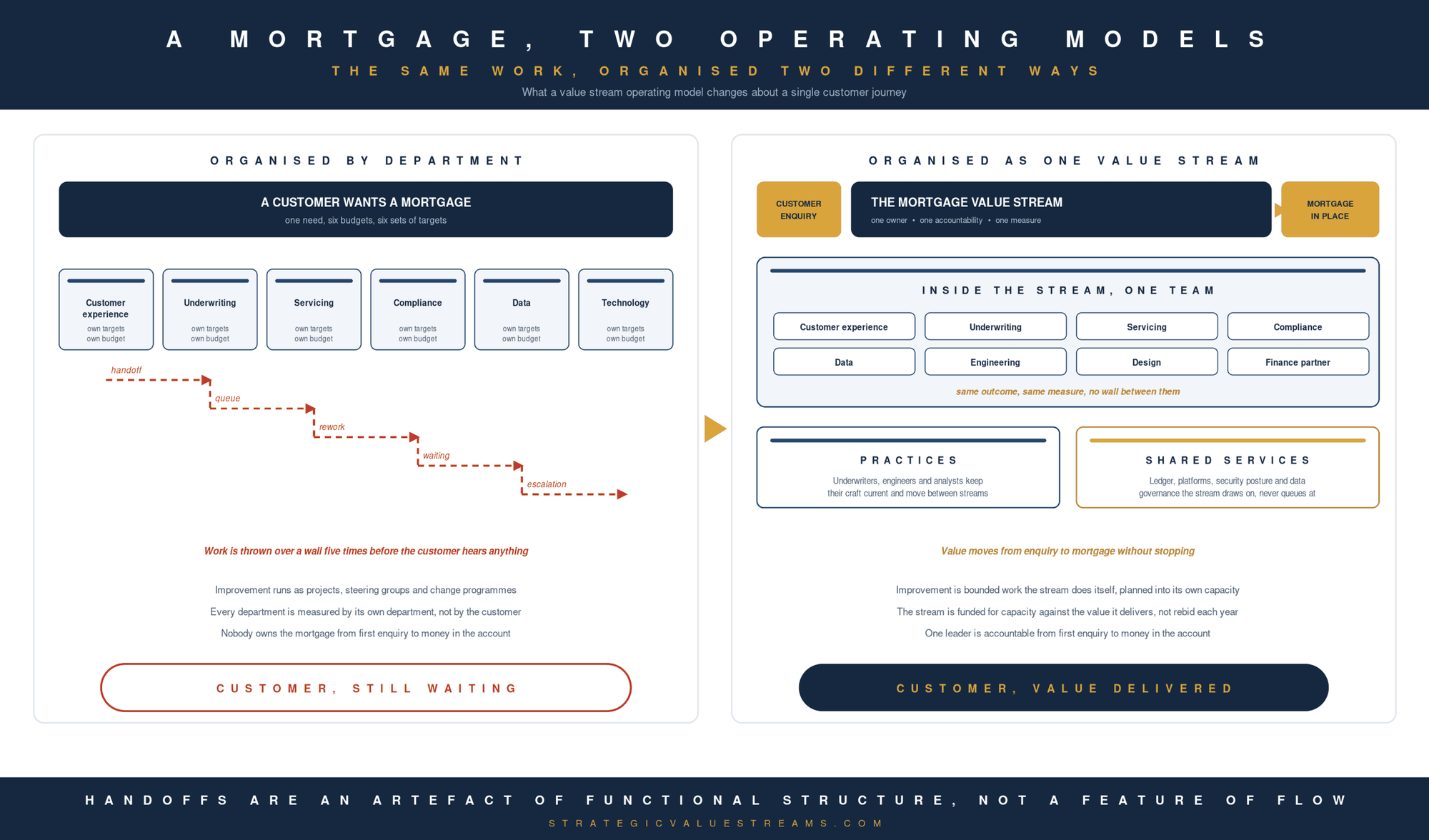
Consider a retail bank improving its mortgage business. In a traditional structure, customer experience, underwriting, servicing, compliance, data and technology sit in different departments with different priorities and separate budgets. Improvement runs through projects, steering groups and change programmes, and the work is passed between departments several times before the customer hears anything.
In a value stream operating model the mortgage journey is one long-lived value stream. One leader is accountable from first enquiry to money in the account. The underwriter, the engineer, the compliance specialist and the finance partner work to the same outcome and the same measure. Improvement is bounded work the stream plans into its own capacity rather than change delivered at it by an outside unit. Architecture decisions are shaped by what the stream needs to keep operating well.
The result is not simplicity. Complex organisations stay complex. What changes is that the structure now supports the outcome instead of working against it.
A mortgage journey organised by department compared with the same journey organised as one value stream.
How the money and the people work
This is where most operating model redesigns quietly fail. The diagrams change and the budget does not.
Value streams are where customer value is delivered and revenue is earned, which is what allows a stream to be run as a genuine profit and loss account rather than a label on a chart. The practices and the shared services are costs that stream performance has to cover. Where revenue does not attribute cleanly, and in government or pooled income businesses where there is no per stream revenue at all, streams run as value centres funded against an explicit measure of the value they exist to deliver, with that measure doing the job revenue does elsewhere.
The instrument that makes this work without friction is the rate card. Every role has a standard burdened rate, a single published figure with the cost of the practices and the shared services already folded in. A value stream lead never sees anyone's salary. They see the rate card. Three developers is three times the developer day rate for as long as the stream needs them, and a business case becomes the capacity it needs priced at known rates. One common planning rate makes capacity comparable across the enterprise, so the sourcing decision turns on capability and availability rather than on price.
To employ someone in this model means one exact thing, that the unit carries their cost at the rate card. A stream employs the people it needs for the long term. A shared service employs specialists and sells their capacity into streams as they are needed. A practice employs almost nobody, because a practice is not where people are employed. It is where they belong, and that membership never lapses while employment by a unit comes and goes.
Movement is purposeful rather than a timetable. Every person has a mobility conversation with their practice at least annually, and after roughly two years in one seat their profile is flagged as ready for a new context. Practices are measured on the breadth of their members, and leaders are assessed partly on whether good people grow through and out of their unit, because in this model giving someone up for their development is leadership rather than loss.
How the enterprise changes, projects and Discovery
All three layers are ongoing. Nothing in the stack has a finish line, so the model needs a way to change something built to keep running.
Its first principle is that the units being changed own their own change. A change delivered by the people who will live with it is owned, understood and maintained. A change delivered at them by an outside unit is received, resented and left to decay. That second pattern is the handoff in its most expensive form, and the model refuses it in change exactly as it refuses it in flow.
Projects and programmes still exist. They are simply bounded work with a start and an end, defined by the change they exist to cause rather than by any method. That change is one of three kinds. It changes the value delivered, or it changes the way value is delivered, or it changes a shared service. A Change service supplies change craft into stream owned change at rate card and coordinates work that spans several streams, but the doing stays with the units being changed.
Genuinely new things need a different home, because nothing in that machinery can carry an idea with no owner, no proven value and no obvious place. Discovery is that home. It is funded centrally and reports at board level, which is the only level that can protect exploration from the pull of the day to day. It is staffed by people drawn from across the organisation who join for twelve to twenty four months and then return, carrying what they learned back with them. When Discovery proves something, the board decides what happens to it. It finds a home in an existing stream, it justifies a new one, or it is consciously left, because proving something works is not the same as proving the enterprise should do it.
This is what reconciles the move to value streams with the survival of projects. Organising around value streams does not abolish them. It changes who owns them and how they are paid for.
How do you design a value stream operating model?
Design begins with strategic clarity. The organisation needs to know which outcomes matter most and where long term differentiation or mission performance will come from. Without that, value streams get drawn around convenience rather than around value.
The next step is to identify the major flows of value and work out where durable accountability should sit. This takes capability analysis, journey analysis and an honest look at how work actually moves today. It also takes judgement, because not every activity deserves its own stream and not every existing structure deserves to be preserved.
For each existing function, three questions do most of the work. What does it provide that every stream shares, which points to a shared service. Where does its craft live and how do its people stay current, which points to a practice. And where, if anywhere, does it hold control the enterprise would genuinely be exposed without. Answer those and the shape of the operating model starts to design itself.
Then ownership, governance, funding and measurement have to be designed around the streams. This is the step transformations skip. They produce diagrams of value streams and leave budgets, architecture decisions and reporting lines exactly as they were, and the labels change while the behaviour does not.
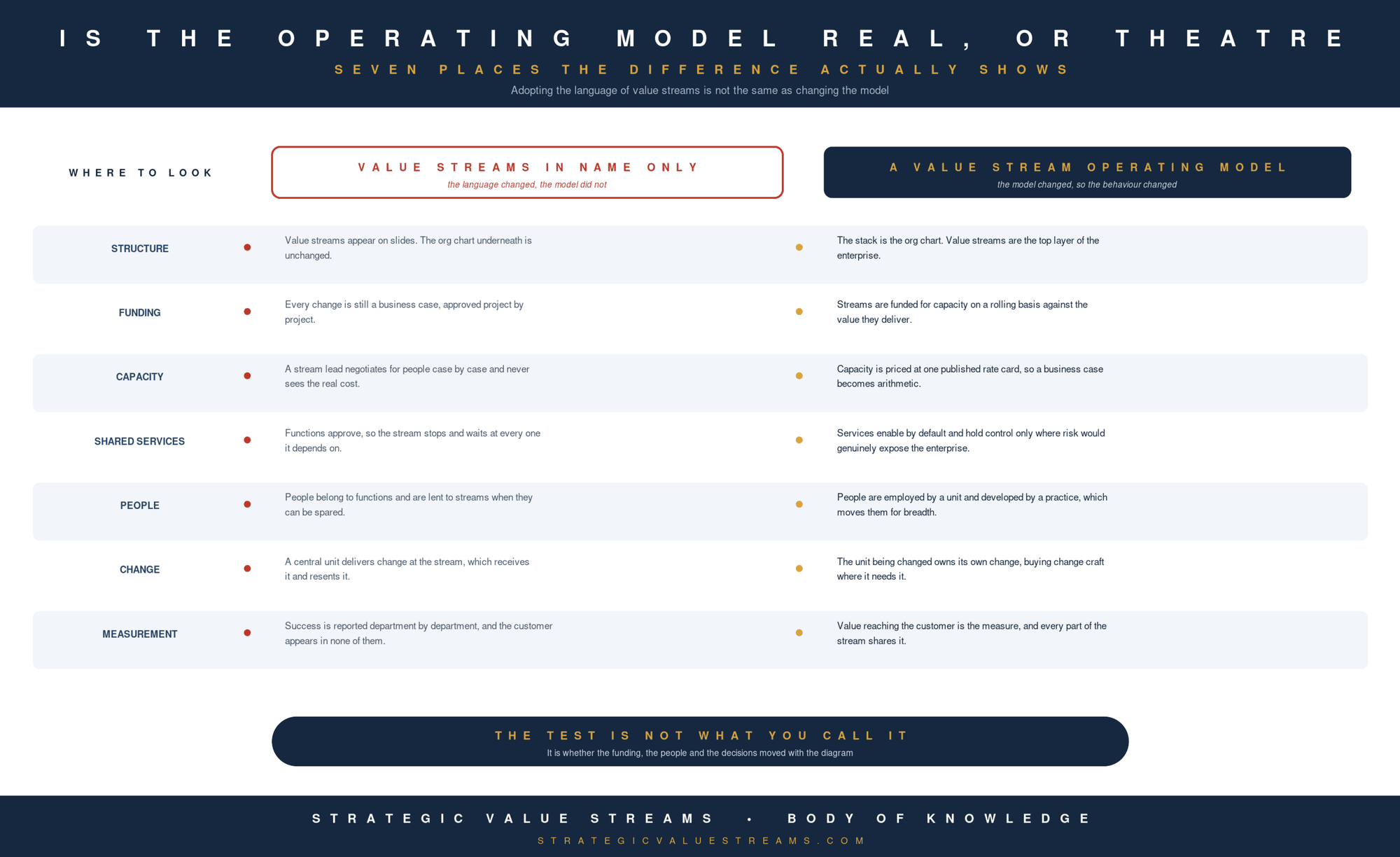
Is the operating model real, or is it theatre?
An organisation has adopted the model when strategy is easier to turn into action, when accountability is clear and when leaders can see how investment connects to the value reaching customers. It has not adopted the model when value streams exist mainly in presentation decks, when funding still behaves as project funding, when governance remains slow and disconnected, or when architecture stops teams from acting within sensible guardrails.
Coordination between streams, and where AI fits
No value stream operates in isolation. Most rely on shared platforms, enterprise data, common controls, external suppliers or specialist craft, and coordination between streams is one of the harder parts of the model. A mature version does not pretend those dependencies disappear. It makes them visible and manages them deliberately, through shared governance, platform structures, enterprise prioritisation rhythms and clear agreements between streams and the services that enable them.
AI raises the stakes on both sides of that. It creates new possibilities for speed and insight, and new coordination demands to go with them. In this model AI is a shared service that owns the blueprint, the reference patterns, the approved tools and models and the guardrails, with a genuinely necessary control core and a much larger surface of enablement. The real question is not whether AI can be added to a value stream. It is whether the organisation is designed to adopt it responsibly, which makes AI adoption part of operating model design rather than a technology decision taken to one side.
Learning about Value Stream Operating Models
Professionals working in strategy execution, enterprise architecture, operating model design, transformation and CIO advisory increasingly need a working command of this subject. It sits at the intersection of strategy, structure, governance and delivery, and it cannot be picked up from agile methods or from architecture alone.
Strategic Value Streams is the professional body for this field. The Body of Knowledge sets out how long-lived value streams, practices, shared services, funding, architecture and organisational flow fit together, and the certification framework provides a recognised way to demonstrate that command.
Take a look at this certification comparison.
FAQ
-
Is a value stream operating model the same as agile?
No. Agile is a way of organising and managing delivery work, usually at team level. A value stream operating model is broader. It defines how the whole enterprise aligns accountability, governance, funding, architecture and delivery around the value it creates.
-
Is it the same as value stream mapping?
No. Value stream mapping is a technique for analysing flow and identifying waste or delay. A value stream operating model is an enterprise design approach that shapes how the organisation is structured, funded and governed.
-
Do functions disappear in a value stream operating model?
No. What each function provides to every stream becomes a shared service, the craft it carries lives in a practice, and its people work in the streams. The function is resolved into the layers rather than abolished.
-
Who should own a value stream?
A leader accountable for the value the stream delivers, from customer trigger through to delivered value. Titles vary. The requirement is real accountability across the whole flow rather than within one department.
-
What happens to projects and programmes?
They continue, as bounded work with a start and an end. What changes is that the unit being changed owns its own change and buys change craft where it needs it, rather than receiving change delivered by a separate unit.
-
How are value streams funded?
On a rolling basis for the capacity they need, priced at a published burdened rate card, rather than through a fresh business case for every change. Significant change is funded separately by the quarter and lands with the units being changed.
-
Can a value stream operating model work in regulated industries?
Yes, with care. Risk, compliance and control keep strong roles, and the shared services that carry them hold genuine control where a real exposure exists. The model works when those are built into the flow rather than bolted on as checkpoints.
Take a look
-

Strategic Value Streams Community
CommunityThe Strategic Value Streams Community of Practice connects professionals applying value stream thinking in real organisations. A space to share insights, ask questions, and learn from peers.
-

Strategic Value Streams Foundation Pack
BundleEarn Foundation certification in value stream operating models. Includes the online examination, preparation support, a verifiable certificate, and digital badge.
£199
-

Strategic Value Streams Membership
BundleJoin Strategic Value Streams free. Get ongoing access to the complete Body of Knowledge, chapter quizzes, the professional community, future editions, updates, and a digital member badge. Prepare for Foundation certification when ready.
Free
