Table of Contents
- Introduction
- The short version
- Delivery and value are two different layers
- SAFe Value Stream Management
- VSM Foundation (DevOps Institute and PeopleCert)
- PMI Value Stream Management
- Strategic Value Streams (Foundation, Practitioner, and Fellow)
- What about Scrum, SAFe Scrum Master, and Agile Alliance?
- How to choose a value stream certification by role and goal
- Where to start
- FAQs
Introduction
Value stream certifications have multiplied over the past few years, and the labels sound almost identical. SAFe, the DevOps Institute, PMI, and Strategic Value Streams all put "value stream" in the title, yet they teach different things to different people for different purposes. If you are choosing where to spend your time and your training budget, the name on the certificate matters far less than what it actually proves and who it is built for.
This guide compares the main value stream certifications on the things that decide fit: scope, audience, format, prerequisites, and cost. It treats every program on the same terms, including our own, so you can see clearly where each one lands.
One distinction runs through the whole comparison. Most of these certifications strengthen delivery: how work flows and how value reaches the customer through a chosen framework. Strategic Value Streams works at the value layer, linking the operating model to strategy so the right value gets delivered in the first place. That makes it a good choice whatever delivery framework your organization has already chosen.
The short version
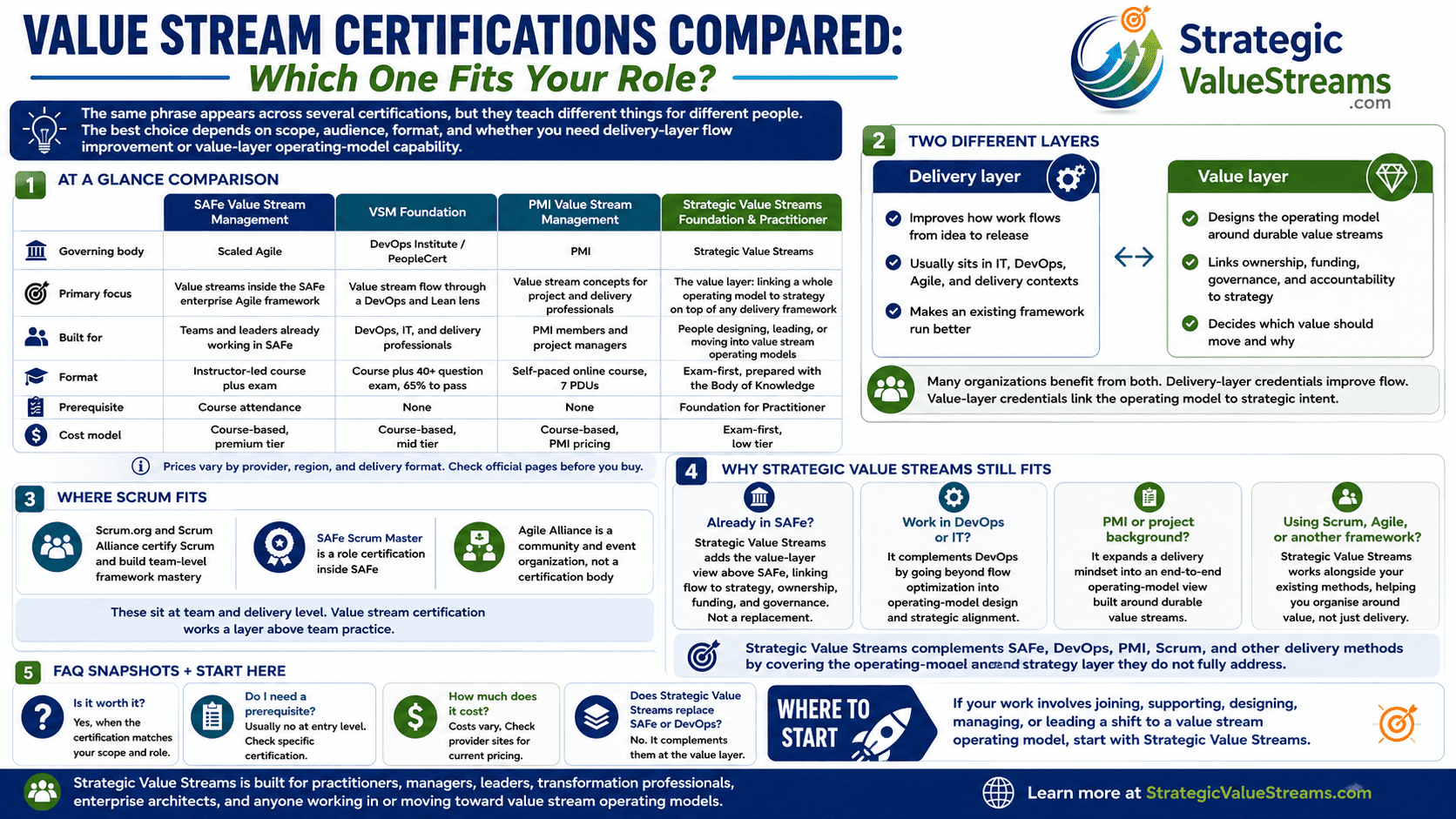
Here is the comparison at a glance. Read the sections below for the detail behind each row.
| Certification | Governing body | Primary focus | Built for | Format | Prerequisite | Cost model |
|---|---|---|---|---|---|---|
| SAFe Value Stream Management | Scaled Agile | Value streams inside the SAFe enterprise Agile framework | Teams and leaders already working in SAFe | Instructor-led course plus exam | Course attendance | Course-based, premium tier |
| VSM Foundation | DevOps Institute / PeopleCert | Value stream flow through a DevOps and Lean lens | DevOps, IT, and delivery professionals | Course plus 40-question exam, 65% to pass | None | Course-based, mid tier |
| Value Stream Management | PMI | Value stream concepts for project and delivery professionals | PMI members and project managers | Self-paced online course, 7 PDUs | None | Course-based, PMI pricing |
| Strategic Value Streams Foundation and Practitioner | Strategic Value Streams | The value layer: linking a whole operating model to strategy, on top of any delivery framework | People designing, leading, or moving into value stream operating models | Exam-first, prepared with the Body of Knowledge | Foundation for Practitioner | Exam-first, low tier |
Prices for these programs vary by provider, region, and delivery format, so check the official pages for current details before you buy.
Delivery and value are two different layers
Every program on this list uses the phrase "value stream," and that is where the similarity ends. The word points at two different layers of the organization, and knowing which one you need is the fastest way to choose.
Most of these certifications work at the delivery layer. They treat a value stream as the flow that carries work from idea to release, usually inside IT, DevOps, or Agile delivery, and they teach you to see that flow, measure it, and improve it. This is valuable work, and for a delivery audience it is exactly the right frame. It makes an existing framework run better.
Strategic Value Streams works at the value layer. It treats a value stream as a durable operating model with ownership, funding, governance, and performance accountability, and it teaches you to link that model to strategy so the organization delivers the value it set out to deliver. This connects the operational substrate to the strategy above it. It applies whether your delivery runs on SAFe, DevOps, Lean, or any other framework, because it governs which value streams should exist and why, and leaves the delivery framework to carry the flow.
That is the distinction to hold as you read the rest of this comparison. A delivery-layer credential improves how value moves. A value-layer credential decides which value to move and holds the operating model to that intent. Many organizations benefit from both, and the two work well together.
Looking beyond delivery frameworks?
Strategic Value Streams certification covers the whole value stream operating model, connecting strategy, organisational design, governance, funding, and performance.
SAFe Value Stream Management
Scaled Agile governs the SAFe Value Stream Management certification, and it lives inside the wider SAFe framework. The course teaches you to apply value stream management practices to accelerate flow within a SAFe enterprise, connecting portfolio strategy, Agile Release Trains, and DevOps delivery.
It suits people who already work in a SAFe organization and want to strengthen how value moves through it. The training is instructor-led, the first exam attempt is usually included when you sit it within 30 days of the course, and retakes carry a small fee. The cost sits at the premium end because you are paying for accredited SAFe training as well as the exam.
The strength is tight integration with SAFe. If your organization has standardized on SAFe, this credential speaks your organization's language. The boundary is the same thing: the value it delivers is highest inside a SAFe context, and it assumes an Agile and IT delivery environment.
VSM Foundation (DevOps Institute and PeopleCert)
The DevOps Institute created the VSM Foundation certification, and PeopleCert administers the exam. It introduces value stream management through the combined lens of Lean, Agile, DevOps, and IT service management, and it walks you through identifying, mapping, and optimizing a value stream for flow.
The format is approachable. There is no prerequisite, the course typically runs across two days, and the exam is 40 multiple-choice questions with a 65% pass mark. This makes it a common first step for DevOps and IT professionals who want a recognized flow credential.
The strength is accessibility and a clear DevOps grounding. The boundary is scope: the frame stays close to technology delivery and the flow of work through it, which fits an IT and DevOps audience well and stays within that context.
PMI Value Stream Management
PMI offers Value Stream Management as a micro-credential aimed at its project and program management community. It is a self-paced online course that awards 7 PDUs and a certificate of completion, introducing value stream thinking in terms familiar to project professionals.
It suits PMI members who want to add value stream vocabulary to a project management foundation and collect PDUs toward renewal at the same time. The commitment is light and the framing is practical for people who manage delivery.
The strength is convenience and PDU value for existing PMI members. The boundary is depth: as a micro-credential it introduces the concepts rather than qualifying you to design or run a value stream operating model.
Strategic Value Streams (Foundation, Practitioner, and Fellow)
Strategic Value Streams is the professional body for value stream operating models. The pathway runs Foundation, Practitioner, and Fellow, and it certifies your ability to design, lead, and run an operating model built around value streams.
The scope is the whole organization, and the frame is value rather than delivery mechanics. It links the operating model to strategy so the value streams the business runs are the ones that carry its strategic intent. That covers IT transformation and digital transformation, and it covers the broader shift where a business reorganizes around the value it delivers to customers. It also sits comfortably on top of whatever delivery framework you already use, because it governs the value layer and leaves your framework to run the flow.
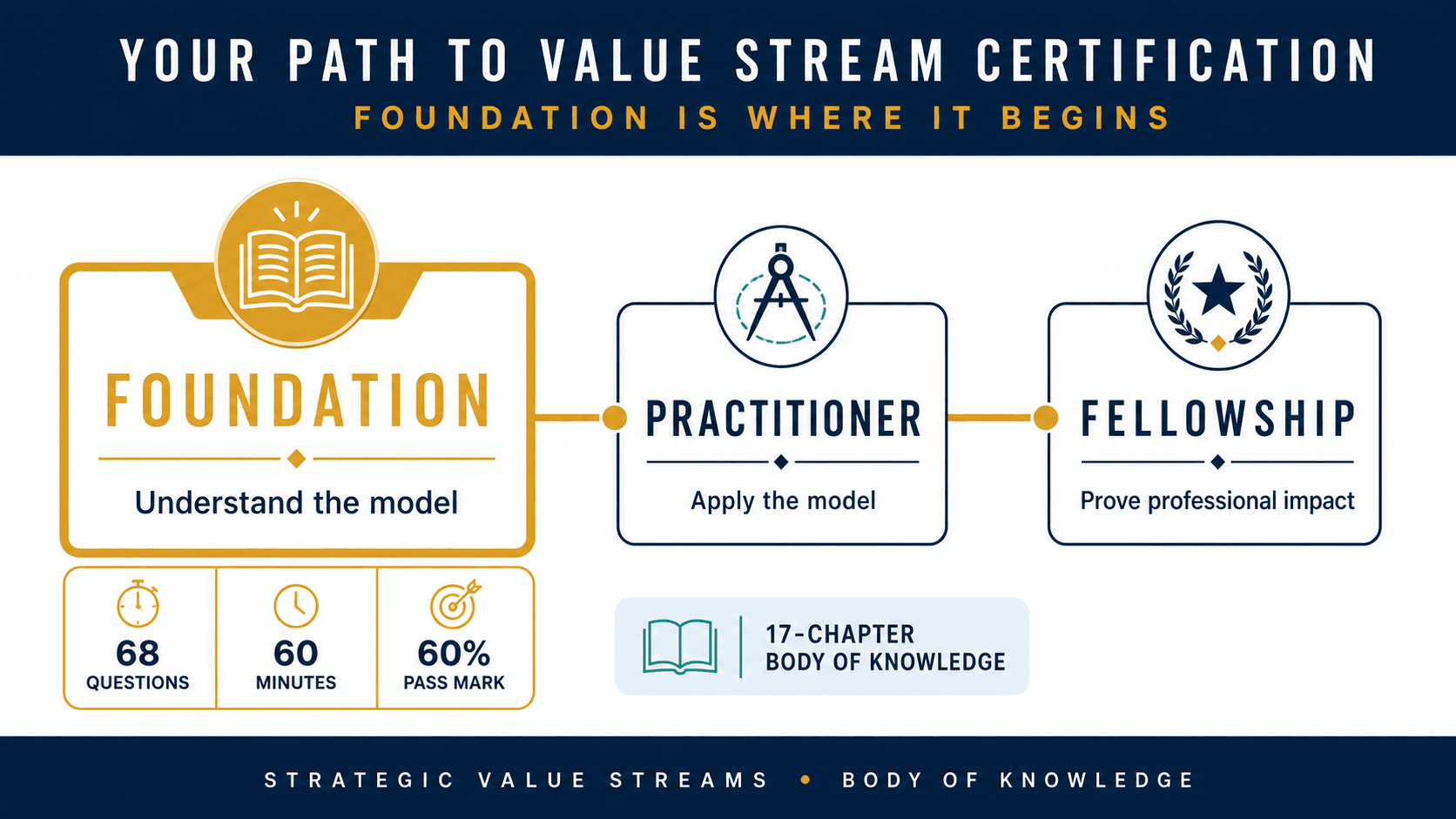
The Foundation level proves you understand the seven core elements of a value stream operating model and can tell a healthy one from a fragmented one. Practitioner proves you can put the model into practice, making design trade-offs and diagnosing where a model underperforms. Fellow recognizes applied work at the leading edge of the discipline.
The pathway is built around who you are and where you sit in the shift to value streams:
- If you are designing value stream operating models, Practitioner and Fellow prove you can do the work to a professional standard.
- If you are managing, leading, or moving into leadership of value stream operating models, Foundation and Practitioner carry your credibility forward.
- If you are part of an organization shifting to a value stream operating model, Foundation gives you the shared language and the fundamentals, with Practitioner as the next step when you are ready.
The format is exam-first. You prepare with the Strategic Value Streams Body of Knowledge, available for free, then sit the exam online. Foundation is 68 questions in 60 minutes at a 60% pass mark with no prerequisite. Practitioner is 102 questions in 90 minutes, and Foundation certification is the prerequisite. Because the credential is exam-first with no mandatory instructor-led course, the total cost sits at the low end of this list, and the Foundation Bundle brings the exam, and exam preparation community access together in one purchase.
The strength is breadth and depth together: a credential that works for IT and digital transformation and for a whole-organization shift, backed by a structured Body of Knowledge. The consideration is that it certifies operating-model capability, so it fits people who are designing, leading, or joining that kind of change rather than people who want a pure flow-mapping tool.
What about Scrum, SAFe Scrum Master, and Agile Alliance?
People often reach a value stream comparison from the Agile and Scrum world, so it is worth being clear about where those credentials sit.
Scrum.org and Scrum Alliance certify Scrum. Their Professional Scrum and Certified ScrumMaster programs build team-level mastery of the Scrum framework, and role certifications like SAFe Scrum Master do the same inside SAFe. These are valuable credentials for people running teams, and they operate at the team and delivery layer, where work is planned, built, and shipped.
Agile Alliance is a nonprofit community and conference organization. It supports the Agile community, runs events, and publishes resources, and it does not offer professional certifications.
A value stream certification works a layer above team practice. It concerns how value flows across the whole organization, and in the case of Strategic Value Streams, how the operating model links to strategy. If you hold a Scrum or SAFe role certification and you are moving toward designing or leading the wider operating model, a value stream certification is the natural next step rather than a replacement.
How to choose a value stream certification by role and goal
The right value stream certification follows from what you are trying to do next.
Choose SAFe Value Stream Management when your organization runs on SAFe and you want to improve flow inside that framework.
Choose VSM Foundation when you work in DevOps or IT and you want an accessible, recognized flow credential grounded in DevOps practice.
Choose the PMI micro-credential when you are a PMI member who wants value stream vocabulary and PDUs with a light time commitment.
Choose Strategic Value Streams when you are designing, leading, or moving into a value stream operating model, or when your organization is shifting to one and you want a credential that covers the whole model and links it to strategy. It fits IT transformation, digital transformation, and a whole-organization shift equally well, and it works no matter which delivery framework your organization has chosen.
Where to start
If your work is designing, leading, or joining a shift to a value stream operating model, the Strategic Value Streams Foundation is the entry point. You prepare with the full Body of Knowledge, then sit the exam when you are ready. The Foundation Bundle brings the exam, the Body of Knowledge, and exam preparation community access together in one purchase, which is the simplest way to start.
Ready to begin the Foundation pathway?
Prepare with the Body of Knowledge, demonstrate your understanding through the Foundation Exam, and join the exam preparation community.
FAQs
Is a value stream certification worth it?
It is worth it when the certification matches the work you do. A flow-focused credential pays off for DevOps and delivery roles. An operating-model credential pays off for people designing, leading, or joining a shift to value stream operating models. Match the scope to your role, and the credential earns its place on your profile.
What is the difference between value stream management and a value stream operating model?
Value stream management typically involves observing and improving the flow of work through the delivery process, often in an IT or DevOps context. A value stream operating model is the wider organizational design where value streams have ownership, funding, governance, and accountability. Management improves the flow; the operating model defines the structure the flow runs through.
Do I need a prerequisite for value stream certification?
Most entry-level value stream certifications have no prerequisite, including VSM Foundation, the PMI micro-credential, the AIGPE specialist, and Strategic Value Streams Foundation. Higher levels do gate: Strategic Value Streams Practitioner requires Foundation certification first.
How much does value stream certification cost?
Cost depends on the model. Course-first certifications like SAFe bundle accredited training into the price and sit at the premium end. Exam-first certifications like Strategic Value Streams keep the cost lower because they do not require a mandatory instructor-led course, and the Body of Knowledge is available by subscription or included in the Foundation Bundle. Always check the official page for current pricing in your region.
Does Strategic Value Streams replace SAFe, DevOps, or my existing framework?
No. It works at the value layer, above the delivery framework you already run. It links your operating model to strategy and decides which value streams should exist, then leaves SAFe, DevOps, Lean, or whatever you use to carry the delivery. That is why it is a good choice no matter which framework your organization has chosen.