
Table of Contents
- Why Professionals Pursue Certification
- Certified professionals are more likely to be employed
- Certification improves promotion odds and career satisfaction
- Certification affects earnings
- Certification changes hiring decisions
- Certification supports retention, not just hiring
- Strategic Value Streams certification and return on investment
- What this means for professionals considering certification
- References
- FAQs
Why Professionals Pursue Certification
Value stream certification has become one of the clearest ways professionals prove what they know and one of the clearest signals employers rely on when deciding who to hire, promote, and retain. For a long time, that value was mostly anecdotal, built on individual stories of a certification opening a door or a raise. That has changed. Large-scale surveys now track certification against employment rates, earnings, hiring decisions, promotion likelihood, and how long people stay in their jobs, and the pattern that emerges is consistent across studies, industries, and regions. The data below draws on research from Gallup, the U.S. Bureau of Labor Statistics, Global Knowledge, the Association for Financial Professionals, and LinkedIn, covering hundreds of thousands of professionals across multiple countries and job functions.
Certified professionals are more likely to be employed
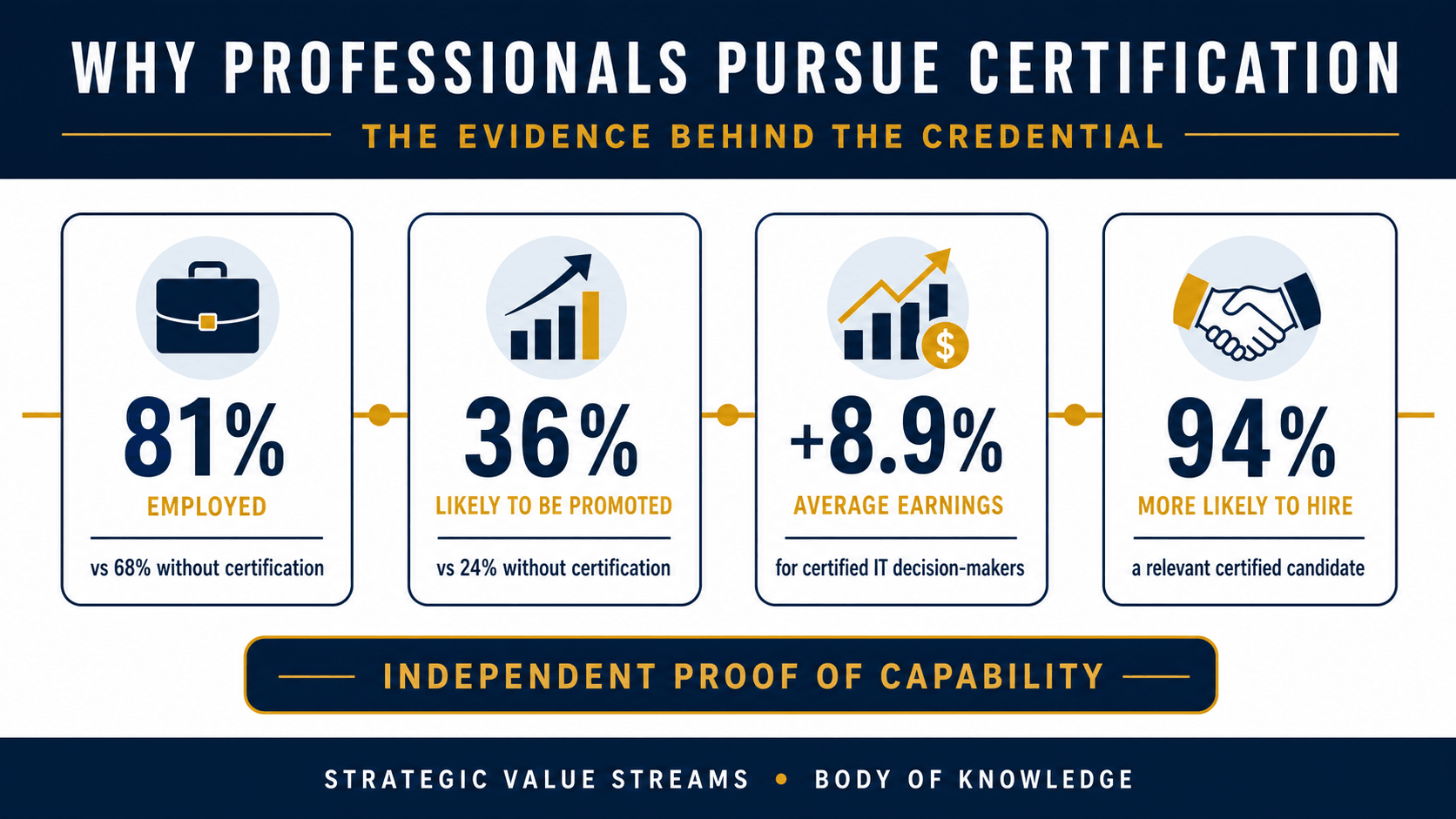
A Gallup study commissioned by the Lumina Foundation found that 41% of Americans in their prime working years hold a professional certification [1]. Among that group, 81% were employed, compared to 68% of those without a certification. The same study found that 76% of certified professionals felt they had the education or training needed for the job they wanted over the next five years, compared to 61% of those without certification.
This pattern holds up in official labor data too. Figures from the U.S. Bureau of Labor Statistics show that individuals with a certification or license participate in the labor force at a higher rate and experience lower unemployment than those without one, a result that held across age, sex, race, ethnicity, and educational attainment [2].
Certification improves promotion odds and career satisfaction
Employment is only part of the picture. The same Gallup study [1] found that certified workers were considerably more optimistic about where their career was heading. Thirty-six percent of certified professionals said it was likely they would be promoted in their current job, compared to 24% of those without a certification. Certified professionals were also more likely to report satisfaction with their career advancement opportunities, at 52% compared to 37% for non-certified peers, and more likely to describe their current job as a career, at 54% compared to 37%.
These figures matter because they capture something salary data alone cannot: how professionals themselves perceive their trajectory. A credential that improves how someone feels about their own prospects tends to translate into more sustained engagement at work, which in turn feeds back into the retention benefits covered later in this article.
Certification affects earnings
Global Knowledge's IT Skills and Salary Report, one of the largest recurring surveys of its kind, found that certified IT decision-makers in North America earned an average of 8.9% more than their non-certified peers, with the gap reaching 10% in Latin America and 13% in EMEA [3]. A more recent edition of the same report found that 97% of IT decision-makers said certified staff add value to their organisation, and 22% estimated that value at $30,000 or more per year [4].
Earnings impact varies by field and region, and the numbers above come from IT roles specifically. Even so, the underlying pattern, that employers are willing to pay more for validated skills, shows up consistently across professional fields wherever certification is well established.
Certification changes hiring decisions
Employers use certification as a fast, reliable way to assess whether a candidate has the skills a role requires. A study commissioned by the Association for Financial Professionals through Martec found that 94% of senior-level finance professionals said they were more likely to hire a candidate with a relevant certification than one without, all else being equal [5]. Separately, surveys cited by the same organisation found that 87% of executives, 81% of supervisors, and 90% of HR professionals believe certified individuals bring more value to the workplace, gain more credibility, and are considered better performers than their non-certified peers.
This matters because certification gives employers something a CV alone cannot provide on its own: independent confirmation that a candidate has met a defined, testable standard.
Certification supports retention, not just hiring
Certification is not only useful for getting a job. It also plays a role in keeping people in one. LinkedIn's Workplace Learning Report found that 94% of employees said they would stay at a company longer if it invested in their career development [6]. A more recent edition of the same report found that 88% of organisations consider retention a concern, and that providing learning opportunities, certification included, is their top retention strategy [7].
Global Knowledge's research reflects the same pattern from the employer side. Certified staff reported higher-quality work, stronger engagement, and better productivity after completing certification training, and organisations that invest in staff certification tend to see a return in the form of reduced turnover and fewer skills gaps [4].
Strategic Value Streams certification and return on investment
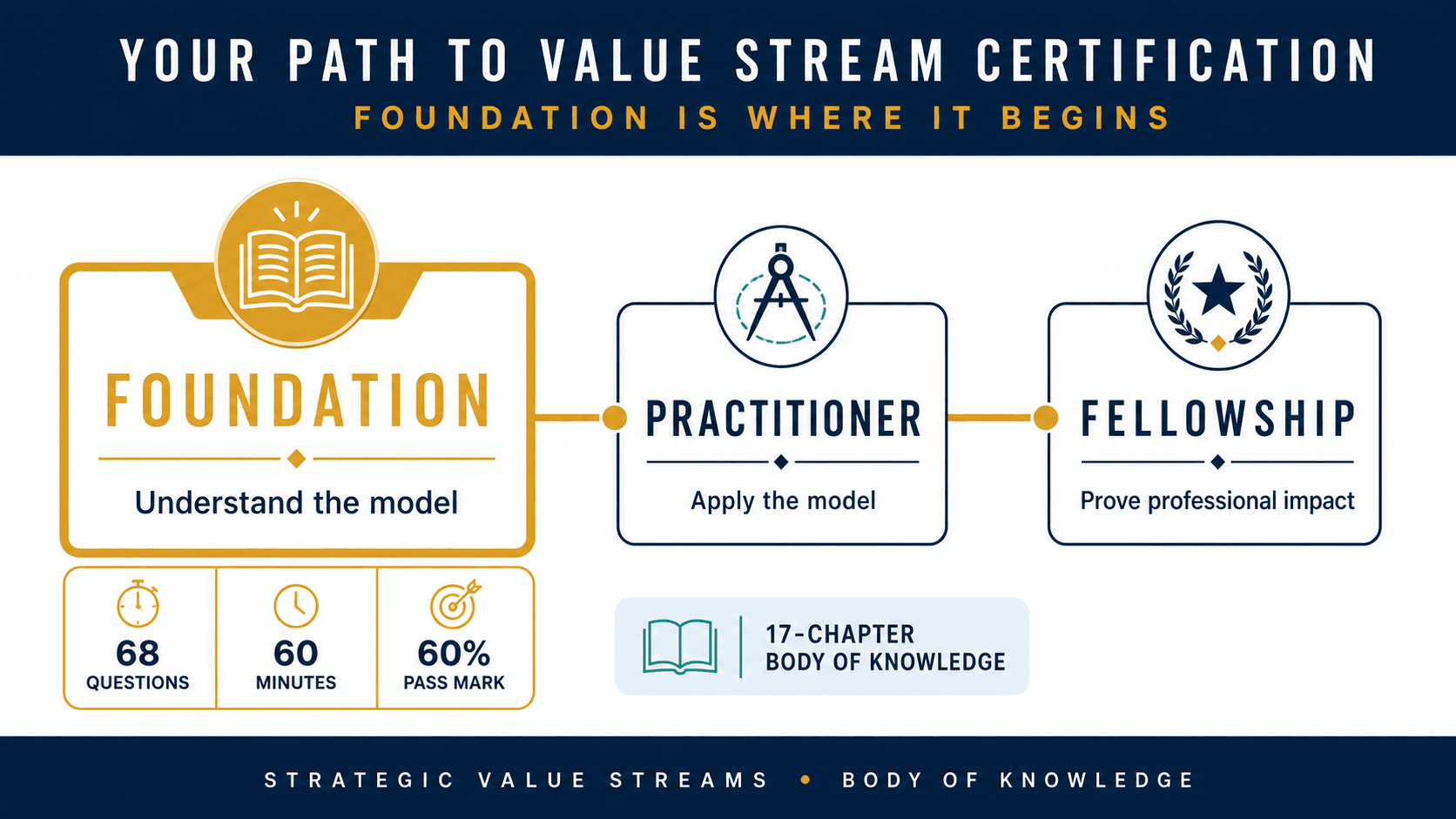
The value case above holds for certification broadly. It becomes even clearer once you look at what value stream certification from Strategic Value Streams actually costs against what candidates get in return.
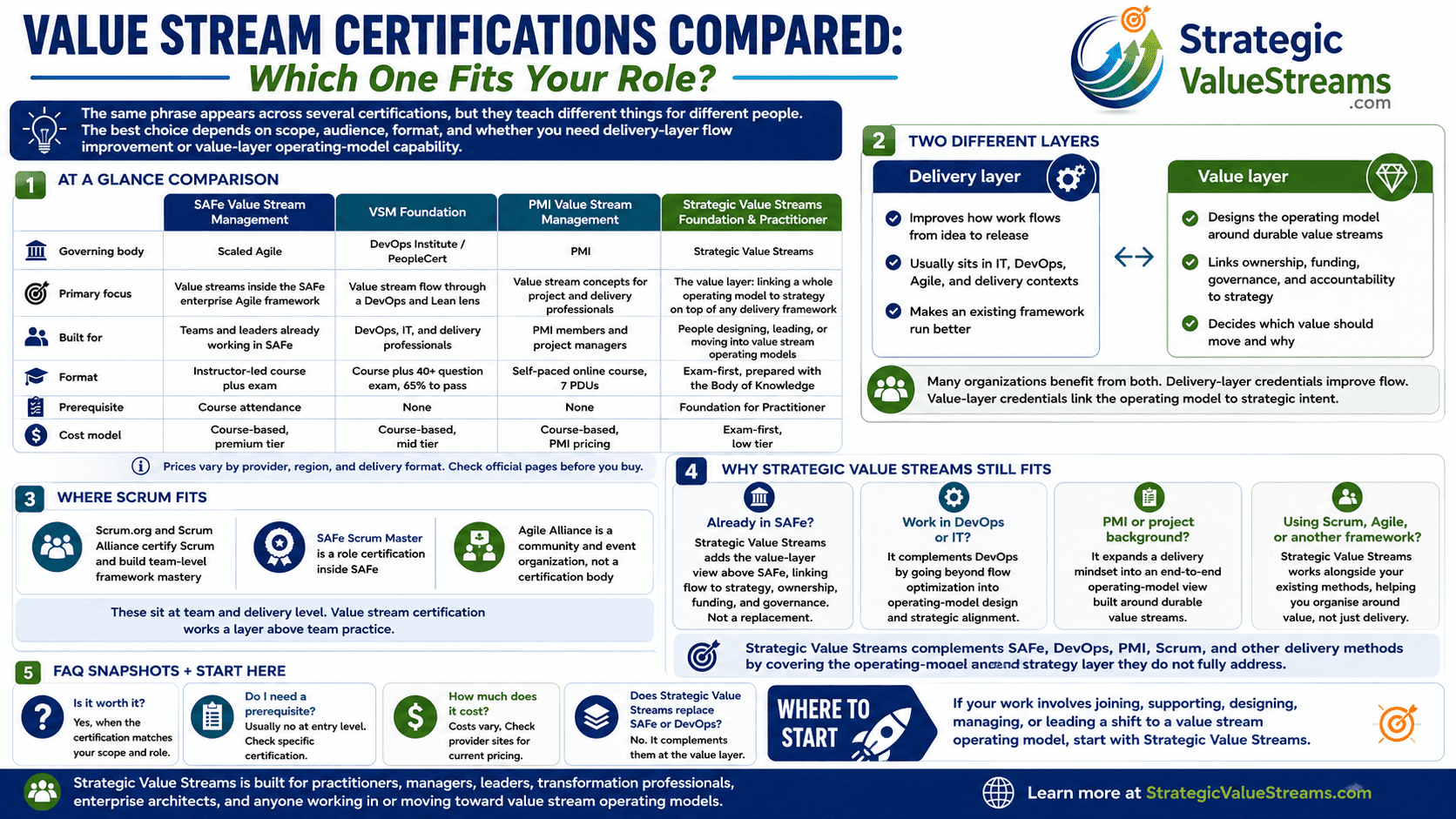
The Foundation Exam costs £199, whether taken on its own or as part of the Foundation Bundle. Practitioner certification costs £299, and the combined Foundation and Practitioner Pack is available for £374. For comparison, certifications like SAFe and PRINCE2 are significantly more expensive, often to the point where professionals need to build a business case and secure organisational funding before they can even enrol. Strategic Value Streams certification sits well below that cost barrier while still producing a verifiable, industry-recognised credential.
| Certification level | Cost | What's included |
|---|---|---|
| Foundation Exam | £199 | Exam only, or bundled with Body of Knowledge access |
| Practitioner Exam | £299 | Applied capability assessment, requires Foundation first |
| Foundation and Practitioner Pack | £374 | Both exams combined |
| Body of Knowledge (all 17 chapters) | Free with Membership | Self-paced reading and sample questions |
| Exam Prep Community | Included with exam purchase | Extra support during preparation |
Time investment is similarly efficient. The Body of Knowledge is free to access with a Strategic Value Streams Membership, so candidates can read all 17 chapters, complete the sample questions built into each chapter, and gauge their own readiness before committing to an exam date. Membership also includes access to the Strategic Value Streams Community, and purchasing the exam includes access to the Exam Prep Community for candidates who want extra support while they prepare. The Foundation Exam takes 60 minutes, gives an immediate result, and comes with a 50% discounted retake if a second attempt is needed. There is no lengthy classroom commitment and no multi-day course to schedule around. Once earned, certification remains valid for 36 months, so the return on that initial time and cost extends well beyond the exam day itself.
Set against the employment, earnings, hiring, and retention benefits documented above, the combination of low direct cost, a free study path, and a 36-month validity period makes value stream certification through Strategic Value Streams a strong return on investment for the time and money involved. Join FREE Today!
What this means for professionals considering certification
Taken together, the data points to a consistent conclusion. Certification improves the odds of being employed, correlates with higher earnings, improves the odds of being promoted, gives employers a faster and more confident way to say yes in a hiring decision, and gives employees a concrete reason to stay with an organisation that invests in their growth.
This holds true across fields, though the strength of the effect varies. Some of the largest and most detailed datasets come from IT, where annual surveys with tens of thousands of respondents make the numbers easy to track over time. But the underlying mechanism, certification as independent, testable proof of capability, is not specific to any one industry. It applies wherever a defined body of knowledge exists and can be assessed consistently, which is exactly the gap that value stream certification for operating model and enterprise design roles has historically filled. Most existing frameworks in this space were built around IT delivery, leaving professionals responsible for whole-organisation design without a credential that reflects the actual scope of their work.
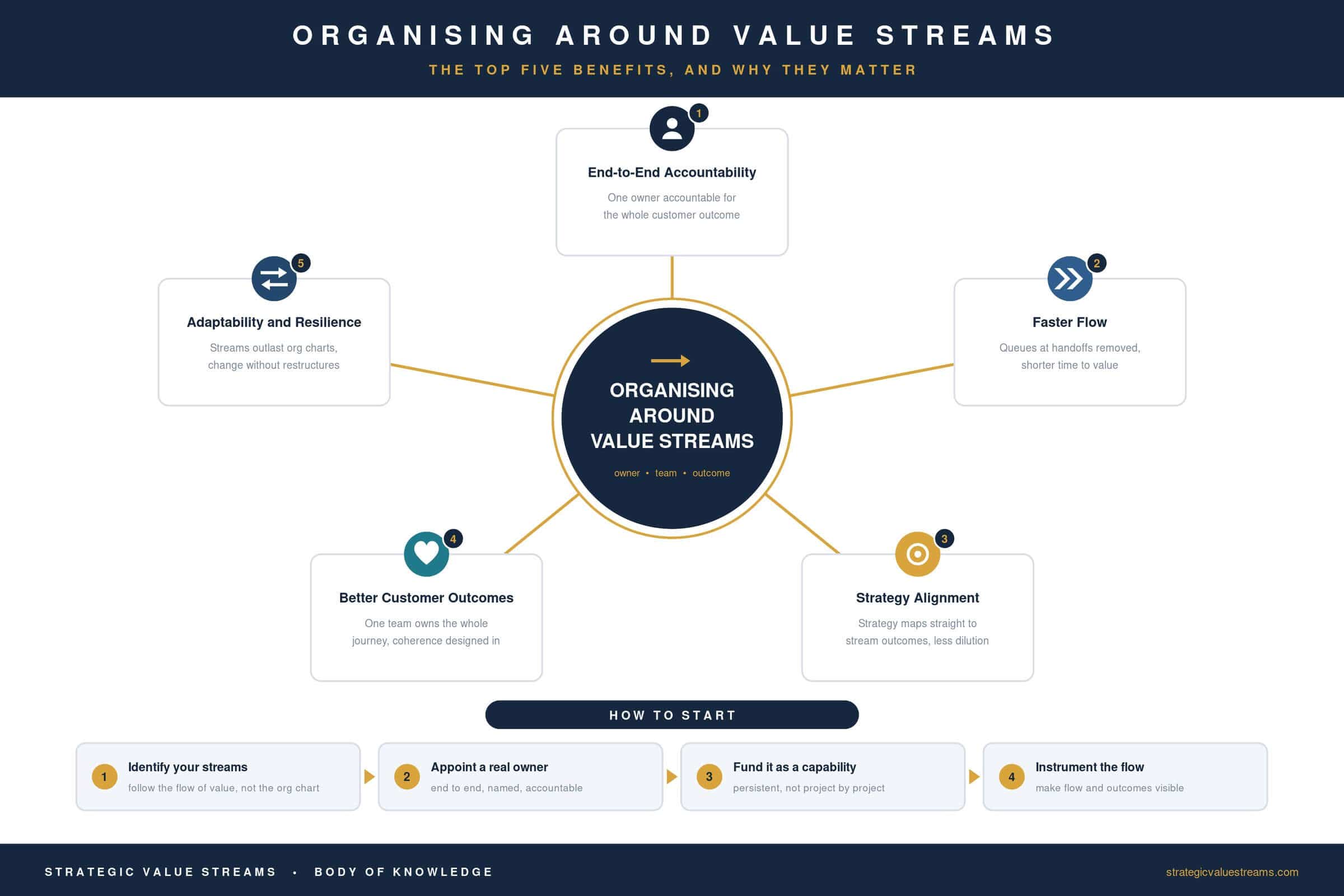
The value comes from what certification represents: a defined, testable body of knowledge that has been independently verified. This is exactly the kind of structured credibility that value stream certification from Strategic Value Streams is built to provide, mapping directly to a published Body of Knowledge that covers strategy, governance, funding, organisation, capability, technology, and measurement together as a single connected model.
If you are weighing whether certification is worth pursuing, the Strategic Value Streams Foundation Exam is a practical place to start, with a free Body of Knowledge available through Membership that you can read before committing to anything. Our guide on how to prepare for the Foundation Exam walks through the format and study approach in detail.
References
Gallup. (2020). Certification: A pathway to good jobs [Research report commissioned by Lumina Foundation]. Gallup, Inc.
U.S. Bureau of Labor Statistics. (2019, June). Professional certifications and occupational licenses: Evidence from the Current Population Survey. Monthly Labor Review. https://www.bls.gov/opub/mlr/2019/article/professional-certifications-and-occupational-licenses.htm
Global Knowledge. (2017). 2017 IT skills and salary report. Skillsoft's Global Knowledge.
Global Knowledge. (2024). 2024 IT skills and salary report. Skillsoft's Global Knowledge. https://www.globalknowledge.com/us-en/content/salary-report/it-skills-and-salary-report/
Association for Financial Professionals. (2022). FP&A certification study [Research conducted by Martec]. AFP.
LinkedIn Learning. (2018). 2018 workplace learning report. LinkedIn Corporation.
LinkedIn Learning. (2025). 2025 workplace learning report. LinkedIn Corporation. https://business.linkedin.com/learn/resources/workplace-learning-report
FAQs
Does certification still matter if I already have years of experience?
Yes. Certification and experience answer different questions for an employer. Experience shows what you have done. Certification shows that your knowledge has been independently tested against a defined standard, which experience alone cannot demonstrate. Combining the two tends to be more effective than either on its own, since certification gives structure and verification to knowledge that experience alone leaves undocumented.
Which industries benefit most from professional certification?
The strongest and most detailed data comes from IT, where certification is well established and surveyed every year. Certification also has a long track record in fields like finance, HR, project management, and healthcare. The underlying mechanism, independent proof of a defined body of knowledge, applies wherever that kind of structured expertise exists, including operating model and enterprise design roles where a recognised credential has historically been missing.
How long does it typically take to prepare for a certification exam?
This varies by certification and by how much relevant experience a candidate already has. For the Strategic Value Streams Foundation Exam, candidates can read all 17 chapters of the Body of Knowledge, work through the sample questions in each chapter, and sit a 60-minute exam, all at their own pace and without a fixed course schedule. Preparation time depends on how quickly someone works through the material instead of any mandatory course length.
Is certification worth pursuing early in a career, or is it better to wait until later?
Certification has value at multiple career stages. Early career professionals can use it to establish credibility where they have limited work history to point to. Mid-career and senior professionals can use it to formalise expertise they have built through experience and open doors to more senior roles. The Gallup data above showing higher promotion likelihood and career satisfaction among certified professionals held across the working population as a whole [1].
How is Strategic Value Streams certification different from certifications focused on a single function, like IT or project delivery?
Most established certifications, including SAFe, PRINCE2, and ITIL, were built around a specific function such as software delivery, project management, or IT service management. Strategic Value Streams certification is built around whole-organisation operating model design, covering strategy, governance, funding, organisation, capability, technology, and measurement as one connected framework. This makes it relevant to a broader range of roles, including operating model practitioners, enterprise and business architects, and senior transformation leaders, alongside those working in IT delivery.