
Table of Contents
- Top Five Benefits of Organising Around Value Streams
- What Does Organising Around Value Streams Mean?
- The Five Benefits at a Glance
- 1. Clear End-to-End Accountability and Ownership
- 2. Faster Flow and Shorter Time to Value
- 3. Tighter Alignment Between Strategy and Delivery
- 4. Better Customer Outcomes and Experience
- 5. Greater Adaptability and Lasting Resilience
- How to Start Organising Around Value Streams
- Formalise Your Value Stream Expertise with Certification
- FAQs
Top Five Benefits of Organising Around Value Streams
Organising around value streams is the practice of structuring an enterprise around the flow of value to its customers rather than around functional departments. Most organisations are still built the other way: sales, marketing, engineering, operations, and finance each sit in their own hierarchy, with their own budget and targets. That structure builds deep expertise, but it is poor at the one thing customers actually care about, the coherent delivery of value from end to end. This article sets out the top five benefits of organising around value streams, why they matter, and how to begin capturing them.
If you are weighing up a shift to a value stream operating model, or you simply want a clear answer to what organising around value streams actually delivers, the five benefits below are the ones that show up most consistently in practice.
What Does Organising Around Value Streams Mean?
Before the benefits, a quick definition. A value stream is the complete set of activities an enterprise performs to deliver a specific outcome to a customer, from the initial trigger through to the realised result. Organising around value streams means making those streams, rather than functional departments, the primary unit around which the enterprise structures its teams, ownership, governance, funding, and measurement.
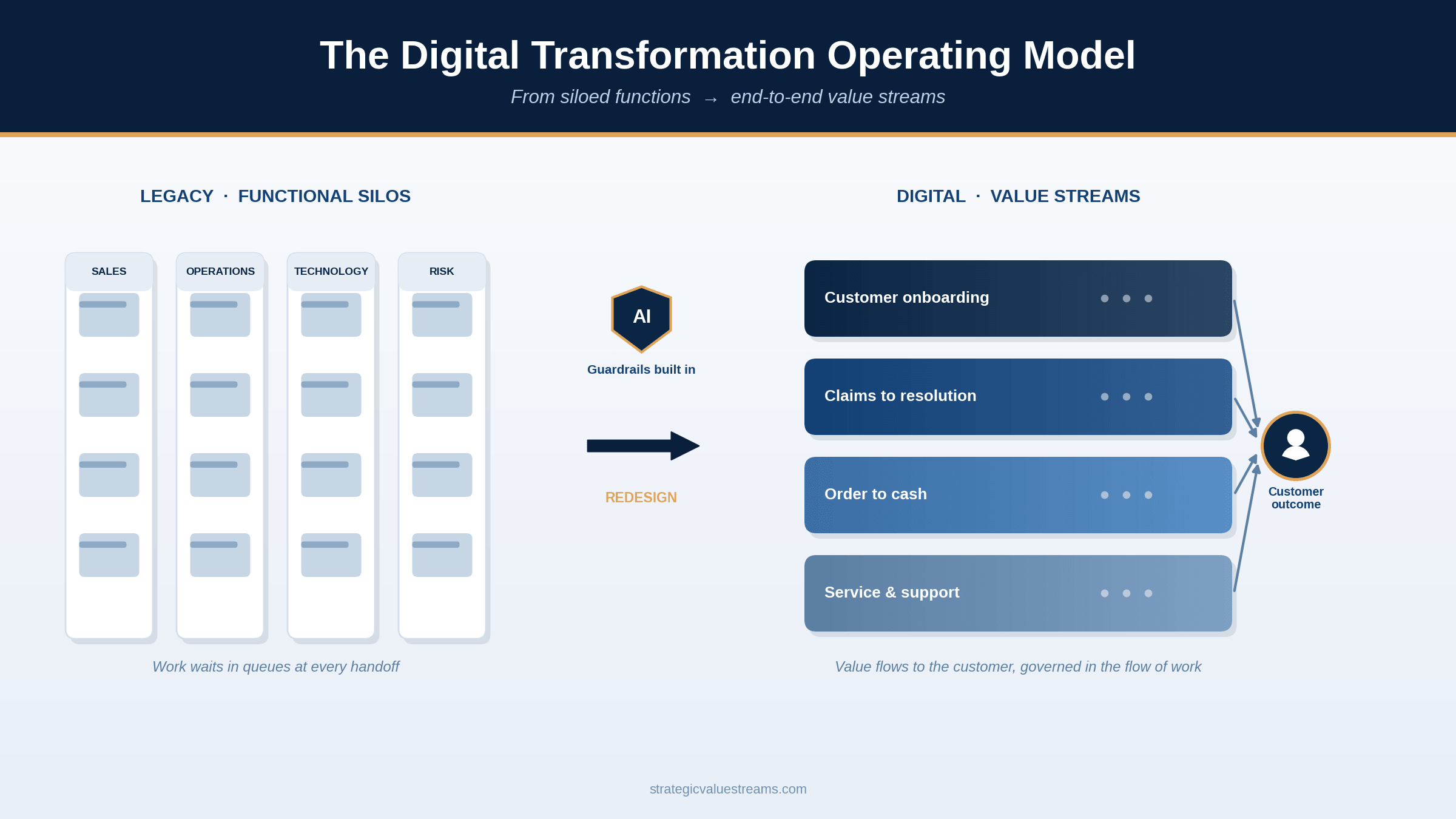
In a functional organisation, a customer need enters through one department, is translated into internal artefacts, and then passes across many departmental boundaries, queuing at each handoff, before it emerges as a delivered outcome. No single leader is accountable for the whole journey. Organising around value streams inverts this: a long-lived team owns the stream end to end, with a named owner, its own funding, and metrics that track how well value actually flows. Everything else, including functional excellence, is arranged to serve that flow.
With that in place, here are the five benefits that make the change worthwhile.
The Five Benefits at a Glance
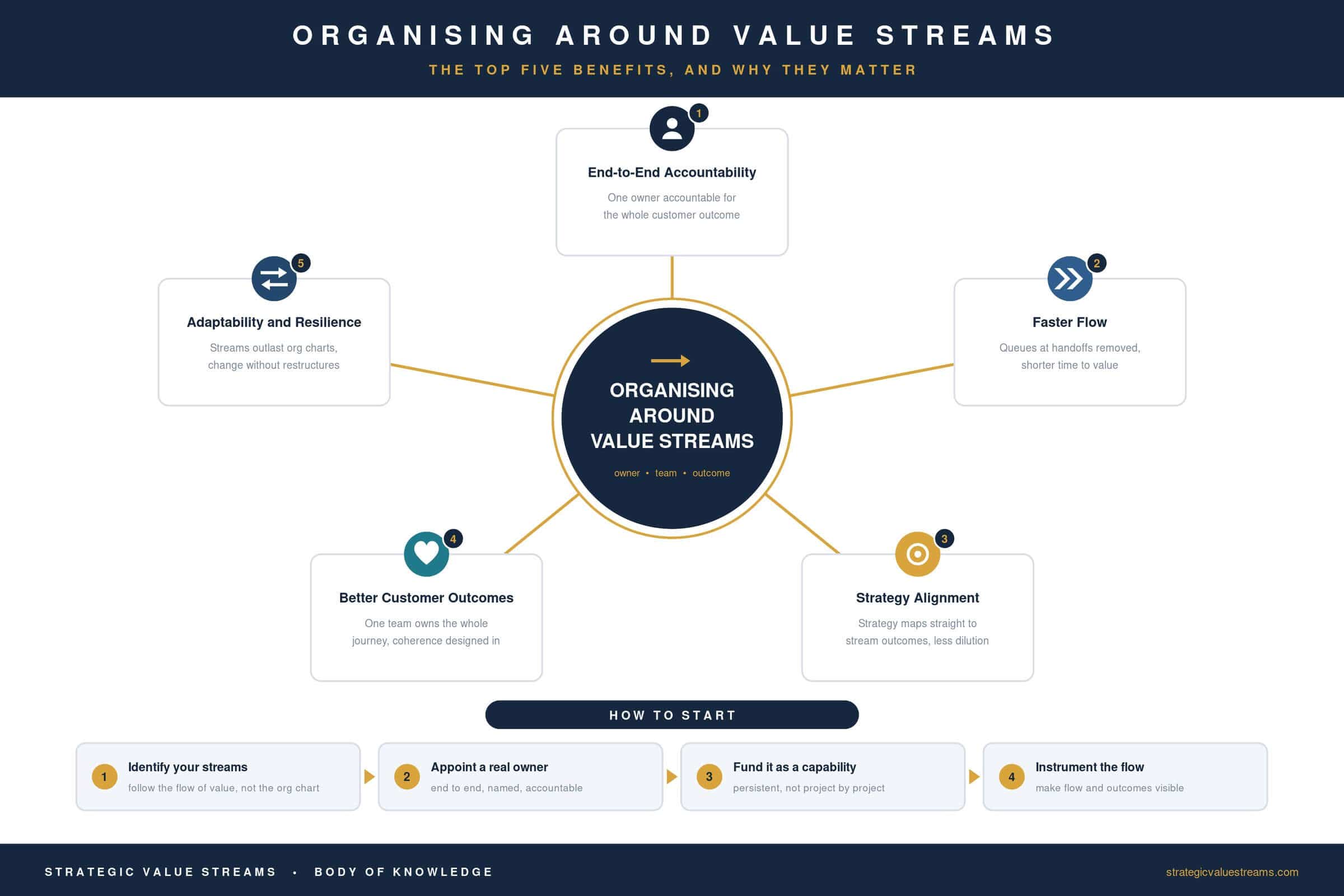
The table below summarises the top five benefits of organising around value streams before we examine each in detail.
| # | Benefit | What changes | Why it matters |
|---|---|---|---|
| 1 | End-to-end accountability | One owner per stream, responsible for the whole outcome | Chronic prioritisation and handoff problems finally have an owner |
| 2 | Faster flow | Departmental boundaries collapse, removing queues | Shorter lead times and quicker time to value |
| 3 | Strategy alignment | Intent maps directly to a stream outcome | Less dilution between what leaders decide and teams deliver |
| 4 | Better customer outcomes | One team owns the whole customer journey | Friction in the seams becomes someone's job to fix |
| 5 | Adaptability | Streams outlast org charts and reorganisations | The enterprise adapts without repeated restructures |
1. Clear End-to-End Accountability and Ownership
The single most valuable benefit of organising around value streams is unambiguous accountability. In a functional structure, responsibility for a customer outcome is spread across many departments, which means it belongs to no one. When delivery is slow or quality slips, each function can point to its own targets being met while the customer experience fails in the gaps between them.
A value stream has a definable start, a definable finish, and a customer. That makes it possible to give it a single owner who is accountable for the whole result, not just a slice of it. This one structural change resolves a surprising number of chronic problems. Prioritisation conflicts that used to escalate for weeks get settled by the person who owns the outcome. Handoff failures that everyone tolerated because they were nobody's responsibility now have an owner motivated to remove them. And leadership finally has a single point of contact who can answer for performance of the whole stream.
Accountability is the benefit from which most of the others follow. Once someone owns the end-to-end flow of value, the incentives to improve speed, alignment, and customer outcomes all point in the same direction.
2. Faster Flow and Shorter Time to Value
The second benefit of organising around value streams is speed. Most delay in large enterprises does not come from people working slowly; it comes from work waiting at the boundaries between departments. Every handoff introduces a queue, a re-prioritisation, and a loss of context. Studies of knowledge work routinely find that items spend the large majority of their elapsed time waiting rather than being worked on.
When you organise around the value stream, you collapse those boundaries. A team that owns the stream end to end can move an item from trigger to delivery without passing it across organisational walls, which removes the queues where time is lost. The result is a shorter lead time, faster feedback, and quicker realisation of value for both the customer and the business.
This benefit compounds. Faster flow means the enterprise learns faster, because it sees the results of its decisions sooner. It can respond to changing customer needs before competitors, and it ties up less capital in half-finished work. Speed, delivered through better flow rather than through working people harder, is one of the clearest and most measurable returns of a value stream operating model.
3. Tighter Alignment Between Strategy and Delivery
A third benefit of organising around value streams is that it closes the gap between what leaders decide and what teams actually do. In functional organisations, strategy is translated through a long chain: strategy becomes annual plans, plans become departmental budgets, budgets become projects, and projects become task lists. At every step, customer intent is diluted and internal logic takes over, so that work often arrives at the delivery team stripped of the context that justified it.
Value streams shorten that chain dramatically. Because a stream maps directly to a customer outcome, strategic intent can be expressed as a desired change in stream performance and handed to the stream owner without passing through layers of translation. Leaders steer by outcomes, and the people delivering the work can see the line connecting their effort to the strategy.
The practical effect is that the enterprise stops being busy in ways that do not matter. Teams organised around value streams are far less likely to be fully compliant with a plan while contributing nothing measurable to the customer, because the connection between their work and the outcome is visible rather than severed three translation layers up.
4. Better Customer Outcomes and Experience
The fourth benefit is the one customers feel directly. Value is created or destroyed across the whole journey, not at a single point of sale. A strong product undermined by painful onboarding, opaque billing, or slow support delivers less net value than a modest product wrapped in a coherent, low-friction experience. Functional structures are prone to exactly this failure, because each department optimises its own piece and no one owns the seams between them.
Organising around value streams aligns the structure of the enterprise with the structure of the customer's experience. Because one team owns the whole journey, the handoffs that customers experience as friction, the conflicting answers, the repeated information requests, the waits between stages, become that team's problem to solve rather than an accepted cost of doing business. Coherence across the journey is designed in rather than hoped for.
This matters most for the higher forms of value. Functional utility can survive a mediocre operating model, but emotional value, such as the customer's confidence and ease, depends on consistency across touchpoints, and strategic value depends on the enterprise behaving as a single coherent system. The higher up the value hierarchy an enterprise intends to compete, the stronger the case for organising around value streams becomes.
5. Greater Adaptability and Lasting Resilience
The fifth benefit of organising around value streams is durability. Organisational structures built around internal functions must be redrawn whenever strategy shifts, and every reorganisation is expensive, disruptive, and slow. The fundamental value streams of a business, by contrast, change far more slowly than its org chart, because they are anchored to enduring customer needs rather than to the current internal division of labour.
That stability makes the enterprise more adaptable, not less. Long-lived teams that own a stream accumulate deep knowledge of their customers and their flow, so they can absorb change and improve continuously rather than being disbanded and reformed with each restructure. When priorities shift, leaders adjust the outcomes they ask streams to pursue and the funding they allocate, without having to redraw the organisation itself.
The result is an enterprise that is both more stable at its foundation and more responsive at its edges. It can reallocate investment quickly, stand up new capabilities within existing streams, and weather disruption without the repeated trauma of large functional reorganisations. In a market where the ability to adapt is a competitive advantage in its own right, this resilience may be the most strategically important benefit of all.
How to Start Organising Around Value Streams
The benefits above are real, but they are earned through deliberate design rather than a change of vocabulary. The most common failure mode is rebranding, renaming departments as value streams while funding, governance, and accountability stay exactly as they were. The language spreads and the behaviour does not.
A more reliable approach starts small and proves the model before scaling it. Identify the enterprise's major value streams by following the flow of value to the customer rather than the existing org chart. Choose one meaningful stream, give it a genuine end-to-end owner, fund it as a persistent capability rather than as a series of projects, and instrument it so that flow and customer outcomes are visible. Once that first stream demonstrates measurable improvement, extend the pattern wave by wave, holding the principles constant while adapting the details to each context.
What must scale fastest is not the structure but the shared understanding. When everyone from the board to the team means the same thing by value stream, flow, ownership, and outcome, the transformation moves quickly and resists dilution. When the language fragments, every initiative pays a recurring tax of redefinition. This is why a shared reference matters, and it is where a common Body of Knowledge earns its place.
Formalise Your Value Stream Expertise with Certification
Understanding the benefits of organising around value streams is one thing; being recognised as capable of designing and leading the change is another. For practitioners and leaders who want to formalise their expertise, the Strategic Value Streams certification framework provides a recognised pathway.
Built on the Strategic Value Streams body of knowledge, certification validates a working command of value stream identification and design, end-to-end ownership, outcome-based governance, stream funding, and flow measurement, the full set of disciplines needed to capture the benefits this article describes. Foundation certification establishes the shared language across an enterprise, while Practitioner certification validates the ability to apply the framework in real organisational contexts. Together they give individuals portable, credible evidence of capability and give organisations the aligned, common reference point that a value stream transformation depends on.
If you are ready to move from understanding the benefits to delivering them, the Strategic Value Streams certification pathway, from Foundation through Practitioner, is the route to take.
FAQs
What are three benefits of organising around value streams?
The three benefits most often cited are clear end-to-end accountability, because each stream has a single owner responsible for the whole customer outcome; faster flow and shorter time to value, because collapsing departmental boundaries removes the queues where work waits; and tighter alignment between strategy and delivery, because a stream maps directly to a customer outcome and needs far less translation from intent to action. Two further benefits, better customer outcomes and greater organisational adaptability, complete the top five.
What does organising around value streams mean?
It means making value streams, the complete sets of activities that deliver outcomes to customers, the primary unit around which an enterprise structures its teams, ownership, governance, funding, and measurement, rather than organising primarily around functional departments. A long-lived team owns each stream end to end, with a named owner and its own metrics for how well value flows.
How is a value stream different from a department?
A department groups people by shared specialism, such as engineering or finance, and is measured on the efficiency of that specialism. A value stream groups people around the flow of value to a customer and is measured on the end-to-end outcome. A department optimises a slice of many customer journeys; a value stream owns one journey from start to finish.
Is organising around value streams the same as agile?
No. Team-level agile methods improve how individual teams work within their own boundaries, which is real progress but only part of the picture. Organising around value streams changes the operating model itself, including how the enterprise funds, governs, and measures work, so that value flows across team and departmental boundaries. An enterprise can have many high-performing agile teams and still deliver value slowly if the surrounding value stream remains viscous.
How do I get certified in value stream operating models?
The Strategic Value Streams certification framework, built on the Strategic Value Streams body of knowledge, offers two tiers. Foundation certification establishes command of the core concepts, including value streams, flow, ownership, and measurement, and suits anyone working in or around enterprise change. Practitioner certification validates the ability to apply the body of knowledge in real enterprise contexts and suits transformation leads, value stream owners, and operating model designers.