
Table of Contents
- What is a Digital Transformation Operating Model?
- Defining the Operating Model in a Digital Context
- Why Digital Transformation Demands a New Kind of Operating Model
- The Agile Operating Model: Core Concept and Origins
- Why Traditional Operating Models Break Down
- Join Strategic Value Streams
- Key Principles of a Digital Transformation Operating Model
- Principle 1: Organise Around End-to-End Value Streams
- Principle 2: Align Strategy to Delivery Across the Whole Enterprise
- Principle 3: Establish Clear Value Stream Ownership
- Principle 4: Redesign Governance and Funding Around Flow
- Principle 5: Measure Outcomes and Flow Metrics, Not Outputs
- Principle 6: Enable Continuous Improvement Through Ways of Working
- Agile Organization Examples: Real-World Operating Model Patterns
- How Value Streams Replace Siloed Functional Structures
- Building and Sustaining an Agile Operating Model at Scale
- How to Get Certified in Value Stream Operating Models
- Connect Digital Transformation to the Wider Operating Model
- Build your value stream operating model expertise
- Next Steps: Apply the Principles and Advance Your Expertise
- FAQs
What is a Digital Transformation Operating Model?
A digital transformation operating model is the deliberate redesign of how an enterprise works, so that digital capability can actually reach customers. Most digital transformations do not fail because of technology. They fail because the organisation asks new technology to flow through an old operating model. Strategy decks promise speed, personalisation, and intelligent automation, while budgets, governance forums, and reporting lines continue to work exactly as they did a decade ago. The result is predictable: pilots that never scale, silos that data cannot cross, and investment that produces motion rather than outcomes.
Where strategy sets ambition, the operating model answers the questions strategy leaves open: how work is structured, how decisions are made, how money flows, and how value is measured. And the stakes have risen sharply. AI has moved from experiment to execution, acting inside customer journeys, operations, and decision-making every hour of the day. An operating model that treats AI as a side project will generate risk faster than value. One that is AI-native, with guardrails and governance designed in from the start, turns the same capability into durable advantage. A modern digital transformation operating model is what makes that difference deliberate rather than accidental.
This article defines the digital transformation operating model, explains why legacy models break down, sets out the design principles that make a modern model work, and shows how value streams, agile ways of working, and built-in AI governance combine into a coherent enterprise design. It closes with a frequently asked questions section and the professional certification pathway for practitioners who want to lead this work. If you are new to the topic, our value-led operating models blog gives useful background before you read on.
Defining the Operating Model in a Digital Context
An operating model is the bridge between strategy and execution. Where strategy answers the question “where will we play and how will we win?”, the operating model answers “how will we actually work to deliver that?”. It covers organisational structure, core processes, governance and decision rights, technology and data, funding mechanisms, and the way performance is measured across the enterprise.
A digital transformation operating model differs from a traditional one in two ways. First, software, data, and AI stop being support functions and become the medium through which value is delivered. The model must therefore govern them as first-class concerns, not delegate them to an IT department. Second, work is no longer performed only by people. AI systems now draft, decide, recommend, and act. A digital operating model has to define how human and machine work combine: which decisions an algorithm may take alone, which require a human in the loop, who owns the outcome either way, and how all of it is monitored. Guardrails, in other words, are not an appendix to the operating model. They are part of its core design.
At minimum, a digital transformation operating model has to define six things:
Structure: how teams are grouped, and around what unit of value.
Decision rights: who decides what, and where those decisions are made.
Funding: how money reaches the work, and on what cadence.
Technology and data: how software, data, and AI are supplied and governed.
Measurement: which outcomes and flow metrics signal success.
Guardrails: how human and machine work is bounded, monitored, and escalated.
Why Digital Transformation Demands a New Kind of Operating Model
Three forces make legacy operating models obsolete, and each one is the reason a purpose-built digital transformation operating model has become necessary rather than optional. The first is speed. Digital competitors release improvements in days, and AI compresses cycle times further still. An enterprise that plans annually, funds by project, and governs by quarterly committee simply cannot keep pace, no matter how talented its people are.
The second is customer-centricity. Customers experience an organisation end to end: one journey, one outcome. Legacy models organise vertically by function, so no single part of the organisation sees or owns the journey the customer actually experiences. The gap between how customers consume value and how organisations produce it is where transformation efforts go to die.
The third force is AI itself. Traditional governance assumes work is done by people who can be trained, managed, and reviewed. AI agents act continuously and at scale, which means oversight can no longer be an after-the-fact inspection. It must be operational: encoded in permissions, escalation thresholds, and monitoring that run as constantly as the AI does. This is what it means for a digital transformation operating model to be AI-native. The organisation does not bolt controls onto AI after deployment; it designs the guardrails into the way work flows, so that speed and safety are produced by the same system.
The Agile Operating Model: Core Concept and Origins
The agile operating model has its roots in lean manufacturing and the agile software movement. Lean contributed the focus on flow, waste elimination, and continuous improvement. Agile contributed small empowered teams, short feedback loops, and adaptive planning. Over two decades these ideas escaped software delivery and became a template for enterprise-wide organisational design: durable multidisciplinary teams, decentralised decision-making, and iterative delivery of value rather than big-bang programmes.
We are now in a third wave, and it is what the modern digital transformation operating model is built on. Lean answered how work should flow. Agile answered how humans should collaborate to deliver quickly. The AI-native operating model answers how humans and intelligent systems collaborate safely, at enterprise scale. It keeps the agile foundations, teams, flow, and feedback, and adds a new design layer: explicit decision rights for AI, built-in governance, and platforms that make the safe path the easy path.
From Waterfall Hierarchies to Agile Value Streams
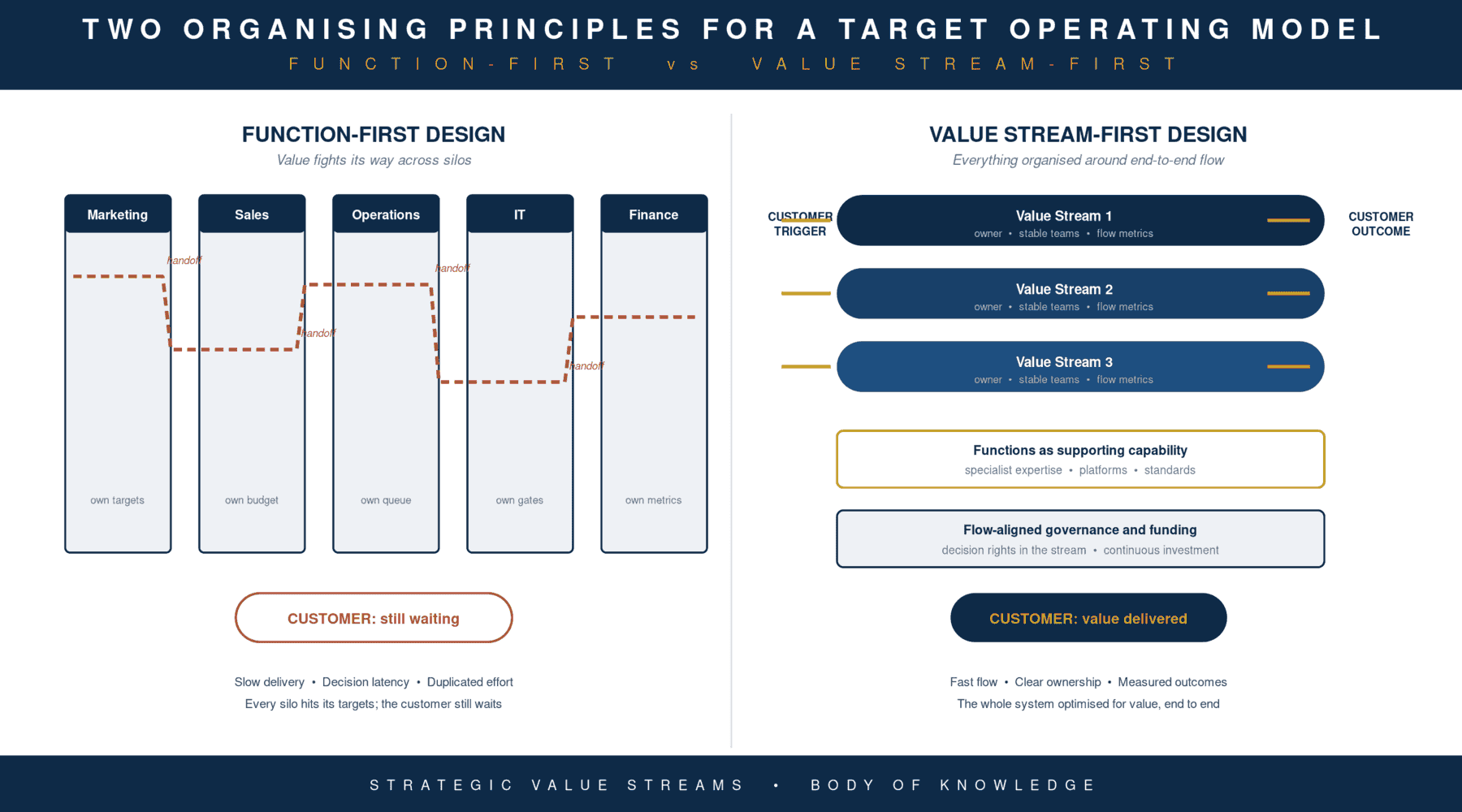
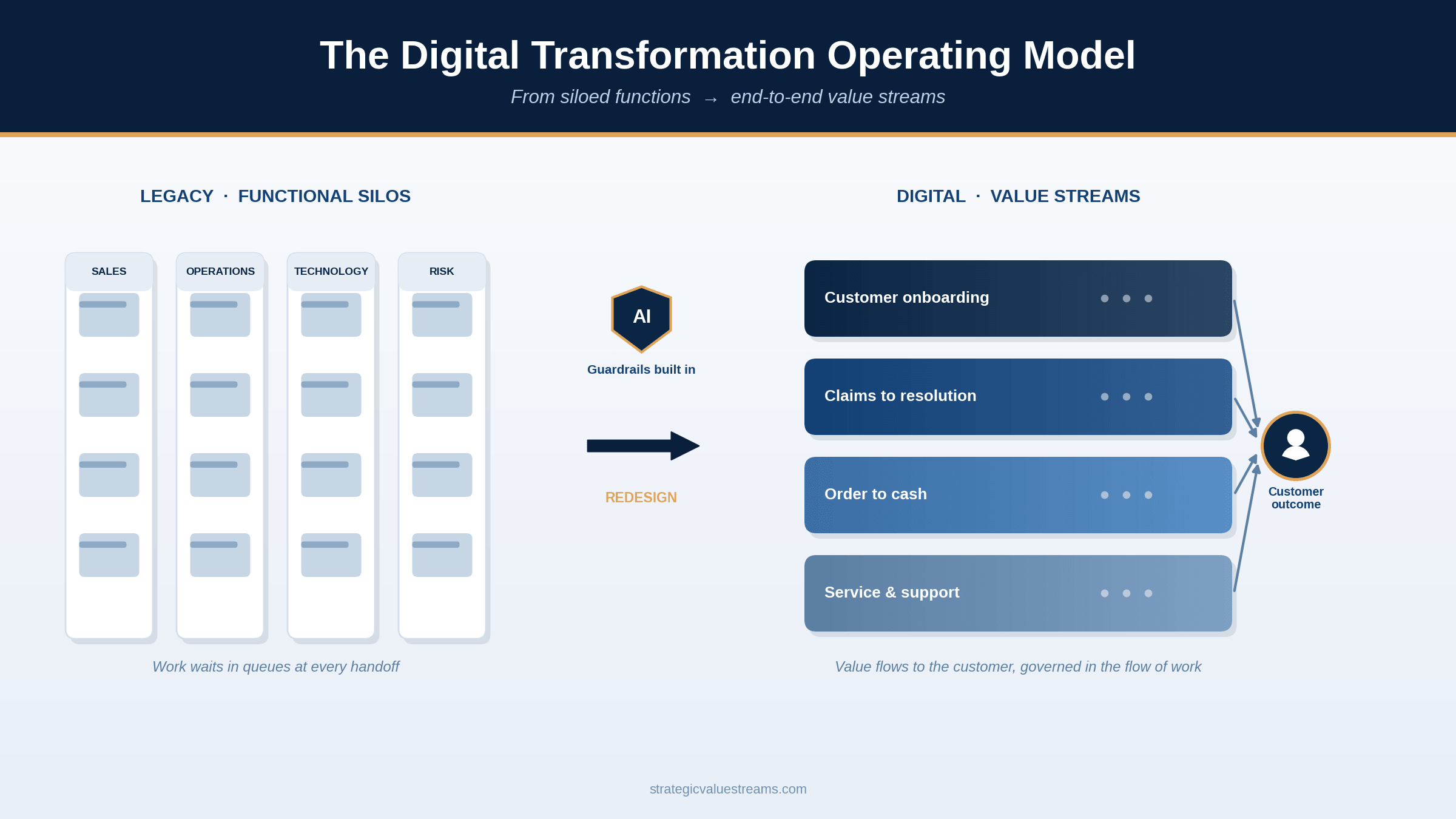
In a waterfall hierarchy, work is packaged at the top, decomposed through layers of management, executed in functional silos, and reassembled at the end. Decisions travel up; work travels sideways through handoffs. Every handoff adds queue time, translation loss, and diluted accountability.
In a value stream structure, work flows horizontally through a stable sequence of activities aligned to a customer outcome, and decisions are made where the information lives: inside the stream. The difference matters enormously for AI. Applied to a hierarchy, AI merely automates the handoffs, paving the old cow paths faster. Applied to a value stream, AI removes handoffs altogether, because a model that sees the end-to-end flow can act on the whole journey rather than one department’s fragment of it. This shift, from vertical function to horizontal flow, is the structural heart of any digital transformation operating model, and value stream mapping is how most organisations make the shift concrete.
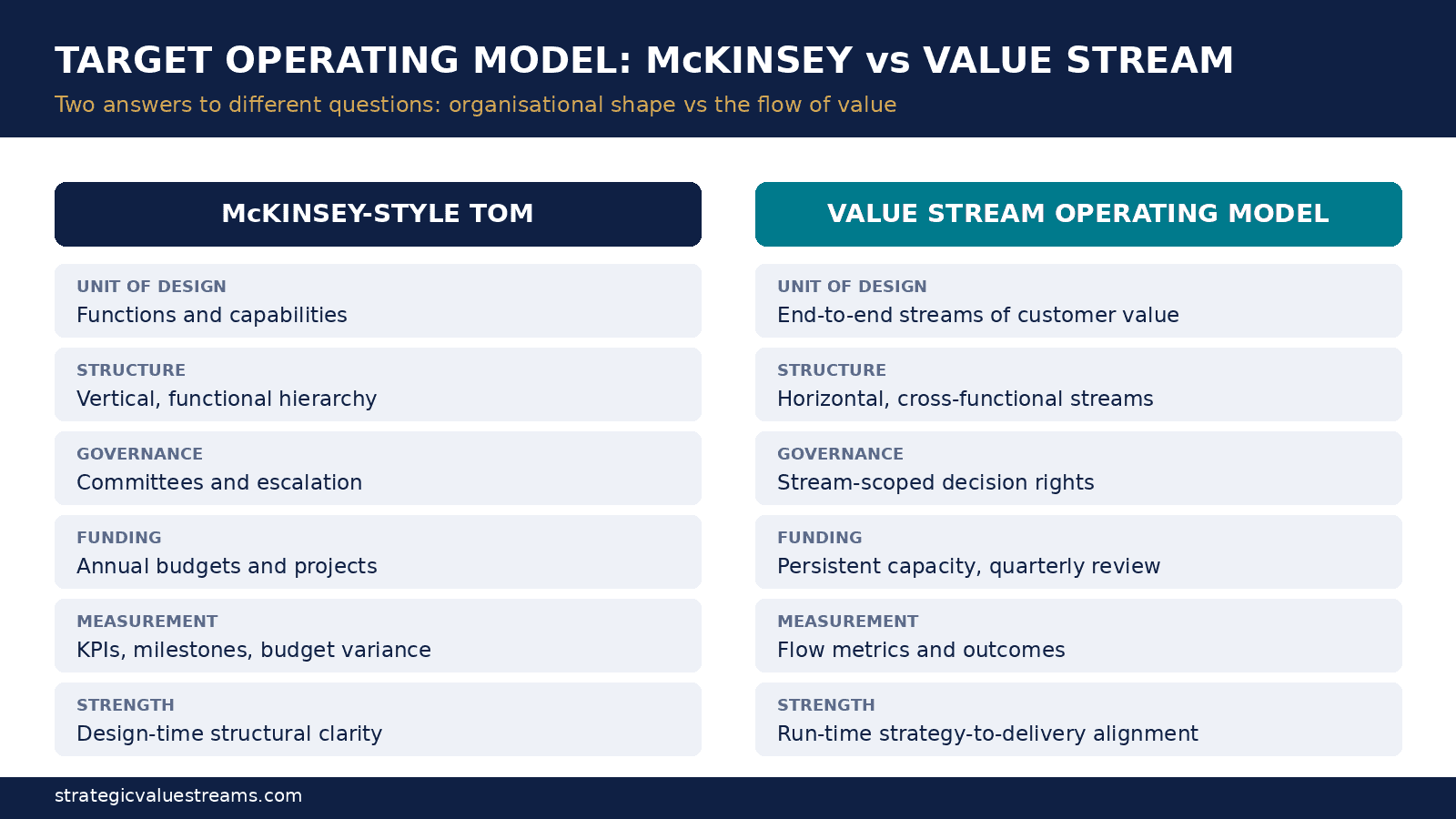
The contrast between the two models is easiest to see side by side:
Dimension | Legacy operating model | Digital transformation operating model |
|---|---|---|
Organising unit | Function or department | End-to-end value stream |
Decision-making | Escalated up the hierarchy | Made inside the stream, where the information lives |
Funding | Temporary projects, annual business case | Durable stream capacity, reviewed on a cadence |
Governance | Stage gates and quarterly committees | Controls embedded in the flow of work |
Measurement | Utilisation and output counts | Outcomes and flow metrics |
Role of AI | Bolted on after deployment | AI-native, with guardrails designed in |
How an Agile Target Operating Model Is Structured
A well-designed agile target operating model has a small number of interlocking components. Durable, multidisciplinary teams do the work. Value streams group those teams around end-to-end customer outcomes and act as the primary unit of organisation, investment, and accountability. A thin governance layer sets direction, allocates capacity, and manages risk, pushing every other decision into the streams. Funding flows to streams as durable capacity, reviewed on a cadence, rather than to temporary projects.
An AI-native digital transformation operating model adds one more component: a shared platform layer that provides AI capability with guardrails built in. Rather than every stream procuring its own tools and inventing its own controls, the platform supplies vetted models, data access governed by policy, identity and permissions for AI agents, automated compliance checks, and monitoring. Streams consume safe AI as a service. Governance stops being a gate teams must pass and becomes infrastructure teams build on.
Agile Operations in Operations Management: Bridging the Gap
Agile is often caricatured as a delivery method that ends where operations begin. In practice, the same principles apply to operations management: organise around flow, make work visible, limit work in progress, and improve continuously. The bridge between delivery agility and operational stability is the value stream, which contains both the change work and the run work for a given outcome, managed by the same owner against the same measures.
This bridge matters most where AI enters operations: intelligent document processing, predictive maintenance, automated scheduling, customer-service agents. When these are deployed inside the digital transformation operating model, they inherit its ownership, monitoring, and escalation paths. When they are deployed around it, the organisation accumulates shadow automation: ungoverned systems making operational decisions nobody formally owns. The operating model is what keeps automation accountable.
Why Traditional Operating Models Break Down
Traditional operating models fail for structural, strategic, and cultural reasons, and every one of these failure points is amplified by AI. Understanding them is the clearest argument for adopting a purpose-built digital transformation operating model. Three deserve particular attention.
The Cost of Organisational Silos
Silos are excellent at building specialist expertise and terrible at delivering end-to-end value. Their cost rarely appears as a line item. It shows up as elapsed time: work that takes two weeks of effort but six months of calendar time because it spent the difference in queues between departments. It shows up as customer experiences assembled from fragments that were each locally optimised and collectively incoherent.
AI raises the price of silos twice over. First, siloed organisations produce siloed data, and AI trained on fragments delivers fragmentary value; the models that transform businesses are the ones that can see an entire journey. Second, silos breed AI sprawl: each function buys its own tools, applies its own informal rules, and creates its own risks. The organisation ends up with dozens of ungoverned AI deployments and no single view of what its machines are deciding on its behalf.
Misalignment Between Strategy and Delivery
In most enterprises, strategy is set annually at the top and delivery happens continuously at the bottom, and the connective tissue between them is thin. Strategic priorities are translated through layers of planning until the teams doing the work can no longer see which outcome their backlog serves. Investment follows the org chart rather than the strategy, and transformation spend produces activity that no one can trace to results.
AI initiatives suffer this misalignment acutely. Analysts consistently find that the majority of enterprise AI pilots never reach production, and the root cause is rarely the technology. Pilots launched without a value stream to live in, an owner to scale them, or funding beyond the proof of concept die in the gap between strategic intent and delivery execution. Pilot purgatory is an operating model problem wearing a technology costume, and it is exactly the problem a digital transformation operating model is designed to remove.
Lack of Shared Ownership and Accountability
When value crosses five functions on its way to a customer, and each function owns only its fragment, no one owns the outcome. Escalations climb the hierarchy to executives too distant from the work to decide well. Change programmes stall because every affected function can veto and none can commit.
Add AI and the accountability gap becomes a governance failure. When a model declines a loan, misprices an order, or gives a customer wrong advice, who is accountable? In a functional model the answer is genuinely unclear: the data science team that built it, the IT team that hosts it, the business team that uses it, or the risk team that reviewed it. A digital transformation operating model with clear end-to-end ownership answers the question before the regulator asks it.
Join Strategic Value Streams
Become a free member of the professional community for value stream operating models. Join the member community and receive practical resources, new articles, and webinar invitations.
Key Principles of a Digital Transformation Operating Model
An effective digital transformation operating model is not a template to copy but a set of design imperatives to apply. Six principles matter most, and each one carries a specific AI dimension: the guardrails and governance are designed into the principle, not added afterwards. In summary, they are:
Organise around end-to-end value streams, not functions.
Align strategy to delivery across the whole enterprise.
Establish clear, single-owner value stream accountability.
Redesign governance and funding around flow.
Measure outcomes and flow metrics, not outputs.
Enable continuous improvement through ways of working.
The rest of this section takes each principle in turn.
Principle 1: Organise Around End-to-End Value Streams
Structure the organisation around the end-to-end flows that deliver customer outcomes, rather than around functions. Value streams improve flow because work stops queueing at departmental borders; they improve focus because every team can see the outcome it serves; and they improve customer results because someone finally owns the whole journey.
For AI, the value stream is the natural unit of deployment. Embedding AI within a stream gives it access to end-to-end context and puts it under the stream’s ownership and controls. Guardrails can be tailored to the stream’s actual risk profile: an AI agent drafting marketing copy and one adjudicating insurance claims need very different oversight, and stream-level governance can make that distinction where enterprise-wide blanket policy cannot.
Principle 2: Align Strategy to Delivery Across the Whole Enterprise
A digital transformation operating model creates an unbroken line of sight from strategic goals to daily delivery. Enterprise outcomes cascade to value stream outcomes, which shape team priorities, which determine the work in progress today. Anyone in the organisation should be able to trace their current task to a strategic intent in two steps.
This alignment is what rescues AI investment from scatter. Instead of a hundred disconnected experiments, AI capability is allocated against the outcomes each value stream is accountable for, and every deployment has a strategic reason to exist, an owner committed to scaling it, and a funded home. Strategy-to-delivery alignment is the difference between an AI portfolio and an AI junk drawer.
Principle 3: Establish Clear Value Stream Ownership
Every value stream needs a single accountable owner with genuine authority: influence over priorities, people, and investment within the stream. Ownership without authority is theatre. The owner is accountable for the end-to-end performance of the stream, from trigger to outcome, regardless of which functions the work passes through.
In an AI-native model, that accountability explicitly includes the machine work. The value stream owner is answerable for the decisions AI takes inside the stream: for the escalation thresholds that route edge cases to humans, for monitoring model performance and drift, and for the customer outcomes of automated decisions. This closes the accountability gap that functional models leave open. There is never a decision, human or machine, without a named owner.
Principle 4: Redesign Governance and Funding Around Flow
Traditional governance inspects work at stage gates; traditional funding finances temporary projects. Both interrupt flow. A flow-based digital transformation operating model funds value streams as durable capacity, adjusted on a regular cadence based on outcomes, and replaces inspection gates with controls embedded in the work itself: automated quality checks, policy encoded in pipelines, and decision rights placed inside the stream.
This is where AI governance becomes practical rather than aspirational. Guardrails are built into the platform and the flow of work: AI agents operate under scoped permissions, policy is enforced as code at the moment of action, every automated decision is logged for audit, and high-stakes or irreversible actions route to a human by design. Compliance stops being a periodic review that slows everything down and becomes a property of the system that runs continuously. Funding follows the same logic: the AI platform and its guardrails are financed as permanent enterprise capability, not as a line item in someone’s project budget that expires at year end.
Principle 5: Measure Outcomes and Flow Metrics, Not Outputs
Mature operating models measure two things: outcomes, meaning the customer and business results a stream exists to produce, and flow, meaning how quickly and predictably value moves from trigger to delivery. Flow time, flow efficiency, and throughput replace utilisation and output counts, because busy functions and delivered value are entirely different things.
AI extends the measurement system in both directions. It is measured, through decision logs, intervention rates, drift indicators, and the effect of automation on flow and outcomes, so leaders can see whether the machines are helping and can prove to auditors how they behave. And it measures, because instrumented value streams generate the telemetry that lets AI spot bottlenecks and predict delays. Measurement by design is also transparency by design: the same instrumentation that improves flow makes AI explainable.
Principle 6: Enable Continuous Improvement Through Ways of Working
An operating model that cannot improve itself becomes the next legacy. Continuous improvement must be embedded in the ways of working: regular retrospectives at team and stream level, capacity explicitly reserved for improvement work, and leaders who treat problems surfaced as gifts rather than failures.
AI both accelerates this loop and is subject to it. Flow data analysed by AI reveals systemic bottlenecks no retrospective would find, closing improvement cycles faster. At the same time, the guardrails themselves must be treated as living design: escalation thresholds tuned as models prove reliable or fail, permissions widened or narrowed with evidence, governance iterated with the same discipline as the product. Static AI policy ages even faster than static org design.
Agile Organization Examples: Real-World Operating Model Patterns
Principles become credible when you can see them in operation. Across industries, high-performing organisations converge on recognisable operating model patterns, whether they arrived from a digital-native starting point or transformed a legacy structure into a digital transformation operating model.
What High-Performing Agile Enterprises Have in Common
The structural traits repeat across high performers:
Durable multidisciplinary teams instead of project staffing.
Organisation around products, journeys, or value streams instead of functions.
A strong internal platform that makes the right way of working the easy way.
Funding by capacity rather than business case theatre.
A thin, fast governance layer that decides in days, not quarters.
The cultural traits repeat too: leaders who design systems rather than direct traffic, transparency of work and measures, and tolerance for learning through small failures. The newest common trait is treating AI governance as a product, not a policy document. High performers build guardrails into their platforms, staff a team to own and improve them, and measure their effectiveness, exactly as they would any other product. Enterprises that publish AI policy without building AI infrastructure get neither safety nor speed.
Lessons from Digital-Native vs. Legacy Enterprise Transformations
Digital natives never had a legacy operating model to escape, and it shows in how they adopt AI: capability lands directly in stream-aligned teams that already own outcomes end to end, on platforms where permissions, monitoring, and policy enforcement already exist. Their lesson for everyone else is that governance built early is cheap, and governance retrofitted late is expensive.
Legacy enterprises carry the harder task of building a digital transformation operating model on top of decades of accumulated structure, but not a hopeless one. Their advantages are real: deep domain knowledge, rich data assets, customer trust, and regulatory experience that digital natives often lack. Their trap is additive change: layering agile teams, AI pilots, and new governance on top of untouched functional structures, so that every new capability pays rent to the old model. The lesson from successful legacy transformations is subtractive: decommission the old governance forums, the project funding cycle, and the functional scorecards as the new model takes hold. What you remove matters as much as what you add.
How Value Streams Replace Siloed Functional Structures
The organisational shift at the heart of a digital transformation operating model is from function-first to value stream-first design. Functions do not disappear; they become homes for craft and capability, while the value stream becomes the primary unit of organisation, investment, and accountability. Roles change accordingly: value stream owners carry end-to-end accountability, functional leaders develop people and standards, and teams align long-term to streams rather than rotating through projects. Reporting follows value, not just hierarchy.
Value Stream Mapping as a Design Tool
Value stream mapping is the practical entry point into a digital transformation operating model. By visualising every step, handoff, queue, and system between a customer trigger and its outcome, a map makes the invisible cost of the current model undeniable: the weeks of waiting hidden inside months of elapsed time, the rework loops, the approvals that add delay but not safety.
In an AI-native redesign, the map does double duty. It reveals where automation genuinely helps, which is usually the queues and handoffs rather than the work itself, and it reveals where guardrails belong. Every decision point on the map can be classified into one of three categories:
Safe to automate fully, where the decision is low-risk and reversible.
Automate with monitoring, where the machine acts but its behaviour is watched.
Automate only with a human in the loop, where the decision is high-stakes or irreversible.
Governance decisions become design decisions on the same page as everything else, made stream by stream with evidence rather than enterprise-wide by decree.
Designing the Agile Target Operating Model Around Customer Value
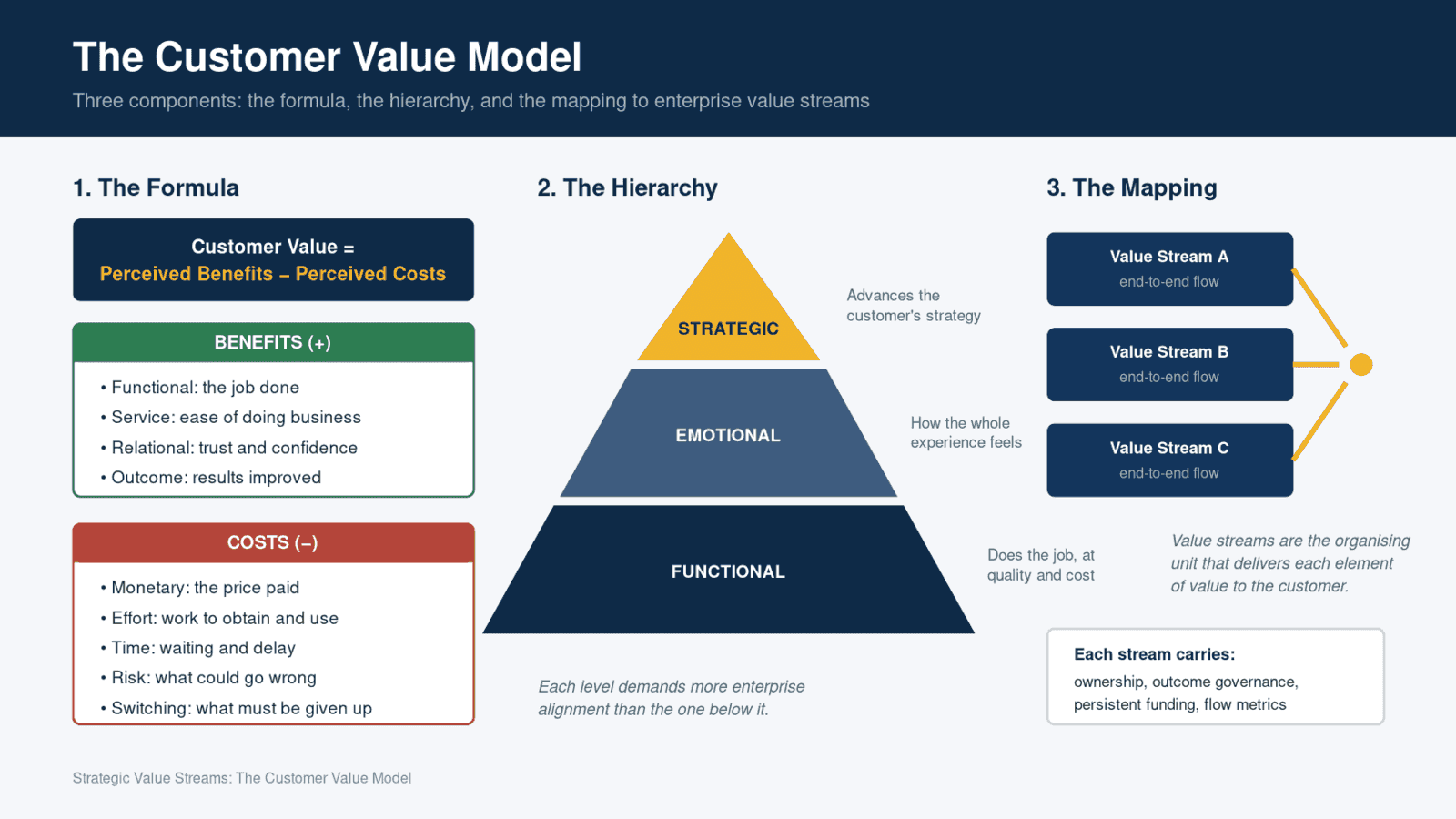
Customer value is the anchor that keeps operating model design honest. Define the outcomes customers actually seek, identify the streams that deliver them, and then, and only then, shape structure, governance, funding, and measures around those streams. Design that starts anywhere else, with the org chart, the technology estate, or the AI roadmap, optimises the wrong thing.
This ordering disciplines AI investment too. The question is never “where can we use AI?” but “where does this stream fail its customers, and can AI close that gap?”. Anchoring AI to customer value filters out automation for its own sake and concentrates capability where it changes outcomes.
Integrating Lean Agile Principles into Organisational Design
Lean and agile principles translate directly into the design choices behind a digital transformation operating model: small stable teams with minimal dependencies, decisions decentralised to the information, work in progress limited so flow stays visible and fast, and feedback loops shortened at every level. Team topology, governance design, and resource allocation all follow from these commitments.
One lean idea deserves special attention in the AI era: jidoka, often translated as “automation with a human touch.” In Toyota’s system, machines were designed to stop and summon a human the moment something abnormal occurred. That is precisely the design stance an AI-native operating model takes: intelligent systems that act autonomously within defined bounds and stop and escalate when they meet uncertainty. The guardrail is not a restraint imposed on the machine; it is the machine’s own built-in quality.
Building and Sustaining an Agile Operating Model at Scale
Designing a digital transformation operating model is the easy half. Building it across a large enterprise, and sustaining it once the transformation programme ends, is where most efforts falter. Three challenges decide the outcome.
Scaling Agile Across the Whole Enterprise, Not Just Delivery Teams
An agile island in a waterfall ocean drowns. If delivery teams work in streams but finance still funds projects annually, HR still rewards functional performance, and risk still governs by stage gate, the old model wins by default, because it controls the money, the careers, and the approvals. Scaling means bringing finance, HR, risk, legal, and operations into the new model as participants, not spectators.
AI makes this non-negotiable. Meaningful AI governance requires risk and compliance expertise embedded in the streams where AI operates, legal input at design time rather than after deployment, and funding structures that sustain platforms and guardrails as permanent capability. An enterprise cannot be AI-native at the edges and legacy at the core.
Overcoming Organisational Viscosity and Resistance to Change
Organisational viscosity is the accumulated structural friction that makes an enterprise flow slowly regardless of how hard its people work: approval chains, dependency webs, committee calendars, and incentive schemes that reward the old behaviour. Viscosity is not resistance in the emotional sense; it is resistance engineered into the system, which is why exhortation never fixes it.
The remedies are structural. Map the approval chains and delete the steps that add delay without adding safety. Change incentives before demanding new behaviour. Transform incrementally, one value stream at a time, so evidence builds and the redesign learns. And expect AI adoption to encounter the same viscosity: fear about roles, comfort with familiar process, and quiet non-use can stall AI as effectively as any committee. Transparent guardrails help here in an unexpected way: people adopt AI faster when they can see exactly what it is allowed to do and who remains accountable.
The Role of Leadership in Sustaining Enterprise Transformation
Operating models are sustained or destroyed by leadership behaviour. Leaders sustain a digital transformation operating model when they hold value stream owners to outcomes rather than reaching around them to direct work, when they protect capacity-based funding through budget pressure, when they keep attending the flow reviews long after the novelty fades, and when they treat surfaced problems as system signals rather than personal failures.
AI adds a further leadership duty: setting risk appetite explicitly. Where may AI act autonomously, where must humans decide, and what evidence will change those boundaries? Leaders who leave these questions to technologists get guardrails shaped by convenience; leaders who answer them make governance a strategic asset. Sustained transformation, with or without AI, is less about launching change than about refusing to let the old model quietly reassemble itself.
How to Get Certified in Value Stream Operating Models
Everything in this article, stream design, ownership, flow-based governance, funding, measurement, and the guardrails that make AI safe at scale, is a professional discipline that can be learned, practised, and formally recognised. For practitioners who intend to lead digital transformation operating model work rather than watch it, the Strategic Value Streams certification pathway is the logical next step.
Why a Recognised Qualification Matters for Value Stream Practitioners
Operating model transformation is high-stakes work: it redirects funding, redraws accountability, and now governs how AI acts on the organisation’s behalf. Employers staffing that work look for evidence of rigour, and a recognised qualification provides it: a shared vocabulary, a tested body of method, and independent confirmation that a practitioner’s knowledge goes deeper than familiarity with the buzzwords. For the practitioner, certification compounds over a career, differentiating candidates for transformation roles and giving consultants and internal leaders alike a credential their claims can stand on.
Foundation, Practitioner, and Fellow: The Professional Certification Pathway
The Strategic Value Streams certification pathway has three tiers:
Foundation establishes the core concepts: what value streams are, how they are identified and mapped, and how a value stream operating model differs from functional and matrix designs. It suits anyone involved in transformation, from analysts to executives who need fluency in the model they are sponsoring.
Practitioner goes deeper into application: designing value streams, establishing ownership and governance, reshaping funding and measurement, and leading the organisational change that makes the design real. It is intended for the people doing the design work: transformation leads, operating model architects, coaches, and senior managers.
Fellow recognises sustained mastery: practitioners who have led significant operating model transformations, contributed to the advancement of the discipline, and can evidence outcomes at enterprise scale.
The Strategic Value Streams Body of Knowledge Explained
The certifications rest on the Strategic Value Streams Body of Knowledge, an integrated framework covering the five disciplines this article has drawn on throughout: value stream ownership, governance aligned to flow, funding models for continuous delivery, flow itself, and outcome-based measurement. Its distinguishing feature is integration: rather than treating structure, governance, funding, and metrics as separate specialisms, the Body of Knowledge treats them as one interlocking system, because in a real enterprise that is what they are.
That integration is exactly what a digital transformation operating model demands. Clear ownership, embedded governance, durable funding, and instrumented flow are the same disciplines that make AI deployment safe and scalable. Practitioners grounded in the Body of Knowledge are equipped to design operating models in which intelligent systems work inside the guardrails, not around them.
Connect Digital Transformation to the Wider Operating Model
Digital transformation cannot be sustained by technology and delivery teams alone. The wider value stream operating model determines how long-lived value streams connect strategy, ownership, funding, governance, architecture and performance.
See how these elements translate into organisation design in our guide to designing a target operating model around value streams.
Build your value stream operating model expertise
The Strategic Value Streams Foundation Bundle combines the Body of Knowledge, Foundation Exam, digital badge, and exam preparation community. Explore the Foundation Bundle
Next Steps: Apply the Principles and Advance Your Expertise
Start where the evidence is. To begin building a digital transformation operating model in practice, take these first steps on a single value stream:
Pick one value stream that matters to customers and map it end-to-end.
Let the map expose the queues, handoffs, and ungoverned automation the current model hides.
Assign a single accountable owner to the stream.
Choose one governance decision and move it into the stream.
Classify the stream’s decision points for automation with the guardrails each one deserves.
Small, real, structural changes teach more than any enterprise-wide blueprint.
Then formalise what you are learning. The Strategic Value Streams certification pathway, from Foundation through Practitioner to Fellow, turns practical experience into recognised expertise, grounded in a body of knowledge built for exactly this work. The enterprises that thrive in the AI era will be the ones whose operating models were designed for it: organised around value, governed in the flow of work, and safe by design. The practitioners who can build those models are already in demand, and that demand is only growing.
FAQs
What is a digital transformation operating model?
A digital transformation operating model is the deliberate redesign of how an enterprise is structured, governed, funded, and measured, so that digital capability, data, and AI can reach customers as end-to-end value rather than stalling inside functional silos. It defines how work flows, how decisions are made, and how human and machine work combine under clear guardrails.
How is it different from a traditional operating model?
A traditional operating model organises work by function, escalates decisions up a hierarchy, funds temporary projects, and inspects quality at stage gates. A digital transformation operating model organises work around end-to-end value streams, makes decisions inside the stream, funds durable capacity, and embeds governance into the flow of work. Crucially, it treats software, data, and AI as first-class concerns rather than delegating them to IT.
What does it mean for an operating model to be AI-native?
An AI-native operating model designs guardrails and governance into the way work flows rather than bolting controls onto AI after deployment. AI agents operate under scoped permissions, policy is enforced as code at the moment of action, every automated decision is logged for audit, and high-stakes or irreversible actions route to a human by design. Speed and safety are produced by the same system.
Why do most digital transformations fail?
Most fail not because of technology but because new technology is forced through an old operating model. Pilots launch without a value stream to live in, an owner to scale them, or funding beyond the proof of concept, so they die in the gap between strategic intent and delivery execution. Redesigning the operating model, rather than adding more technology, is what closes that gap.
What role do value streams play in a digital transformation operating model?
Value streams are the organising unit of a digital transformation operating model. They group multidisciplinary teams around end-to-end customer outcomes and become the primary unit of organisation, investment, and accountability. Because a value stream sees the whole journey, it is also the natural place to deploy AI safely, with ownership, monitoring, and escalation built in.
How can practitioners learn to design these models?
Operating model design is a discipline that can be learned and formally recognised. The Strategic Value Streams certification pathway, from Foundation through Practitioner to Fellow, is grounded in the Strategic Value Streams Body of Knowledge and equips practitioners to lead this work. Start by mapping one real value stream, then formalise what you learn through certification.