
Table of Contents
- What Is Customer Value? A Complete Definition
- Customer Value Meaning: The Core Concept
- Customer Value in Marketing vs. Organisational Design
- Why Customer Value Is the Right Organising Principle for Enterprises
- The Customer Value Model: Structure, Formula, and Hierarchy
- The Customer Value Formula Explained
- The Customer Value Hierarchy: From Functional to Emotional to Strategic
- Customer Value Model Examples Across Industries
- How to Build a Customer Value Model for Your Organisation
- Why Most Enterprise Operating Models Are Not Aligned to Customer Value
- Designing an Enterprise Operating Model Around Customer Value
- What a Customer-Value-Led Operating Model Looks Like
- Introducing Value Streams as the Core Organising Unit
- Value Stream Ownership: Accountability for End-to-End Customer Value
- Aligning Governance to Customer Value Outcomes
- Turn Customer Value into Organisation Design
- Funding Value Streams Instead of Departments or Projects
- Measuring What Matters: Flow Metrics and Customer Value Indicators
- Scaling the Customer Value Model Across the Enterprise
- Get Certified in Enterprise Value Stream Operating Models
- FAQs
What Is Customer Value? A Complete Definition
Ask ten executives to define customer value and you will get ten different answers. Marketing leaders talk about perceived benefits and brand positioning. Finance leaders talk about lifetime value and margin. Operations leaders talk about service levels and cost to serve. Each answer is partially right, and that is precisely the problem. When an enterprise lacks a shared customer value model, a rigorous, common definition of what value means and how it is created, every function optimises for its own interpretation, and the customer experiences the fragmented result.
This article provides a complete definition of customer value, what it means, how the customer value model structures it, and why it should serve as the primary organising principle for the modern enterprise. We will move from the core concept through the customer value formula and hierarchy, examine why most operating models fail to align with it, and set out how to design an enterprise operating model, governance system, funding approach, and measurement framework around it. We will finish with how the Strategic Value Streams body of knowledge and certification framework can formalise this expertise across your organisation.
Customer Value Meaning: The Core Concept
At its core, customer value is the balance between what a customer receives and what a customer gives up. It is the net worth of an exchange as experienced by the customer, not as calculated by the provider. If you are approaching the subject for the first time, our companion article on what customer value is and why enterprises must own it covers the ground from the executive perspective.
What the customer receives includes functional benefits (the job the product or service performs), experiential benefits (how it feels to use), and outcome benefits (the change it creates in the customer's life or business). What the customer gives up extends well beyond price. It includes time, effort, risk, learning curves, switching costs, and the cognitive load of dealing with the provider.
Two implications follow from this definition, and both are routinely underestimated.
First, customer value is perceived, not declared. An enterprise can invest millions in a feature the customer does not notice, or remove a small point of friction and transform the customer's perception of the entire relationship. Value exists in the customer's assessment, which means the enterprise must have reliable mechanisms for sensing it rather than assuming it.
Second, customer value is created or destroyed across the whole journey, not at a single point of sale. A brilliant product undermined by a painful onboarding process, an opaque billing system, or a slow support function delivers less net value than a modest product wrapped in a coherent, low-friction experience. This is why customer value cannot be owned by one department: every function that touches the journey either adds to the benefit side of the equation or adds to the cost side.
Customer Value in Marketing vs. Organisational Design
The phrase "customer value" appears in two very different conversations inside most enterprises, and confusing them causes real damage.
In marketing, customer value is primarily a communication concept. It shapes the value proposition: the promise of benefits made to a target segment, expressed through positioning, messaging, and pricing. Marketing asks, "What value do we claim, to whom, and how do we articulate it more compellingly than competitors?" This is essential work, but it operates largely on the perception of value before and around the purchase.
In organisational design, customer value is a structural concept. It asks a harder question: "Is the enterprise actually built to deliver the value we promise, end to end, repeatedly, and at pace?" Here customer value is not a message but an architectural requirement. It determines how work flows, how teams are formed, how decisions are governed, and how money is allocated.
The gap between these two uses of the term is where enterprises get into trouble. A company can have a world-class value proposition and a delivery system structurally incapable of fulfilling it. Marketing writes cheques the operating model cannot cash. Customers experience the difference between the promise and the delivery as broken trust, and no amount of repositioning can message away a structural problem.
Mature enterprises connect the two: the marketing definition of customer value sets the target, and the organisational design ensures the enterprise can hit it. The remainder of this article focuses on the second, less discussed, and more consequential use of the term.
Why Customer Value Is the Right Organising Principle for Enterprises
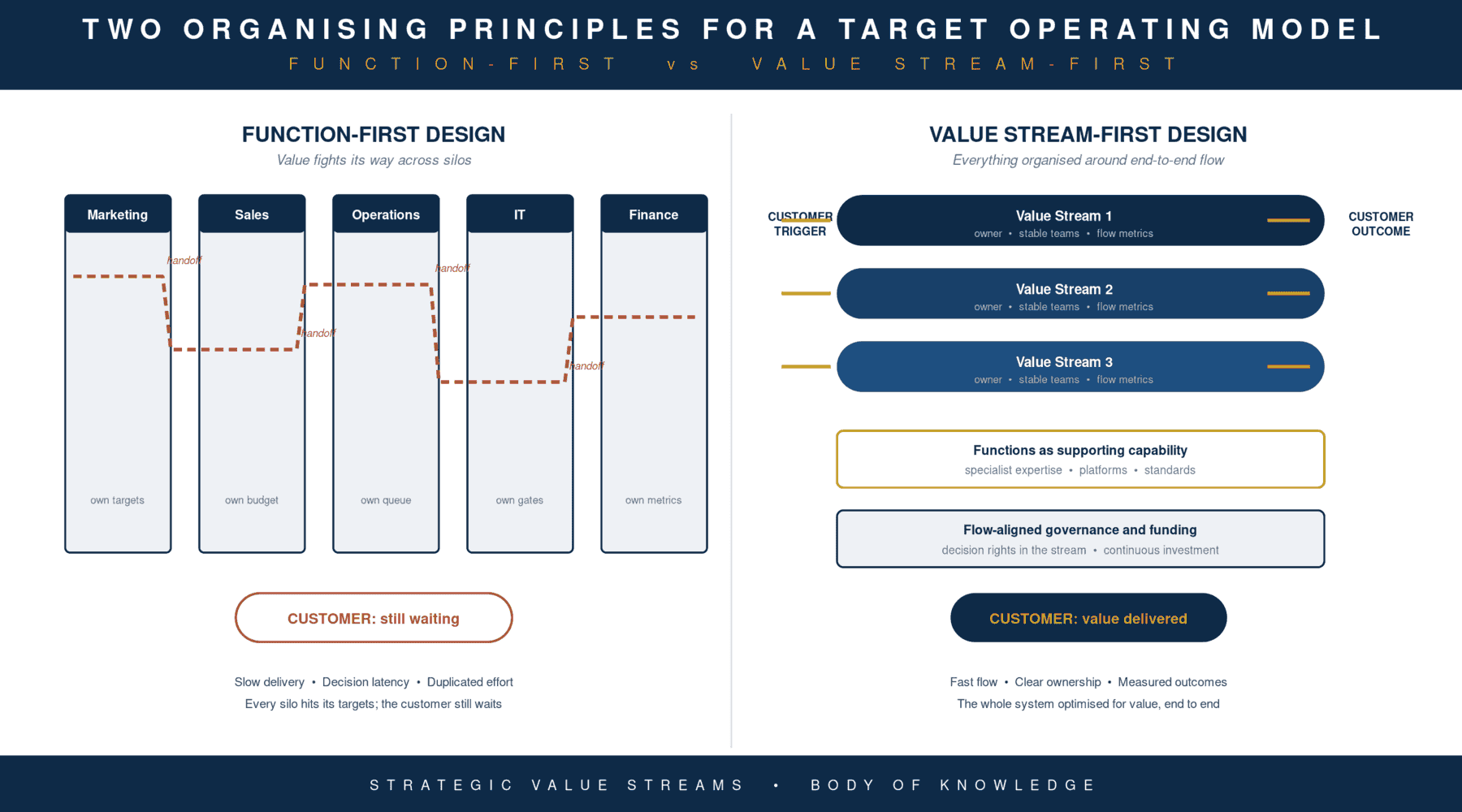
Every enterprise is organised around something. Most are organised around function: sales, marketing, engineering, operations, finance, each with its own hierarchy, budget, targets, and reporting lines. Functional organisation is excellent at building deep expertise and achieving economies of scale within a specialism. What it is poor at is the one thing customers actually care about: the coherent, end-to-end delivery of value.
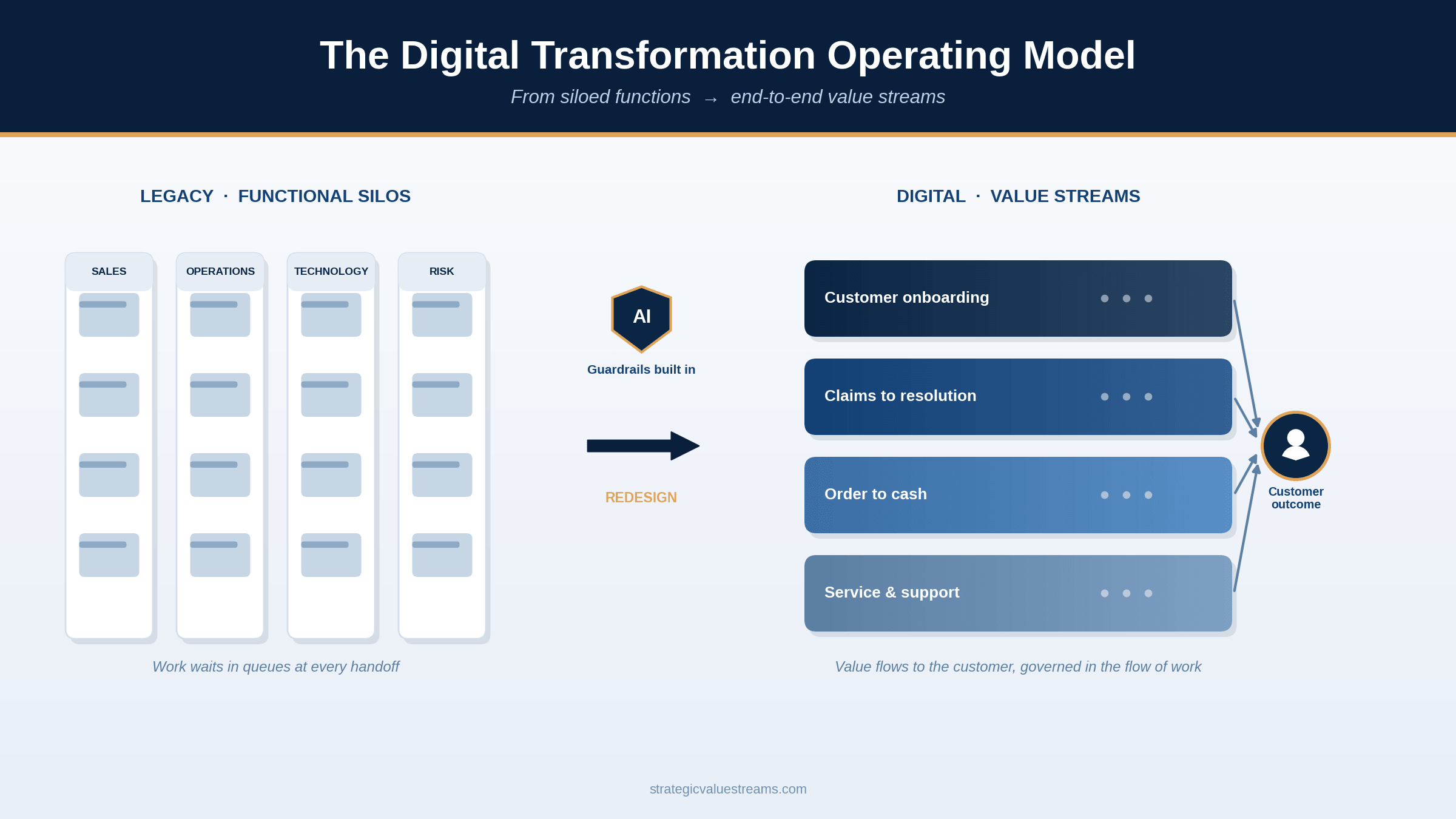
Consider what happens to a customer need inside a functionally organised enterprise. The need enters through one department, is translated into internal artefacts (tickets, requirements, projects), passes across multiple departmental boundaries, queues at each handoff, and eventually emerges as a delivered outcome. At every boundary, context is lost, priorities conflict, and time is consumed. No single leader is accountable for the whole journey, so no single leader can fix it.
Organising around customer value inverts this. Instead of asking "how do we group similar skills?", the enterprise asks "what are the major streams of value we deliver to customers, and how do we organise so each stream flows with minimal friction?" Skills still matter, and functional excellence still matters, but they serve the flow of value rather than governing it. We set out the practical case for this in more detail in the top five benefits of organising around value streams.
Customer value is the right organising principle for three reasons. It is the only principle that aligns naturally with revenue, because customers pay for value received, not for departmental efficiency. It is the only principle that creates unambiguous end-to-end accountability, because a value stream has a definable start, finish, and customer. And it is the most durable principle available, because organisational structures built around internal functions must be redrawn whenever strategy shifts, while the fundamental value streams of a business change far more slowly than its org chart.
The Customer Value Model: Structure, Formula, and Hierarchy
To use customer value as an organising principle, an enterprise needs more than a slogan. It needs a customer value model: a structured, shared representation of what value means for its customers, precise enough to guide design decisions and measurable enough to govern with.
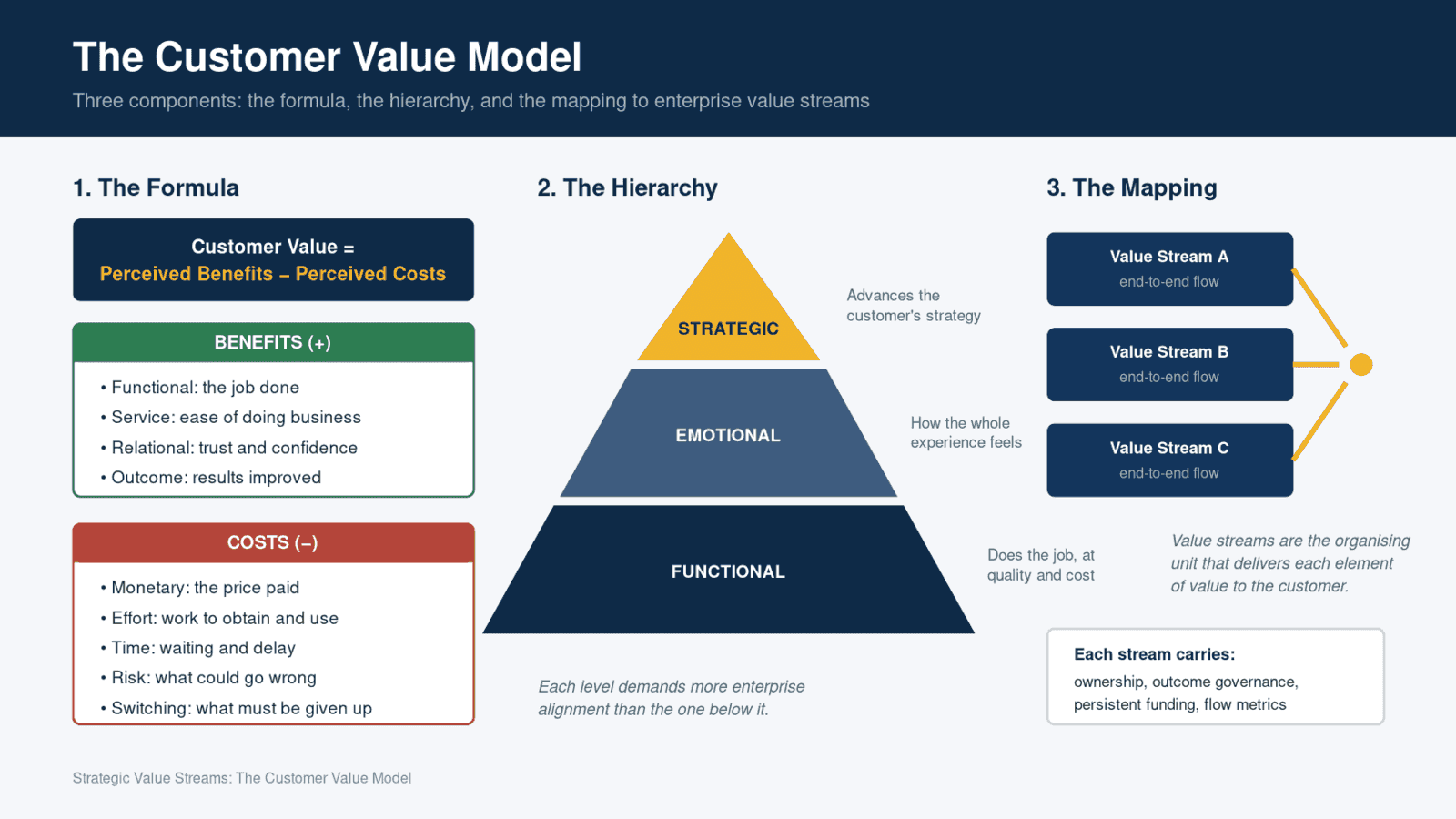
A complete customer value model has three components. The first is the customer value formula, which defines the arithmetic of value: what counts as a benefit, what counts as a cost, and how the two net out for each customer segment. The second is the customer value hierarchy, which recognises that value operates at multiple levels, from functional utility through emotional experience to strategic outcomes. The third is the mapping of the model onto the enterprise: the identification of the value streams through which each element of value is actually created and delivered.
Together, these components turn the customer value model from an abstraction into a design tool. The formula tells you what to maximise and minimise. The hierarchy tells you where to compete and differentiate. The mapping tells you what to build, fund, govern, and measure. The following sections examine each in turn.
The Customer Value Formula Explained
At the heart of the customer value model sits the formula. In its simplest form, it is:
Customer Value = Perceived Benefits − Perceived Costs
Some practitioners prefer the ratio form, Value = Benefits ÷ Costs, which usefully highlights that reducing the denominator can be as powerful as increasing the numerator. Either form works, provided the enterprise defines the variables honestly.
Perceived benefits decompose into several categories. Functional benefits are the direct utility delivered: the problem solved, the job done, the capability gained. Service benefits are the quality of interaction around the core offering: responsiveness, reliability, ease of doing business. Relational benefits are trust, familiarity, and confidence built over time. Outcome benefits are the measurable improvements in the customer's own results, which matter most in business-to-business contexts where your product exists to improve someone else's performance.
Perceived costs are broader than price. Monetary cost is the obvious component, but effort cost (how hard the customer must work to obtain and use the value), time cost (how long they must wait), risk cost (what could go wrong, and who bears it), and switching cost (what they must give up or unlearn) all sit on the same side of the equation.
The enterprise implication is critical: most of the levers in this formula are operational, not promotional. Marketing can influence perception, but the operating model determines the underlying reality. Waiting time is a function of flow. Effort is a function of process design. Risk is a function of quality and reliability. When leaders internalise that the customer value formula is largely determined by how the enterprise is structured and how its work flows, the case for treating customer value as an operating model concern, and not merely a marketing concern, becomes unavoidable.
The Customer Value Hierarchy: From Functional to Emotional to Strategic
Not all value is created equal. The second component of the customer value model, the customer value hierarchy, organises value into three ascending levels, and understanding it helps enterprises decide where to compete.
The functional level is the foundation: does the product or service do the job, at acceptable quality, at acceptable cost? Functional value is necessary but rarely sufficient, because it is the level most easily replicated by competitors. Enterprises that compete only on functional value are perpetually exposed to commoditisation.
The emotional level concerns how the customer feels across the relationship: confidence, ease, status, reassurance, delight, or their negatives, anxiety, frustration, and distrust. Emotional value is created less by individual features and more by the coherence of the whole experience, which makes it heavily dependent on how well the enterprise's internal parts work together. A customer who receives conflicting answers from two departments is experiencing an organisational design failure as an emotional cost.
The strategic level applies most strongly in B2B relationships: does the provider materially advance the customer's own strategy? At this level the customer is not buying a product but a capability, and the provider becomes a partner in the customer's outcomes. Strategic value commands the highest margins and the deepest loyalty, and it is impossible to deliver from within silos, because it requires the provider to orchestrate its full capability around the customer's goals.
The hierarchy shapes enterprise decision-making in a practical way: each level demands a higher degree of internal alignment than the one below it. Functional value can survive a mediocre operating model. Emotional value requires consistency across touchpoints. Strategic value requires the enterprise to behave as a single coherent system. The higher up the hierarchy you intend to compete, the stronger the case for organising around customer value.
Customer Value Model Examples Across Industries
The customer value model looks different in every industry, but the structure holds. Consider four examples.
In retail banking, functional value is safe, accurate handling of money and access to credit. Emotional value is the feeling of financial confidence and being known by the institution. Strategic value, for business customers, is the bank acting as a growth partner. The dominant cost-side variables are effort and time: onboarding friction, approval delays, and disjointed channels. Banks that model value this way discover that their biggest value leaks are not product gaps but flow problems, such as a mortgage approval that crosses six departments.
In software as a service, functional value is the capability delivered and its reliability. Emotional value is user confidence and low frustration. Strategic value is the measurable improvement in the customer's business results, evidenced through adoption and outcomes. Costs include subscription price, implementation effort, and the risk of failed adoption. SaaS providers who model value end to end realise that renewal is determined less by the sales function than by the entire stream from onboarding through support to product improvement.
In healthcare, functional value is effective diagnosis and treatment. Emotional value is dignity, communication, and trust at moments of vulnerability. Strategic value, for health systems and payers, is improved population outcomes at sustainable cost. The cost side is dominated by time, anxiety, and coordination burden placed on the patient. Health providers that map value discover that the patient experiences the gaps between specialisms as the primary cost of care.
In manufacturing, functional value is product performance and dependable supply. Emotional value, largely institutional, is confidence in the supplier's reliability. Strategic value is co-innovation and supply chain resilience offered to key accounts. Cost-side variables include total cost of ownership and supply risk.
Across all four customer value model examples, the same lesson recurs: the components of value that customers weight most heavily are created across departmental boundaries, and the largest destroyers of value live in the handoffs.
How to Build a Customer Value Model for Your Organisation
Building a customer value model is a structured exercise, not a workshop poster. A practical approach has five steps.
First, segment before you model. Value is defined per customer segment, because different segments weight benefits and costs differently. A model that averages across all customers describes none of them.
Second, gather evidence, not opinions. Combine qualitative inputs (customer interviews, journey research, complaint and churn analysis) with quantitative inputs (usage data, retention drivers, win/loss analysis). A customer value model built on what internal stakeholders believe, rather than what customers actually trade off, will fail its first contact with reality.
Third, construct the formula for each segment. List the benefits by category (functional, service, relational, outcome) and the costs by category (monetary, effort, time, risk, switching). Weight them based on evidence. Be especially rigorous on the cost side, since enterprises systematically underestimate the effort and time costs they impose.
Fourth, align stakeholders on the model. This step is political as much as analytical. Each function will recognise its own contribution in the model and, more uncomfortably, its own contribution to the cost side. The model becomes useful precisely when leaders accept a shared definition of value that no single function controls. Securing that agreement at executive level is what turns the model from a document into a governing instrument.
Fifth, validate and iterate. Test the model's predictions against reality: if the customer value model says effort cost drives churn in a segment, reducing effort should measurably improve retention. A customer value model is a living artefact, reviewed on a regular cadence as markets, competitors, and customer expectations shift.
The finished customer value model should be concise enough for an executive team to hold in their heads and precise enough to settle arguments about priorities. If a funding debate cannot be resolved by reference to the customer value model, the model is not yet finished.
Why Most Enterprise Operating Models Are Not Aligned to Customer Value
Here is the uncomfortable truth: almost no large enterprise is structurally organised around the customer value it claims to prioritise. This is not because leaders do not care about customers. It is because the modern enterprise inherited its structure from a management paradigm designed for a different problem.
The functional hierarchy was built to maximise efficiency of specialised labour in stable, predictable markets. It optimises resource utilisation: keeping every specialist busy within their department. But customer value is not delivered by busy departments. It is delivered by work flowing across departments, and the functional model treats that flow as nobody's job.
The misalignment shows up in three compounding patterns, which the next sections examine: a disconnect between strategy and delivery, silos that create organisational viscosity, and governance and funding structures that reward the wrong things. Each pattern is individually manageable. Together they form a system that reliably dilutes customer value regardless of how talented or well-intentioned the people inside it are. That is the defining characteristic of an operating model problem: it produces poor outcomes from good people, and it cannot be fixed by asking those people to try harder.
The Strategy-to-Delivery Disconnect
Most enterprises have a strategy that mentions customers prominently and a delivery engine that never sees that strategy in actionable form. Between the two sits a chain of translation: strategy becomes annual plans, plans become departmental budgets, budgets become projects, projects become task lists. At each translation, customer intent is diluted and internal logic takes over.
By the time work reaches a delivery team, it arrives as a feature request or a project milestone, stripped of the customer context that justified it. Teams optimise for the artefact in front of them: the ticket, the deadline, the scope document. They can be fully compliant with the plan while contributing nothing measurable to customer value, because the connection between their work and the customer outcome was severed three translation layers up.
The reverse path is equally broken. Insight generated at the point of delivery, where teams see how customers actually behave, rarely travels back up to reshape strategy. The enterprise steers using last year's assumptions while its own front line accumulates evidence it cannot transmit. The result is an organisation where strategy and delivery each operate in good faith and the customer falls into the gap between them.
Siloed Departments and Organisational Viscosity
Viscosity is a useful metaphor: it is the internal friction of a fluid, the property that determines how easily it flows. Enterprises have viscosity too. Organisational viscosity is the aggregate resistance that work encounters as it moves through the enterprise, and silos are its primary source.
Every departmental boundary that a piece of customer-relevant work must cross adds a queue, a handoff, a reprioritisation, and a loss of context. Work that requires four departments does not take four times as long as work requiring one; it often takes ten or twenty times as long, because the elapsed time is dominated by waiting between departments rather than working within them. Studies of flow efficiency in large organisations routinely find that work items spend the vast majority of their lifecycle sitting in queues. We examine how to measure and improve this directly in our guide to value stream flow and the metrics that expose it.
Silos also fragment the customer experience directly. Each department sees its own slice of the customer and optimises locally: sales optimises the close, onboarding optimises its checklist, support optimises ticket resolution time. Each local optimisation can be individually rational and collectively incoherent, because no one owns the customer's cumulative experience of all of them.
The critical insight is that viscosity is structural, not attitudinal. Exhortations to "collaborate better" or "break down silos" fail because the silos are load-bearing: they are how budgets are allocated, careers advance, and performance is measured. People cooperate exactly as much as the structure rewards, and no more.
Misaligned Governance and Funding Structures
If structure creates viscosity, governance and funding lock it in place.
Traditional governance is organised around internal control: stage gates, steering committees, departmental sign-offs. It asks "is this work compliant with our process?" rather than "is this work producing customer value?" Decision rights sit with people distant from both the customer and the work, so decisions are slow, batched into committee cycles, and made with degraded information. Teams learn that the fastest route to progress is satisfying the governance process, which is not the same thing as satisfying the customer.
Funding compounds the problem. Annual, department-based budgeting funds organisational units rather than customer outcomes, so cross-cutting value work must scavenge resources from multiple budget holders, each with their own priorities. Project-based funding is no better: it funds temporary efforts with fixed scope, disbands teams once "done," and measures success as on-time-on-budget delivery of outputs rather than realisation of outcomes. A project can be a governance triumph and a customer value failure, and under project accounting no one will ever know.
Both models share a deeper flaw: they force the enterprise to predict value annually and in advance, then penalise deviation from the prediction. But customer value is discovered continuously through delivery and feedback. A funding system that punishes learning guarantees that the enterprise keeps investing in last year's guesses.
The Hidden Cost of Ignoring Customer Value at the Operating Model Level
The costs of this misalignment are largely invisible in conventional accounts, which is why they persist. They deserve to be made explicit.
There is the cost of delay: revenue and competitive position forfeited because value that could have reached customers in weeks took quarters. When a capability worth a million in monthly revenue ships six months late because of queues and handoffs, the enterprise has silently spent six million, and no report will ever show it.
There is the cost of misinvestment: the portion of the change portfolio spent on work that produces no customer value. Industry studies have repeatedly suggested that a large fraction of delivered features see little or no use. In an operating model with no line of sight from investment to customer outcome, this waste is not an anomaly, it is the default.
There is the cost of churn and margin erosion: customers who leave, or demand discounts, because accumulated friction outweighed delivered benefit. These losses get attributed to "price pressure" or "competition" when their root cause is effort and time costs the operating model imposed.
And there is the organisational cost: duplicated work across silos, layers of coordination roles that exist only to compensate for structural misalignment, and the attrition of talented people who tire of fighting the system to do good work.
Sum these and the conclusion is stark: for most large enterprises, the operating model itself is one of the largest unmanaged costs on the books. Not managing the flow of customer value is a decision, and it is an expensive one.
Designing an Enterprise Operating Model Around Customer Value
If the diagnosis is structural, the remedy must be structural. Designing an operating model around customer value rests on a handful of principles. For a step-by-step treatment of the design process itself, see our guide to designing a target operating model around value streams.
Organise around the flow of value, not the ownership of resources. Use the customer value model to identify the enterprise's value streams, the end-to-end sequences of activity that deliver value to a customer, and make them the primary units of organisation, accountability, and investment. Functions become centres of expertise that support the streams rather than gates the work must pass through.
Push decision authority to where the information is. Customer value is sensed at the edge of the organisation, in delivery and customer contact. Decisions about how to maximise it should be made as close to that edge as possible, within clear strategic guardrails set by leadership.
Fund outcomes persistently, govern them adaptively. Replace annual departmental and project budgets with persistent funding of value streams, adjusted at a regular cadence based on evidence of outcomes.
Measure flow and value, not utilisation and output. The core management question changes from "is everyone busy?" to "is value flowing to customers, and how fast?"
Design for evolution. Markets shift, so the operating model must include the mechanism of its own adjustment: regular reviews of value stream boundaries, funding levels, and performance.
The sections that follow work through the key elements: what the model looks like, value streams as the organising unit, ownership, governance, and funding.
What a Customer-Value-Led Operating Model Looks Like
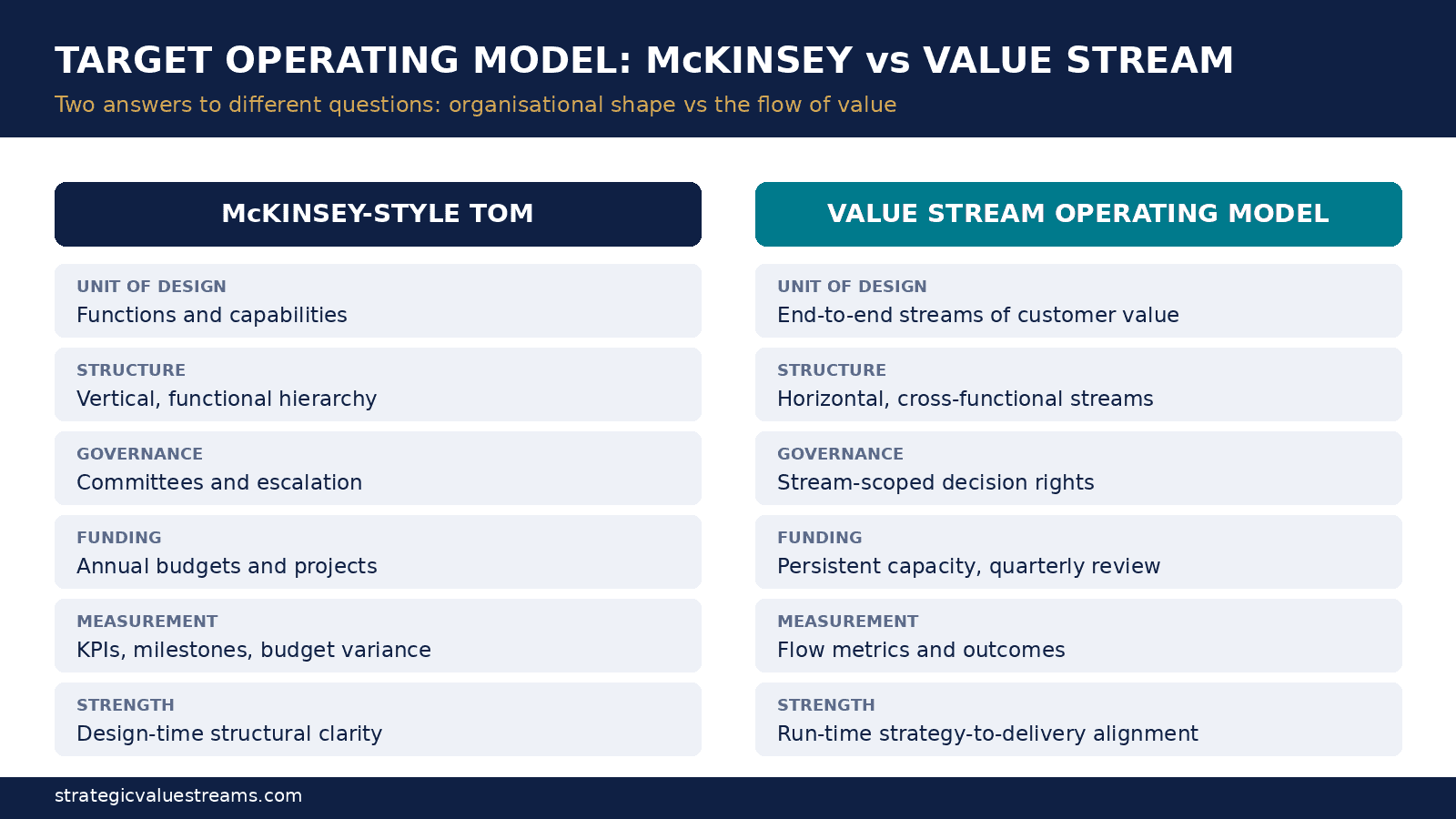
Contrast the two models directly. If you are weighing this against the classical consulting approach to operating model design, we compare them side by side in target operating model: McKinsey versus the value stream approach.
In a traditional function-based operating model, the primary structure is the departmental hierarchy. Work moves horizontally across a vertically organised enterprise, crossing boundaries at every step. Accountability is vertical: each leader answers for their function's performance, and no one below the chief executive owns an end-to-end customer outcome. Planning is annual, funding is departmental or project-based, and success is measured in outputs and utilisation.
In a customer-value-led operating model, the primary structure mirrors the value streams. Long-lived, cross-functional teams are aligned to each stream, containing most of the capabilities the stream needs day to day. Accountability is horizontal: named owners answer for end-to-end customer value and flow within their stream. Functions persist as homes for craft, standards, and career development, but their role is to strengthen the streams, not to sequence the work. Planning is continuous, funding follows the streams, and success is measured in customer outcomes and flow.
To a customer, the difference is felt rather than seen: requests resolve faster, experiences connect coherently, and improvements arrive continuously rather than in annual big-bang releases. To an employee, the difference is felt daily: less time negotiating handoffs and more time delivering, a visible line from their work to a customer outcome, and decisions made in days by people who understand the context.
A customer-value-led model is not a flat organisation, not the absence of functions, and not a licence for chaos. It is a deliberate rebalancing: flow first, function in support.
Introducing Value Streams as the Core Organising Unit
A value stream is the end-to-end sequence of activities an enterprise performs to deliver value to a customer, from the initial trigger (a need, a request, an opportunity) to the realisation of value in the customer's hands. The concept has roots in lean manufacturing, but in the modern enterprise it applies equally to software delivery, services, and internal capabilities.
You will often see value streams divided into two types: operational streams that deliver value to customers, and development streams that build the products and systems those operational streams use. The distinction is worth knowing, because it is common. It is also worth rejecting, because it reproduces the problem the operating model exists to solve.
A value stream that cannot improve itself is not a value stream. It is a production line with a change queue attached. The moment building is separated from running, a handoff appears between the people who change the work and the people who live with the result, and every cost described earlier in this article follows from it: queues at the boundary, context lost in translation, and improvements delivered at a team rather than owned by one.
In a value stream operating model there is one kind of stream. It delivers value continuously and it changes how it delivers value continuously, and both are its own accountability. Bounded change work still exists, with a start and an end, and specialist change craft can be bought in where a stream needs it. What does not exist is a separate stream that owns improvement on another stream's behalf.
Value streams are the most effective organising unit for three reasons. They are customer-anchored by construction: a value stream is defined by the value it delivers and to whom, so organising around it hard-wires customer orientation into the structure rather than relying on culture to supply it. They are end-to-end, which makes flow visible and manageable: once the whole stream is seen as a single system, its queues, bottlenecks, and handoff losses can be measured and removed, work that is literally impossible when the stream is split across departmental accountabilities. And they are stable: an enterprise's fundamental value streams change only when its business model changes, which makes them a far sounder foundation for structure, funding, and careers than the shifting portfolio of projects and reorganisations.
Identifying value streams is itself a discipline, and our step-by-step guide to the value stream mapping process sets out how to do it. It starts from the customer and the value received, not from the org chart, and it typically reveals that the enterprise has a modest number of true value streams (often between five and fifteen at the top level) crossed by dozens of departmental boundaries. That map, of value flowing against structure, is usually the single most clarifying artefact a leadership team can produce.
Value Stream Ownership: Accountability for End-to-End Customer Value
Structure without accountability is decoration. Every value stream needs an owner: a single named leader accountable for the end-to-end customer value the stream delivers and for the health of its flow.
The role has four core responsibilities. The owner is accountable for outcomes: the customer value indicators and business results the stream exists to produce, not the outputs of any single team within it. The owner is accountable for flow: sensing where work queues and stalls across the stream and driving the structural improvements that reduce viscosity, including changes that cross old departmental lines. The owner holds the stream's investment case: proposing funding levels, deciding priorities within the stream's allocation, and answering for the value returned. And the owner is the integration point for the customer: where fragmented perspectives on the customer experience become one coherent view and one improvement agenda.
For the role to be real rather than ceremonial, three conditions must hold. The owner needs authority commensurate with accountability, including genuine influence over priorities, funding deployment, and the shape of teams within the stream; an owner who must negotiate every decision with a row of functional gatekeepers is a coordinator with a grand title. The owner needs visibility, meaning instrumented flow and value metrics for the whole stream. And the owner needs seniority and standing appropriate to the stream's importance, because they will be redistributing influence that currently sits with functions, and that requires organisational weight.
Value stream ownership does not abolish functional leadership; it complements it. Functional leaders own craft excellence, standards, and people development. Stream owners own value and flow. The two axes hold each other in productive tension, and the design of that tension, who decides what, is one of the most consequential choices in the operating model.
Aligning Governance to Customer Value Outcomes
Governance is where an operating model's true priorities are revealed. Whatever the strategy documents say, the questions asked in governance forums are what the organisation actually optimises for.
Customer-value-led governance rests on a simple shift: govern outcomes, not process compliance. Instead of asking "did you follow the stages and produce the artefacts?", governance asks "what customer and business outcomes were achieved, what was learned, and what should change as a result?"
Practically, this means several changes. Governance forums are restructured around value streams rather than departments or project portfolios, reviewing each stream's customer value indicators, flow health, and investment performance on a regular cadence. Decision rights are tiered: leadership sets strategic direction, allocates funding across streams, and defines guardrails (risk, compliance, brand, architecture); stream owners decide priorities within their streams; teams decide how to execute. Each decision sits at the lowest level with sufficient context, which drains the standing agenda of most steering committees.
Compliance and risk management are not abandoned, they are embedded. Regulatory, security, and quality requirements become explicit constraints built into the streams' ways of working and, where possible, automated, rather than inspection gates that batch work and add queues. The aim is that conforming work flows without stopping, and only genuine exceptions escalate.
The tell-tale sign of successful governance realignment is what happens when evidence and plan diverge. In compliance-oriented governance, the plan wins and reality is managed as "variance." In value-oriented governance, the evidence wins: funding shifts, priorities change, and the plan is updated without ceremony. Governance becomes the enterprise's steering mechanism rather than its brake.
Turn Customer Value into Organisation Design
A customer value model defines the outcomes an organisation exists to create. A value stream operating model turns that understanding into organisation design by aligning ownership, governance, funding, architecture and delivery around those outcomes.
Funding Value Streams Instead of Departments or Projects
Funding is the operating model's bloodstream: whatever the structure says, resources flow where the funding model sends them. A customer-value-led operating model therefore requires a different funding approach.
The shift is from funding temporary projects and permanent departments to funding persistent value streams. Each value stream receives an ongoing allocation, sized to its strategic importance and demonstrated return, which funds the long-lived teams and capabilities within it. The stream owner deploys that capacity against the highest-value opportunities as they emerge, without launching a project and assembling a temporary team for each one.
The advantages are substantial. Stability: teams persist, retain context, and compound their expertise, instead of dissolving at each project boundary and taking the learning with them. Speed: new priorities start when capacity allows, not when the next annual funding window opens; the question changes from "can we get budget?" to "what should our existing capacity work on next?" Honesty: because streams are funded on a cadence against evidence of outcomes, investment decisions are made with real information; a stream that is not returning value has its allocation reduced at the next review, a discipline annual budgeting performs poorly and project accounting performs not at all.
Adopting stream funding requires supporting changes: a regular (typically quarterly) investment review cadence in place of the annual budget negotiation; lightweight business cases at the level of outcomes sought rather than features specified; and finance partnership in redesigning cost allocation, capitalisation treatment, and reporting to fit persistent teams. Finance is not an obstacle to this model; done properly, finance gains something annual budgeting never provided, a continuous, evidence-based view of return on the change portfolio.
Funding is frequently the last element of the operating model to change and the one that determines whether the rest of the change endures. An enterprise that reorganises into value streams but keeps annual departmental budgets has changed its diagram, not its behaviour.
Measuring What Matters: Flow Metrics and Customer Value Indicators
An operating model designed around customer value needs an instrument panel to match. Traditional enterprise measurement, built on utilisation, milestones, and departmental KPIs, cannot see the two things that now matter most: how well value flows, and whether customers are receiving it.
The measurement layer of a customer-value-led operating model therefore has two connected families of measures. Flow metrics quantify the movement of value through the enterprise's streams: how fast, how smoothly, how predictably work travels from need to delivery. Customer value indicators quantify what arrives: the benefits customers receive, the costs they bear, and the outcomes that follow, tied back to the customer value formula and hierarchy defined earlier.
Neither family is sufficient alone. Flow without value measurement risks efficiently delivering the wrong things; value without flow measurement shows you outcomes but not the systemic causes behind them. Linked together, and connected upward into strategic decision-making, they give the enterprise something most have never had: a continuous, quantified line of sight from how it works, through what it delivers, to what customers experience and what the business earns.
Flow Metrics as Proxies for Customer Value Delivery
Customer value outcomes are inherently lagging: churn, satisfaction, and revenue tell you what has already happened. Flow metrics are the leading indicators, because value a customer has not yet received is, in almost every case, value currently sitting somewhere in the enterprise's streams.
Five flow metrics form the core set. Flow time measures how long a unit of value takes from commitment to delivery; it is the enterprise's speed limit on responding to customer needs. Flow velocity measures how many units of value are delivered per period, the throughput of the stream. Flow efficiency measures the proportion of flow time spent in active work versus waiting; in unimproved enterprises this figure is routinely shockingly low, which is another way of saying that most "delivery time" is queue time, and that is where the leverage lies. Flow load measures work in progress against capacity; overloaded streams slow down nonlinearly, so load is the earliest warning of trouble ahead. Flow distribution measures the mix of work (new value, defect remediation, risk and compliance, technical debt), revealing whether the stream's capacity is actually being spent on customer value or consumed by internal costs.
Each metric proxies a component of the customer value model's formula. Flow time proxies the customer's time cost. Flow efficiency exposes organisational viscosity directly. Distribution shows whether the benefit side of the formula is being invested in at all. When flow metrics degrade, customer value indicators will degrade next quarter; that predictive relationship is what makes flow the operational heartbeat of a customer-value-led enterprise.
One discipline matters above all: flow metrics are for improving streams, not for judging teams. The moment they become individual performance targets, they will be gamed, and the instrument panel goes dark.
Building a Customer Value Measurement Framework
A measurement framework connects these metrics into a coherent system spanning every level of the enterprise. Building one proceeds in four steps.
Start from the customer value model. For each segment, the model defines weighted benefits and costs; each significant element needs an indicator. Benefits side: adoption and usage depth, outcome attainment (especially in B2B), satisfaction and loyalty measures. Cost side: customer effort scores, end-to-end resolution and delivery times as the customer experiences them, friction and failure demand (contact volume caused by things going wrong). The cost side is the most commonly neglected and often the most revealing.
Layer the framework by altitude. At team level, teams track the flow and quality of their own work alongside direct signals from the users of what they build. At value stream level, owners track end-to-end flow metrics and the customer value indicators for their stream, the level where the two families join. At enterprise level, leadership tracks aggregated value stream performance connected to strategic and financial outcomes: revenue growth, retention, margin, market position. Each layer aggregates upward, so a number on the executive dashboard can be traced down to the streams and teams that produce it.
Establish baselines before targets. Measure the current state honestly, including the uncomfortable numbers like true end-to-end flow time, before setting improvement goals. Frameworks that begin with aspirational targets and no baselines produce theatre, not learning.
Keep it small and review it on a cadence. A framework with forty KPIs is a reporting burden; a framework with a dozen well-chosen measures, reviewed at team, stream, and enterprise cadences, is a management system. Retire indicators that no longer change decisions.
Connecting Measurement to Strategic Decision-Making
Measurement earns its cost only when it changes decisions. The final element of the measurement layer is the explicit wiring between metrics and the decisions they should inform.
Three decision loops matter most. The investment loop: at each funding review, value stream allocations are adjusted based on evidence, streams demonstrating strong value returns and healthy flow attract more capacity, streams showing weak returns face reduction or redesign. Customer value metrics thereby do what business cases alone never could: correct the portfolio continuously with real information rather than annual predictions.
The prioritisation loop: within each stream, owners use value indicators and flow data to sequence work, weighing cost of delay, evidence of customer demand, and the stream's flow distribution. When remediation work or friction-driven failure demand is consuming a growing share of capacity, that fact surfaces in distribution metrics and forces an explicit trade-off, rather than silently taxing delivery.
The operating model loop: the most strategic loop of all. Persistent flow problems are signals about the model itself: a stream whose flow efficiency stays low despite local improvement is telling leadership that a boundary is misdrawn, a dependency is structural, or a governance gate is misplaced. Leadership reviews these signals on a cadence and adjusts the model, boundaries, ownership, funding, guardrails, accordingly. This is what it means for an operating model to be designed for evolution.
The common thread is cadence. Metrics connected to scheduled decision forums change the enterprise; metrics published to dashboards no one is obliged to act on change nothing. Every measure in the framework should have an answer to the question: which decision, made by whom, at what cadence, does this inform?
Scaling the Customer Value Model Across the Enterprise
Everything described so far can be, and usually is, proven first in one part of the enterprise: a single value stream, instrumented and funded properly, with a real owner and outcome-based governance. The harder problem is scale: extending the model across dozens of streams, thousands of people, and the full weight of incumbent structure, without diluting it into vocabulary. The same challenge appears wherever large-scale change is attempted, which is why the principles behind a digital transformation operating model apply directly here.
Scaling fails in predictable ways. It fails by rebranding, when departments are renamed value streams while funding, governance, and accountability remain unchanged; the language spreads and the behaviour does not. It fails by framework imposition, when a scaled model is rolled out as a compliance exercise and teams adopt the rituals without the principles. And it fails by exhaustion, when transformation is run as a project with an end date rather than a permanent change in how the enterprise manages itself.
Scaling succeeds when three things are held constant while everything else adapts. The customer value model itself: one shared definition of value, segments, formula, hierarchy, used from board to team. The structural principles: streams as the organising unit, end-to-end ownership, outcome governance, persistent funding, flow and value measurement. And the evidence standard: every extension of the model to a new area is expected to demonstrate improvement in flow and value, which keeps the transformation honest and self-correcting.
The sequencing that works is expansion by demonstrated success: instrument and improve a first wave of streams, publicise the measured results, then extend wave by wave, adapting the pattern to each area's context while holding the principles fixed. What must scale fastest is not the structure but the shared understanding, which is why the final sections of this article deal with people: capability, common language, and the role of a shared body of knowledge.
From Team-Level Agility to Enterprise-Wide Value Alignment
Many enterprises believe they have already made this journey because their teams practise agile methods. Team-level agility is real progress, but it is the beginning of the journey, not the end, and the gap between agile teams and an aligned enterprise is precisely where most transformations stall. It is also why copying another company's team structure rarely works, a lesson we draw out in why the Spotify model was never a model, and what to keep from it.
An enterprise can contain hundreds of high-performing agile teams and still deliver customer value slowly, because the constraints have moved. Individual teams iterate quickly inside their boundaries while the value stream around them remains viscous: dependencies queue between teams, funding still arrives through annual projects, governance still runs on stage gates, and priorities still descend from departmental plans. The teams are agile; the system is not. Customers experience the system.
The progression runs through recognisable stages. First, agile teams: fast iteration within team boundaries, with the surrounding enterprise unchanged. Second, coordinated teams: teams-of-teams aligned around shared products or platforms, with dependencies actively managed. Third, value stream alignment: long-lived teams organised to end-to-end streams, with ownership, flow measurement, and stream-level priorities. Fourth, enterprise value alignment: funding, governance, strategy, and measurement all operating on the value stream axis, with the customer value model as the shared reference from board to team. Team-level methods can be adopted without a customer value model; enterprise-wide alignment cannot.
Each stage requires changes at a level above the previous one. Moving from stage one to two is a delivery leadership problem. Moving from two to three is an operating model problem. Moving from three to four is an executive problem, because it requires changing how the enterprise plans, funds, and governs itself. This is why team-level methods, however well executed, cannot by themselves produce enterprise-wide value alignment: the deciding moves belong to leadership.
How to Sustain a Customer-Value-Led Transformation
Transformations do not fail at launch; they fail at month eighteen, when initial energy fades and the old system's antibodies get to work. Sustaining a customer-value-led transformation depends on four enablers. It also helps to be clear about which model of change you are actually running, a question we unpack in what organisational change is, with five models compared.
Leadership constancy. The single strongest predictor of endurance is whether executives change their own behaviour: the questions they ask, the forums they attend, the metrics they steer by, the trade-offs they visibly make in favour of customer value over internal convenience. Organisations detect within months whether leadership means it, and calibrate accordingly. A transformation sponsored but not practised by its leaders will be politely outlasted.
Culture built through evidence, not slogans. Culture changes when people repeatedly see the new way working: a funding decision genuinely made on outcome evidence, a stream owner backed in a boundary dispute with a function, a team's flow data prompting help rather than blame. Each such event is worth a hundred posters. The transformation should be run to generate these proof points deliberately and publicise them relentlessly.
Governance as the ratchet. The redesigned governance and funding cadences are what prevent regression. Annual budgeting, stage-gate reviews, and departmental scorecards are the mechanisms through which old operating models reassert themselves; as long as the value-stream-based cadences remain the real decision forums, the change holds. Guard them.
Capability and cadence. The transformation must continuously build skill, in value stream design, flow management, outcome-based governance, and measurement, at every level, and it must run on a heartbeat of regular reviews where the operating model itself is inspected and adjusted. A transformation with no cadence becomes an event; an event is always temporary.
Underneath all four runs a common requirement: people across the enterprise need a shared understanding of what they are doing and why. That is the role of a common body of knowledge.
The Role of a Shared Body of Knowledge in Embedding Customer Value
Every durable discipline rests on a shared body of knowledge. Medicine, engineering, and finance can coordinate thousands of practitioners across organisations because they share defined concepts, a common vocabulary, and agreed standards of practice. Enterprise transformation usually enjoys no such foundation, and it shows: in most organisations, terms like value stream, flow, outcome, and even customer value itself mean different things in different rooms. When language fragments, alignment is impossible, and every initiative pays a recurring tax of redefinition and misunderstanding.
A shared body of knowledge changes this in four ways. It provides a common language: when a stream owner in operations and a finance director both mean the same thing by flow efficiency and value stream funding, conversations that previously took months of mutual translation converge in days. It provides a reference point for design decisions: instead of relitigating first principles in every forum, teams reason from an agreed framework and spend their energy on application to their context. It makes capability portable: people can move between streams, and new joiners can become effective quickly, because the way of working is documented, teachable, and consistent. And it protects the transformation from dilution: with an authoritative reference, the concepts resist being bent back into old meanings, the fate of most transformation vocabulary.
This is the role the Strategic Value Streams Body of Knowledge is designed to fill. It codifies the disciplines this article has surveyed, the customer value model, value stream identification and design, ownership, outcome-based governance, stream funding, and flow measurement, into a coherent, teachable framework that an entire enterprise can reference. It functions as the stable core that scaling requires: the thing held constant while application flexes to each context.
A body of knowledge embeds customer value thinking not by mandating it, but by making it the path of least resistance: the definitions are ready, the patterns are proven, and everyone is reading from the same page.
Get Certified in Enterprise Value Stream Operating Models
Understanding these concepts is one thing; being recognised as capable of applying them is another. For practitioners and leaders who want to formalise their expertise in customer-value-led operating models, the Strategic Value Streams certification framework provides the recognised pathway.
Built on the Strategic Value Streams body of knowledge, certification validates that an individual can do more than use the vocabulary: it confirms a working command of the customer value model, value stream identification and design, ownership and governance patterns, stream-based funding, and flow measurement, the full span of what this article has covered. For organisations, certifying practitioners across functions creates exactly the shared language and common reference point that scaling and sustaining a transformation demand.
Foundation and Practitioner Certification Pathways
The certification framework offers two tiers, designed as a progression. If you are weighing this against other credentials in the field, we compare the main options in value stream certifications compared: which one fits your role.
Foundation certification establishes command of the core concepts: the customer value model, formula, and hierarchy; value streams and their types; the principles of value-stream-based operating models; and the fundamentals of flow measurement. It is suited to anyone who works in or around enterprise change: team members, analysts, functional managers, agile practitioners, and leaders who want a rigorous grounding before sponsoring change. Foundation ensures that when your enterprise talks about customer value and value streams, everyone means the same thing.
Practitioner certification goes further, validating the ability to apply the body of knowledge in real enterprise contexts: identifying and mapping value streams, constructing customer value models, designing ownership and governance arrangements, building measurement frameworks, and shaping funding models. It is suited to those who lead this work: transformation leads, operating model designers, value stream owners and candidates for that role, senior delivery leaders, and consultants. Practitioner certification signals not familiarity but capability.
The tiers work together organisationally: Foundation certification spread broadly creates the shared language; Practitioner certification concentrated in key roles creates the design and leadership capability. Enterprises pursuing customer-value-led transformation typically need both.
Why Professional Certification Validates Your Customer Value Expertise
In a field crowded with vocabulary and thin on rigour, certification serves a real function: it separates demonstrated understanding from borrowed language.
For the individual, certification against an established body of knowledge provides credible, portable evidence of expertise. Operating model design, value stream ownership, and transformation leadership are increasingly sought-after capabilities, and roles carrying them command significant responsibility. Certification gives hiring managers and executive sponsors something concrete to trust: not a claim of experience with the words, but validated command of the discipline. It also gives the practitioner confidence in their own foundations, the assurance that their approach rests on a coherent framework rather than fragments assembled from conference talks.
For the organisation, certification is an alignment instrument. A transformation staffed by people certified against the same body of knowledge starts with its common language already in place, its concepts already agreed, and its standards of practice already understood. The recurring tax of redefinition, the months lost to competing interpretations of value stream or outcome, is simply not paid. And because the certification framework is external and stable, it provides continuity that survives personnel changes, reorganisations, and the arrival of new leaders with new vocabularies.
Customer value, as this article has argued, is not a slogan but a discipline: a definable concept, a formal model, an organising principle, and a measurable practice. Disciplines deserve credentials. If you are ready to validate your expertise in customer-value-led enterprise operating models, the Strategic Value Streams certification pathway, from Foundation through Practitioner, is the route to take.
FAQs
What is a customer value model?
A customer value model is a structured, shared representation of what value means for an enterprise's customers. It has three components: the customer value formula (perceived benefits minus perceived costs), the customer value hierarchy (functional, emotional, and strategic levels of value), and the mapping of that value onto the enterprise's value streams. It turns customer value from a slogan into a tool that guides structure, funding, governance, and measurement.
What is the customer value formula?
The customer value formula is Customer Value = Perceived Benefits − Perceived Costs. Benefits include functional, service, relational, and outcome benefits. Costs go beyond price to include effort, time, risk, and switching costs. Some practitioners express it as a ratio (benefits divided by costs), which highlights that reducing customer effort and waiting time can create as much value as adding new benefits.
How is customer value different in marketing and organisational design?
In marketing, customer value is a communication concept: it shapes the value proposition, positioning, and messaging. In organisational design, it is a structural concept: it determines how the enterprise organises, governs, funds, and measures itself so it can actually deliver the value it promises. Enterprises get into trouble when the marketing promise outruns what the operating model can deliver.
Why should enterprises organise around customer value instead of functions?
Functional structures build deep expertise but leave no one accountable for the end-to-end delivery of value, so work queues at every departmental handoff and the customer experience fragments. Organising around customer value, through value streams with named owners, creates unambiguous end-to-end accountability, aligns structure with revenue, and provides a more durable foundation than org charts that must be redrawn with every strategy shift.
How do I get certified in customer value and value stream operating models?
The Strategic Value Streams certification framework, built on the Strategic Value Streams Body of Knowledge, offers two tiers. Foundation certification establishes command of the core concepts, including the customer value model, value streams, and flow measurement, and suits anyone working in or around enterprise change. Practitioner certification validates the ability to apply the body of knowledge in real enterprise contexts and suits transformation leads, value stream owners, and operating model designers.