
Table of Contents
- Target Operating Model McKinsey vs Value Stream Approach
- What Is a Target Operating Model?
- The Origins and Purpose of the TOM in Enterprise Transformation
- Why the McKinsey Target Operating Model Framework Became the Default Reference
- The McKinsey Target Operating Model Framework: A Deep Dive
- The Limitations of the McKinsey Target Operating Model for Modern Enterprises
- What Is a Value Stream Operating Model?
- Target Operating Model McKinsey vs Value Stream Approach: Head-to-Head Comparison
- When to Use the McKinsey Target Operating Model Framework
- When a Value Stream Operating Model Is the Better Choice
- Can You Combine Both Approaches?
- How to Get Formally Certified in Value Stream Operating Models
- Conclusion: Blueprint Plus Operating System
- FAQs
Target Operating Model McKinsey vs Value Stream Approach
Type “target operating model McKinsey” into any search engine and you will see how completely one firm has come to dominate this subject. Yet ask what the target operating model McKinsey framework actually is, and the answers become vague quickly. This article examines what the McKinsey approach to operating model design really consists of, where it delivers value, where it falls short for modern customer-centric enterprises, and how a value stream operating model addresses those gaps. We finish with a head-to-head comparison and practical guidance on when to use each, how to combine them, and how to build formally certified expertise in value stream operating models.
What Is a Target Operating Model?
A target operating model, commonly abbreviated to TOM, is a blueprint for how an organisation intends to operate in a desired future state. Where a business strategy defines what an organisation wants to achieve, the target operating model defines how the organisation must be configured to achieve it: how work is structured, how decisions are made, how people and technology are deployed, and how processes connect to deliver outcomes.
Organisations use a TOM during enterprise transformation because strategy alone changes nothing. A strategy that is not reflected in structure, governance, funding, and daily work remains a document. The TOM exists to translate strategic intent into an operational design, giving leaders a shared picture of the destination and a basis for planning the journey from the current operating model to the target one.
A well-constructed TOM answers questions such as: What capabilities do we need? How should we organise them? What processes and platforms support them? What decision rights and performance measures hold the design together? In principle, it is the bridge between the boardroom and the front line.
The Origins and Purpose of the TOM in Enterprise Transformation
The target operating model has its roots in management consulting. As large organisations undertook restructurings, mergers, technology programmes, and cost transformations through the 1980s, 1990s, and 2000s, consulting firms needed a repeatable way to describe both the current state of an organisation and the future state a transformation was meant to produce. The operating model became that descriptive device, and the “target” operating model became the articulation of where the transformation was heading.
Its original purpose was to bridge the gap between strategic intent and operational reality. Strategy work produced direction; delivery programmes produced change; the TOM sat between them, specifying the organisational design that the strategy required and that the programmes would build. Firms including McKinsey, Bain, BCG, KPMG, Deloitte, EY, PwC, and Accenture all developed their own operating model methodologies, and TOM engagements became a staple of large-scale transformation.
The intent was sound. Many transformations fail not because the strategy is wrong but because the organisation is never actually reconfigured to deliver it. A TOM forces leadership to confront the structural implications of their strategy before spending on change programmes begins.
Why the McKinsey Target Operating Model Framework Became the Default Reference
It is worth being precise here, because much of what is written on this topic is not. McKinsey has never published a single, official product called “the McKinsey Target Operating Model framework.” What the market refers to by that phrase is a body of McKinsey thinking on organisational and operating model design, assembled from decades of published frameworks and client work, that has become the default reference point for TOM design.
Three factors explain this dominance, and why professionals search for “target operating model McKinsey” rather than pairing the term with any other firm. The first is intellectual legacy. The McKinsey 7-S Framework, developed by consultants including Tom Peters, Robert Waterman, and Julien Phillips in the late 1970s and popularised through the 1980 article “Structure Is Not Organization” and the 1982 bestseller In Search of Excellence, established the idea that organisational effectiveness depends on the alignment of multiple interdependent elements: strategy, structure, systems, skills, staff, style, and shared values. That systemic view of organisational design underpins virtually every TOM methodology in use today, from any firm.
The second is reach. McKinsey’s consulting footprint across the world’s largest enterprises means its operating model vocabulary spreads through client organisations, alumni networks, and business schools. When executives describe operating models in terms of structure, processes, people, technology, and governance, they are usually speaking a dialect that traces back to McKinsey publications.
The third is continued publication. McKinsey has kept its operating model thinking current, most visibly through its 2017 work on the “next-generation operating model” for the digital world, which reorganises operations around end-to-end customer journeys, and its more recent “Organize to Value” refresh of 7-S, which expands the model to twelve elements including purpose, value agenda, structure, governance, processes, technology, and talent. Because McKinsey’s material is widely available, widely cited, and continuously renewed, it functions as the industry’s default TOM reference even without a formally branded framework.
The McKinsey Target Operating Model Framework: A Deep Dive
When practitioners talk about applying the target operating model McKinsey framework, they generally mean a structured approach to enterprise design drawn from this body of work: define the strategy, identify the capabilities the strategy requires, then design the organisational elements that deliver those capabilities as an aligned system. The emphasis on alignment is the defining McKinsey characteristic. No single element, however well designed, produces performance on its own; performance comes from the coherence of the whole.
The sections below break down the dimensions this approach typically covers, how it is structured in practice, and where it adds the most value. Understanding the approach on its own terms matters, because its genuine strengths and its structural blind spots both become clearer.
Core Dimensions of the McKinsey Operating Model Framework
McKinsey’s published work describes the operating model through a consistent set of dimensions, even as the labels have evolved from the original seven S’s to the twelve elements of Organize to Value.
Structure covers how the organisation is arranged: business units, functions, reporting lines, spans and layers, and the design of accountable units and teams. Processes cover the formal workflows and routines that run the business, from planning and budgeting to product development and customer service. People, in the form of talent, skills, and workforce planning, covers whether the organisation has the capabilities its strategy requires and how it attracts, develops, and deploys them. Technology covers the platforms, systems, and data that enable work. Governance covers decision rights: which bodies make which decisions, with what authority and what cadence. Around these sit the softer elements that McKinsey has always insisted matter as much as the hard ones: leadership, behaviours, culture, and rewards.
Each dimension is designed to address a specific failure mode. Structure addresses unclear accountability. Process addresses inconsistent execution. Governance addresses slow or contested decisions. The framework’s claim is that a transformation which redesigns only one dimension while leaving the others untouched will regress, because the untouched elements pull the organisation back to its old shape.
How the McKinsey TOM Template Is Structured and Applied
In practice, a target operating model McKinsey engagement follows a recognisable arc. It begins with strategy clarification: what value the enterprise intends to create, for whom, and how it will win. From this, the team derives the capabilities required, then assesses the current operating model against them, dimension by dimension, to produce a gap analysis.
The target state is then designed as a layered artefact. At the top sits a one-page operating model blueprint showing the major structural choices. Beneath it, each dimension is elaborated: target organisation structures, target process maps, technology architecture, governance forums and decision rights, workforce and location plans. The final layer is the transformation roadmap, sequencing the moves from current to target state, typically in waves over one to three years.
Consultants and leaders apply the target operating model McKinsey template as both a design tool and an alignment tool. Its greatest practical use is often not the document itself but the conversations it forces: executives must agree explicitly on structural choices they would otherwise leave ambiguous.
Where McKinsey’s Approach Adds the Most Value
The McKinsey approach is at its strongest in situations that demand top-down structural clarity. Post-merger integration is a classic example: two organisations must be combined into one coherent design, quickly, with clear decisions about structures, roles, and systems. Large-scale cost transformation is another, where the TOM provides the analytical basis for simplifying structures and processes. Regulatory-driven change, market entry, and functional redesigns such as building a new finance or technology operating model also suit the approach well.
It also adds value wherever an enterprise has grown by accretion and no longer has any deliberate design at all. For such organisations, a McKinsey-style TOM imposes a first coherent architecture: it names the capabilities, draws the structure, and establishes governance where none existed. As a strategic design instrument for executives, it has few rivals.
The critical question is what happens after the blueprint is drawn. That is where the limitations begin.
The Limitations of the McKinsey Target Operating Model for Modern Enterprises
None of what follows suggests the McKinsey body of work is wrong. It is incomplete, and incomplete in ways that matter enormously for modern enterprises whose value is delivered through fast-moving, technology-enabled, cross-functional work. The target operating model McKinsey tradition was forged in an era of periodic restructuring: design the organisation, implement the design, run it until the next redesign. Modern enterprises do not work that way. Value delivery is continuous, customer expectations shift constantly, and the organisation must sense and respond without waiting for the next transformation programme. Against that reality, four structural gaps stand out.
The Strategy-to-Delivery Alignment Gap
The TOM connects strategy to organisational design, but it does not maintain the connection between strategy and day-to-day delivery. The blueprint is drawn at a point in time. Once the transformation programme ends, there is no living mechanism in the model that continuously traces strategic intent down to the work delivery teams are actually doing this quarter, this month, this week.
The result is a familiar pattern. Eighteen months after a TOM implementation, the organisation chart matches the blueprint, but portfolio decisions, team backlogs, and daily priorities have drifted. Strategy is revised annually; work is reprioritised weekly; nothing structural binds the two. The alignment the TOM created at design time decays at run time, because the model describes an organisation’s shape rather than the ongoing flow of strategic work through it.
Siloed Departments and the Absence of Customer-Centric Flow
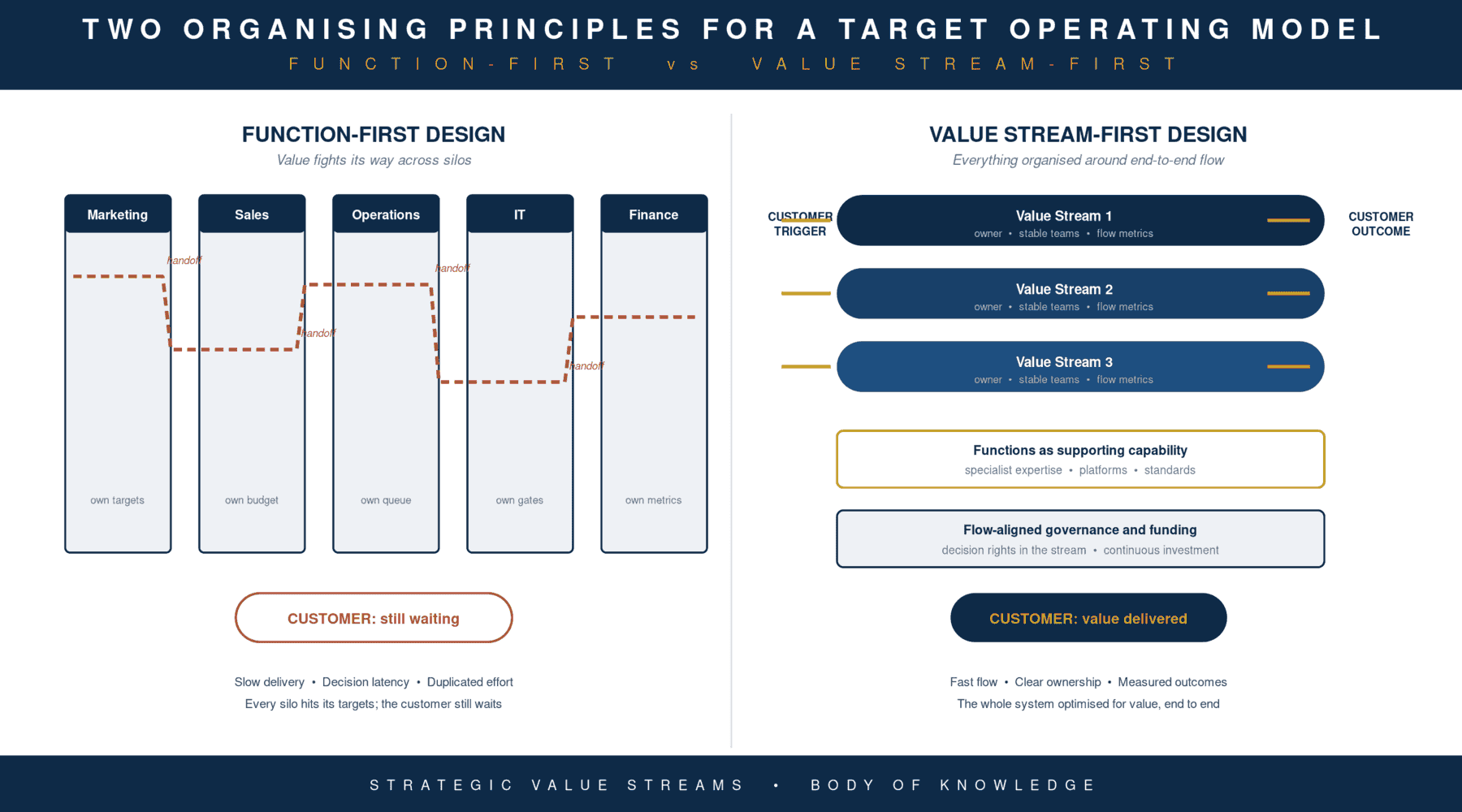
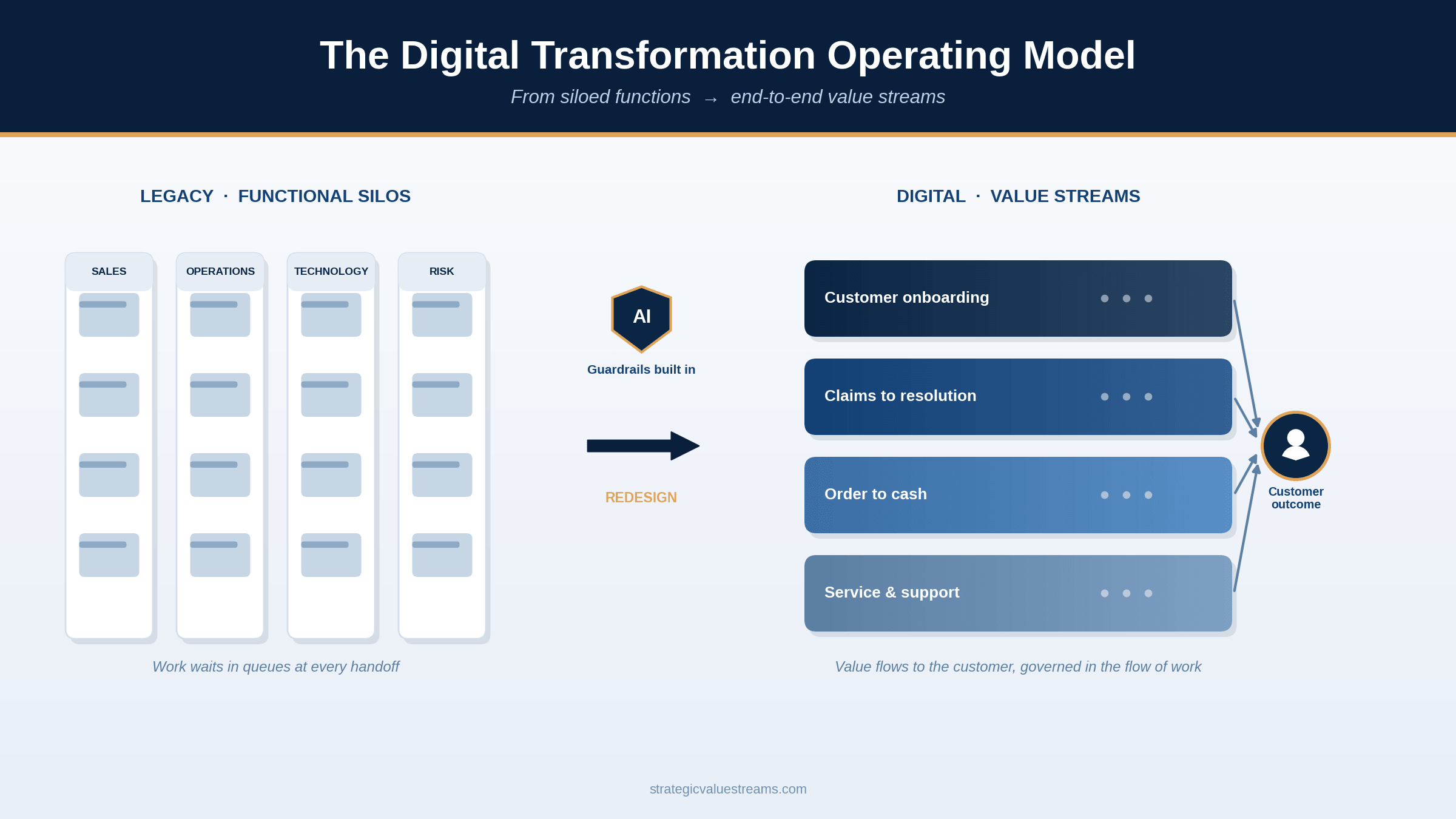
Most TOM implementations still resolve into functional structures: technology, operations, marketing, finance, each optimised within its own boundary. The framework’s dimensions describe each function’s structure, processes, and governance, but customer value is not created inside any single function. It is created by work flowing across all of them, from customer need to delivered outcome.
The McKinsey TOM tradition has no first-class construct for this end-to-end flow. McKinsey’s own 2017 next-generation operating model work implicitly concedes the point, urging organisations to reorganise around customer journeys rather than functions. But journey thinking remains an overlay in most TOM engagements rather than the organising principle. The default output is still a set of well-designed vertical silos, with the horizontal path the customer actually experiences left as an emergent property of handoffs between them. Every handoff adds queues, translation loss, and delay, and no one in the design owns the whole path.
No Built-In Governance or Funding Model for Value Delivery
A McKinsey-style TOM defines governance as forums and decision rights, and funding is typically inherited from the existing corporate model: annual budgets allocated to functions and cost centres, with change delivered through project-based business cases. What the framework does not provide is governance and funding at the level where value is actually delivered.
There is no construct in the traditional TOM for governing an end-to-end stream of customer value: no defined owner accountable for its outcomes, no decision rights scoped to it, no investment mechanism that funds it as a long-lived capacity rather than a sequence of projects. Project-based funding in particular works against continuous value delivery, because it funds temporary initiatives rather than persistent streams, disbands teams at precisely the moment they have learned the domain, and measures success as on-time delivery of outputs rather than realised customer and business outcomes.
Why McKinsey’s TOM Is a Starting Point, Not a Complete Operating System
Taken together, these gaps point to a single conclusion. The target operating model McKinsey tradition is an excellent blueprint and a poor operating system. It answers the design-time questions, namely what shape the organisation should be, with rigour and depth. It does not answer the run-time questions: how strategic priorities become funded work, how that work flows to customers, who owns each stream of value end to end, how performance of that flow is measured, and how the whole system adapts continuously without waiting for the next redesign.
An enterprise needs both. It needs a deliberate structural design, and it needs an operating system that runs value delivery through that design every day. The first is what the McKinsey tradition provides. The second is what a value stream operating model provides.
What Is a Value Stream Operating Model?
A value stream operating model organises the enterprise around the end-to-end streams through which customer value is delivered, rather than around internal functions. Where traditional TOM thinking asks “how should we structure our capabilities?”, the value stream approach asks “what are the streams of value we deliver, and how do we structure, govern, fund, and measure the organisation so that each stream flows from strategic intent to customer outcome with minimal friction?”
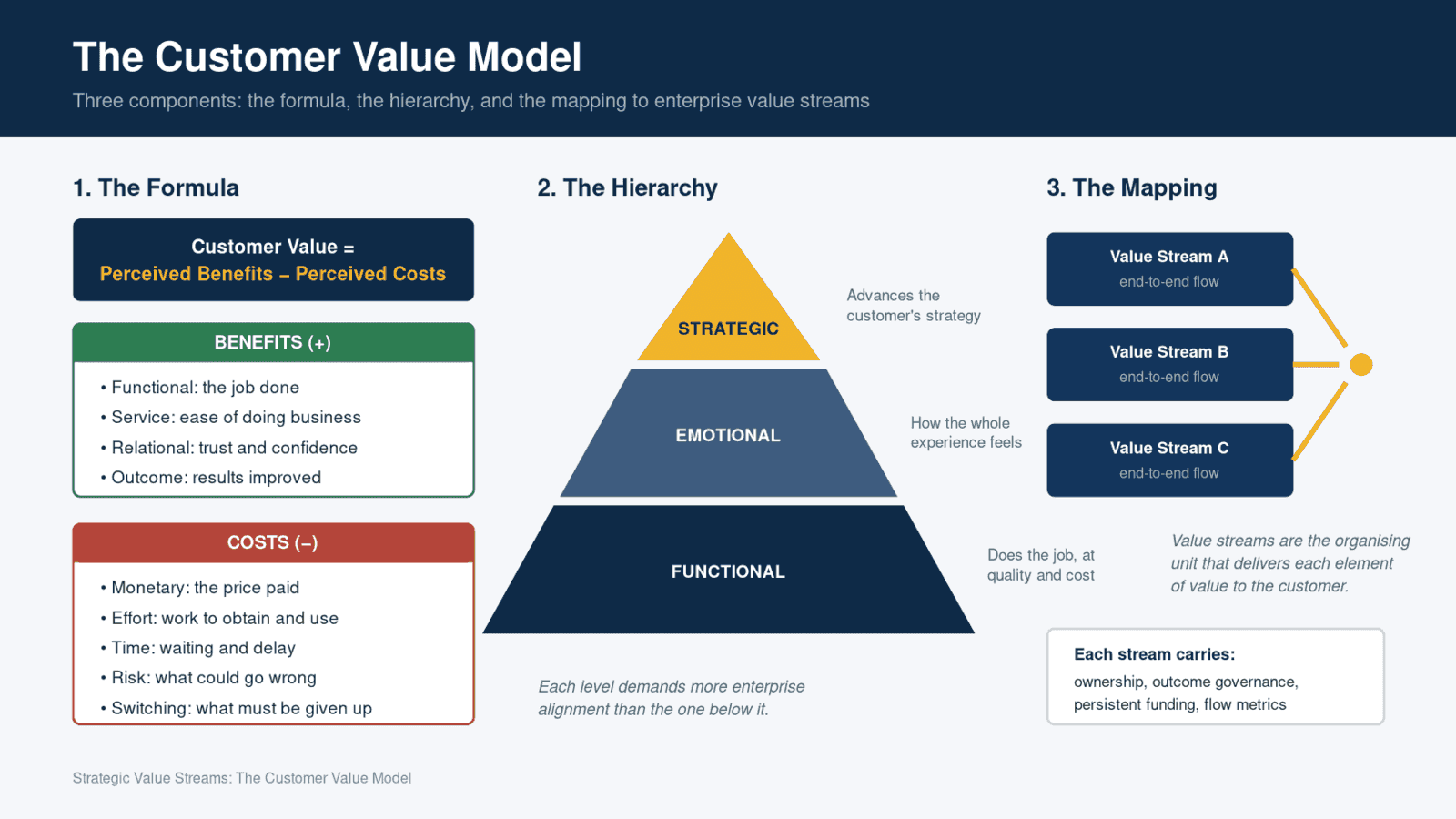
The distinction is not cosmetic. In a value stream operating model, the value stream is a first-class structural element of the enterprise: it has an owner, a governance rhythm, a funding allocation, a set of flow measures, and defined ways of working. Functions still exist, and functional excellence still matters, but functions serve the streams rather than governing the work. Alignment between strategy and delivery stops being an annual reconciliation exercise and becomes a structural property of the organisation.
Defining Value Streams in an Enterprise Context
The term “value stream” originates in Lean. James Womack and Daniel Jones coined it in Lean Thinking (1996) to describe all the activities required to take a product from concept to launch and from order to delivery, and Mike Rother and John Shook’s Learning to See (1998) codified value stream mapping as an improvement technique. More recently, agile scaling frameworks have used value streams primarily as a lens for organising software delivery teams.
At the enterprise level, the concept is broader than either usage. An enterprise value stream is a persistent organisational structure encompassing everything required to deliver a defined stream of value to a customer or stakeholder: the people, platforms, processes, budgets, and decisions involved, across every function the work touches. It is not a mapping workshop output, and it is not a team-of-teams label. It is a unit of organisational design, sitting at the same level of importance as the business unit or the function, and in a mature value stream operating model it is the primary unit through which strategy is executed.
The Six Pillars of a Value Stream Operating Model: Ownership, Governance, Funding, Flow, Measurement, and Ways of Working
A complete value stream operating model rests on six pillars, and it is the combination that makes the model coherent rather than any pillar alone.
Ownership establishes a single accountable owner for each value stream, responsible for its end-to-end outcomes rather than any one function’s contribution to it. This closes the accountability gap that functional structures create, where everyone owns a segment and no one owns the result.
Governance defines decision rights and rhythms at the value stream level. Prioritisation, trade-off, and investment decisions are made within the stream, inside clear enterprise guardrails, rather than escalated through functional hierarchies. Governance provides boundaries that enable autonomy instead of committees that consume it.
Funding allocates investment to value streams as long-lived capacities, reviewed at a regular cadence against outcomes, rather than to temporary projects approved through business cases. Money follows value, and reallocation happens by adjusting stream funding rather than by standing up and tearing down initiatives.
Flow treats the movement of work through the stream as the primary object of management attention. Queues, handoffs, dependencies, and delays are made visible and systematically reduced, because the speed and smoothness of flow determine how quickly strategy becomes outcome.
Measurement replaces activity and output metrics with flow and outcome measures: how fast value moves through the stream, how much is delivered, where it stalls, and what customer and business outcomes it produces. Measurement makes the stream’s performance an empirical question rather than a reporting exercise.
Ways of Working defines how teams within the stream collaborate: the practices, cadences, and engineering and operational disciplines that make sustained flow possible. This pillar keeps the model honest, because structure without working practices decays into diagram-ware.
How a Value Stream Operating Model Links Strategy to Delivery
The value stream operating model creates a traceable, structural chain from strategic intent to customer outcome. Strategy defines which value streams matter most and what outcomes each must produce. Funding follows those priorities, allocating capacity to streams in proportion to strategic importance. Each stream’s owner translates outcome targets into a prioritised flow of work. Teams within the stream deliver that work, and flow metrics and outcome measures report progress back up the same chain.
Every link in that chain is inspectable. Leadership can ask, for any strategic priority, which stream carries it, what has been funded, what is flowing, and what outcomes have moved. Teams can ask, for any item of work, which strategic intent it serves. This is the alignment that the traditional TOM promises at design time but cannot maintain at run time, achieved not through documentation but through structure.
Target Operating Model McKinsey vs Value Stream Approach: Head-to-Head Comparison
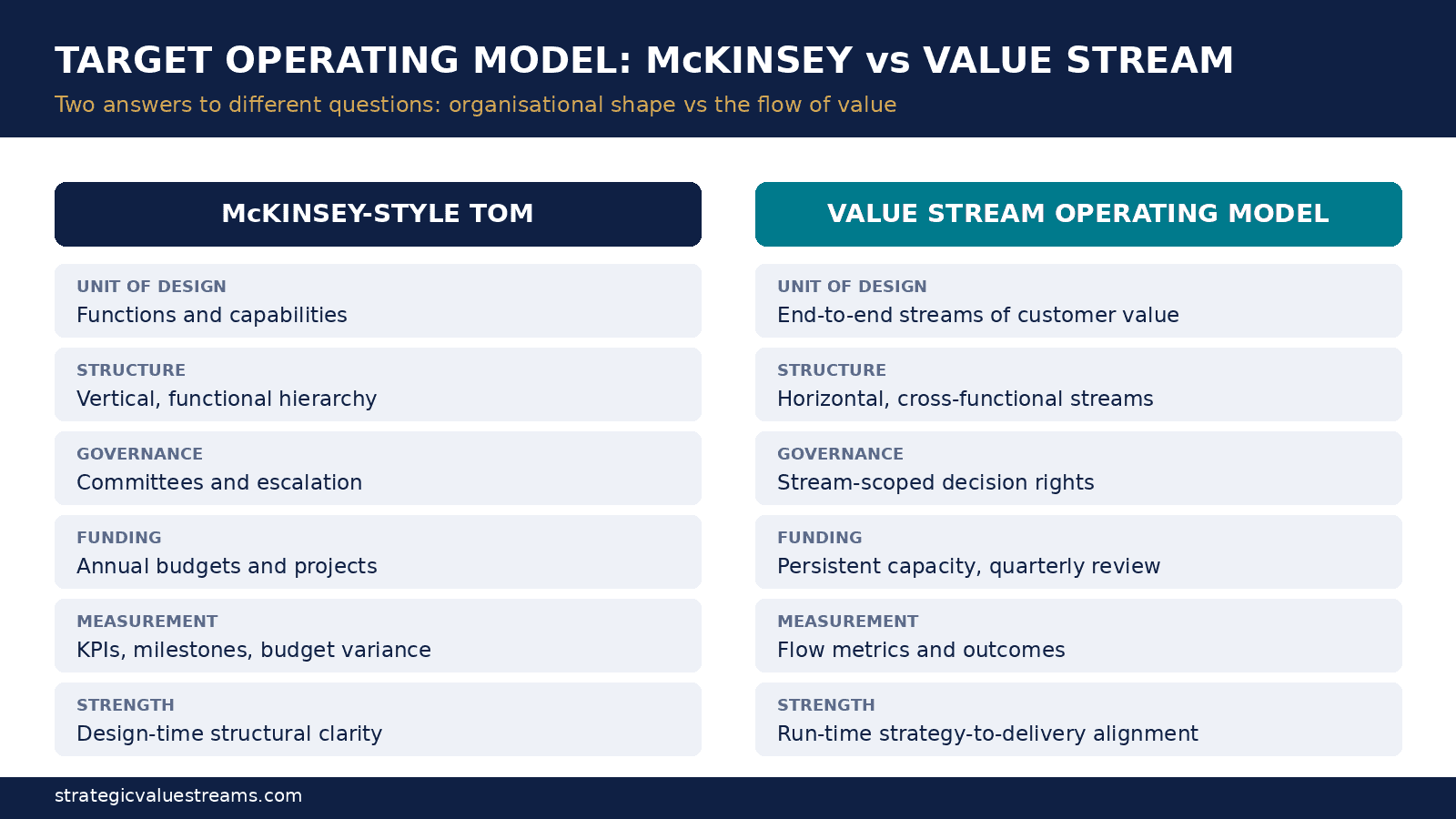
The two approaches are best understood side by side. They differ not merely in emphasis but in what they treat as the fundamental unit of organisational design: the capability and function on one side, the end-to-end stream of customer value on the other. The table below summarises the target operating model McKinsey vs value stream comparison at a glance, and the sections that follow work through each dimension in detail. As you read, keep one framing in mind: the McKinsey tradition answers “what shape should the organisation be?”, while the value stream model answers “how does value run through it?”
Dimension | Target operating model McKinsey approach | Value stream operating model |
Unit of design | Functions and capabilities | End-to-end streams of customer value |
Structure | Vertical, functional or hybrid hierarchy | Horizontal, cross-functional value streams |
Governance | Committees, escalation through hierarchy | Decision rights scoped to each stream |
Funding | Annual budgets, cost centres, projects | Persistent stream capacity, reviewed quarterly |
Measurement | Functional KPIs, milestones, budget variance | Flow metrics and customer outcomes |
Alignment | Created at design time, decays at run time | Maintained structurally at run time |
Scalability | Structural replication is easy, coherence suffers | Delivery coherence scales, demands maturity |
Credentialing | No formal industry certification | Foundation, Practitioner, and Fellow levels |
Organisational Design and Structure
A McKinsey-style TOM typically produces a functional or hybrid structure: business units and functions arranged for capability depth, accountability, and scale, with clear vertical reporting lines. The design is elegant when viewed top-down. Viewed along the path a customer need actually travels, it is a series of boundaries to cross.
A value stream operating model inverts the geometry. The primary structures are horizontal, cross-functional streams organised around customer value, each containing or drawing on the functional skills it needs. Functions become homes for craft and standards rather than the axis along which work is organised. The trade-off is real: the value stream model accepts some duplication of skills across streams in exchange for eliminating handoffs, and it demands more deliberate management of functional excellence.
Governance and Decision-Making
TOM governance is built from forums and escalation: decisions flow up functional hierarchies to committees whose members represent departmental interests. Decision rights are defined, but they are defined around the structure, so any decision spanning functions requires escalation to the level where the functions meet, often the executive committee. This is thorough and slow.
Value stream governance scopes decision rights to the stream. The stream owner and the teams within it hold the authority to prioritise, trade off, and adapt within enterprise guardrails covering risk, compliance, architecture, and investment limits. Escalation is reserved for genuine boundary conflicts. Accountability sharpens, because one owner answers for outcomes, and decision speed improves, because the decision sits where the context is.
Funding Models and Financial Alignment
The funding model is arguably the sharpest point of difference. TOM implementations almost always inherit annual, cost-centre and project-based funding: functions receive budgets, change is funded through project business cases, and finance tracks cost against plan. Investment is aligned to organisational units, not to customer value, and the annual cycle makes in-year reallocation painful.
A value stream operating model funds streams as persistent capacities, with allocations reviewed at a regular cadence, typically quarterly, against delivered outcomes. Business cases give way to capacity allocation; project accounting gives way to stream-level investment tracking. Financial alignment to strategy stops being an inference and becomes an observable fact: the funding profile across streams is the strategy, expressed in money.
Flow Metrics and Performance Measurement
Traditional TOM measurement leans on functional KPIs, milestone tracking, and budget variance: measures of activity, output, and conformance to plan. These tell leadership whether departments are busy and programmes are on schedule. They say little about whether value is reaching customers faster or whether strategic outcomes are moving.
A value stream operating model measures the flow of value itself: how long items take to move through the stream, how much is delivered over time, how much work is in progress, where it queues, and how flow divides across new value, risk, debt, and defect work. These flow measures are paired with outcome measures for each stream, so the conversation shifts from “did we deliver the project on time?” to “is value flowing faster, and is it producing the outcomes we funded?”
Scalability Across the Whole Enterprise
The McKinsey tradition scales structurally with ease: functional designs replicate cleanly across regions and divisions, which is one reason global enterprises favour them. What scales poorly is coherence of delivery, because every added unit multiplies the boundaries work must cross, and the cultural cost of silo behaviour compounds with size.
The value stream model faces the opposite challenge. It scales delivery coherence naturally, since each stream is a self-aligned unit, but it demands more of the enterprise as it grows: streams must be well defined and periodically redrawn as strategy shifts, shared platforms must serve many streams without becoming bottlenecks, and leaders raised in functional hierarchies must learn to lead through outcomes rather than control. Structural scalability is easier for the TOM; cultural and delivery scalability favour the value stream model. Enterprises that combine deliberate stream design with strong platform thinking have scaled the model across tens of thousands of people.
Certification, Professional Development, and Credentialing
Here the difference is stark. Despite decades of TOM practice, there is no formal, industry-recognised credential for target operating model design. What exists is a patchwork of vendor courses, consulting firm methodologies, and video tutorials. TOM expertise is acquired through consulting apprenticeship and remains largely tacit, locked inside firms.
Value stream operating models, by contrast, have a defined professional discipline with a formal credentialing pathway. The Strategic Value Streams body of knowledge and certification framework provides structured levels from Foundation through Practitioner toward Fellow, giving individuals verifiable evidence of capability and giving enterprises a way to build this expertise internally rather than renting it from consultancies. For transformation leaders planning multi-year change, the availability of formal credentials is a practical consideration, not a footnote: it determines whether the capability can be institutionalised.
When to Use the McKinsey Target Operating Model Framework
The target operating model McKinsey approach is the right instrument when the problem is fundamentally one of structural design. Post-merger integration, where two organisations must become one coherent design under time pressure. Major cost restructuring, where spans, layers, and duplicated capabilities must be analysed and rationalised. Regulatory change that mandates specific structural separations or controls. New market entry or the design of a new division from a blank sheet. Functional redesigns, such as modernising a finance, HR, or technology function.
It also suits organisations at an earlier maturity level: enterprises that have never had a deliberate operating model design at all gain enormous value from a first structured blueprint. And it fits transformation goals that are episodic by nature, where the objective is to reach a defined future state rather than to build a continuously adapting delivery system. In all these cases, the TOM’s top-down rigour, dimensional completeness, and executive-level clarity are exactly what is needed.
When a Value Stream Operating Model Is the Better Choice
A value stream operating model is the better choice when the problem is the flow of value rather than the shape of the structure. The signals are recognisable. Strategy and delivery have drifted apart: leadership sets priorities, yet quarters pass and delivery does not visibly move them. Customer experience is fragmented across departmental boundaries, and no one owns any journey end to end. Agile teams perform well locally while the enterprise remains slow, because the impediments live between teams, in queues, dependencies, and funding cycles. Annual project funding keeps disbanding teams just as they become effective. Transformation programmes keep “completing” without the operating reality changing.
Organisations undertaking customer-centric redesign, scaling agility beyond the team level, shifting from project to product, or seeking durable strategy-to-delivery alignment will find the value stream model addresses these conditions directly, because it was designed for precisely them.
Can You Combine Both Approaches?
The two approaches are not mutually exclusive, and treating the choice as binary is a mistake. They answer different questions at different altitudes. The McKinsey tradition provides the enterprise’s strategic architecture: what businesses it is in, what capabilities it needs, how the whole is structured and governed at the top. The value stream model provides the delivery architecture: how value actually runs from strategic intent to customer outcome, continuously, through owned, governed, funded, measured streams.
An enterprise that adopts only the first gets a well-designed organisation that struggles to deliver. An enterprise that adopts only the second risks building excellent flow inside an incoherent overall structure. Combined deliberately, each supplies what the other lacks.
How McKinsey’s TOM Can Serve as a Foundation for Value Stream Design
A target operating model McKinsey engagement produces artefacts that value stream design needs as inputs. The strategy and value agenda define what value the enterprise must deliver, which is the raw material for identifying value streams. The capability map shows what the streams will draw on. The technology architecture reveals the platforms streams will share. The governance design defines the enterprise guardrails within which stream-level autonomy will operate.
The practical approach is to treat the TOM as the design of the enterprise’s fixed structure, the chassis, and the value stream operating model as the design of its drivetrain. Value streams are identified from the TOM’s value agenda, laid horizontally across its structure, and then given the six pillars: an owner, governance rights, funding, flow management, measurement, and ways of working. The TOM’s functional structures persist as capability homes, while day-to-day delivery runs through the streams.
Practical Steps to Transition from a McKinsey-Style TOM to a Value Stream Model
Moving from a target operating model McKinsey blueprint to a value stream model is best done incrementally, not as another big-bang transformation. A workable sequence looks like this.
First, identify and map the enterprise’s value streams: the handful of end-to-end paths through which customers and stakeholders actually receive value. Validate them against strategy, not against the current organisation chart. Second, select one or two streams where pain is high and sponsorship is strong, and pilot the full model there: appoint an accountable owner, define stream-scoped decision rights, and fund the stream as a capacity for at least two quarters. Third, instrument flow before changing anything else, because baseline flow measures both guide the redesign and evidence its results. Fourth, align the operating rhythm, connecting quarterly funding reviews and priority setting to stream outcomes. Fifth, expand stream by stream, using results from the pilots, while functions evolve into centres of capability that serve the streams. Throughout, keep enterprise guardrails explicit, since autonomy without boundaries fragments the enterprise as surely as hierarchy without autonomy slows it.
Two failure modes deserve warning. Renaming existing departments as “value streams” changes nothing and discredits the model. And piloting flow practices while leaving project funding untouched suffocates the pilot, because the funding model is where the old operating model defends itself most effectively.
How to Get Formally Certified in Value Stream Operating Models
Everything described above is a professional discipline: identifying enterprise value streams, designing ownership and governance, constructing stream-based funding models, instrumenting flow, and leading the transition. Like any discipline, it can be learned in a structured way and formally credentialed. The Strategic Value Streams body of knowledge and certification framework exists for exactly this purpose, and for transformation professionals it offers something the TOM world has never had: a formal, verifiable qualification in operating model design centred on value delivery.
The Value Stream Body of Knowledge (BoK): What It Covers
The Strategic Value Streams Body of Knowledge is the reference foundation for the discipline. It defines value streams as organisational structures through which strategy is delivered, not merely as mapping diagrams or improvement techniques, and it covers the domains a complete value stream operating model requires: strategy and how value streams exist to achieve it, competitive advantage and the concept of organisational viscosity, value stream identification and design, ownership and accountability, governance and decision rights, funding and investment models, flow and measurement, and the enterprise architecture that enables streams to operate and evolve.
The BoK is guided by five foundational principles: strategy defines value streams, everyone is responsible for value, flow reveals the system, governance provides guardrails, and architecture enables maintained competitive advantage. Together they give practitioners and organisations a shared reference point that remains constant even as implementations differ.
Foundation and Practitioner Certification Pathways
The certification framework progresses through defined levels of professional capability. The Foundation certification establishes conceptual understanding: it confirms that the holder understands value streams as organisational structures through which strategy becomes operational reality and can interpret organisations through that lens. The Practitioner certification assesses application: candidates demonstrate that they can analyse real organisational situations, identify structural constraints, and make informed design decisions that improve alignment between strategy and delivery. Beyond these, the Fellow assessment recognises advanced capability and contribution to the discipline itself.
Candidates can prepare through independent study of the Body of Knowledge or through structured learning with Accredited Training Partners and Accredited Training Organisations. Both routes lead to the same certifications and the same standard.
Why Formal Certification Matters for Enterprise Transformation Leaders
For transformation leaders, certification carries three kinds of value. The first is credibility. Operating model redesign is contested territory, and leaders who can ground their recommendations in a formal body of knowledge, backed by a verifiable credential, carry more weight with executives and clients than those relying on borrowed consulting slideware. The second is career differentiation. TOM expertise has no formal credential; value stream operating model expertise does. In a market where transformation roles increasingly demand evidence of structured capability, that asymmetry favours the certified. The third is organisational impact. Enterprises that certify their own people build the capability to design, run, and evolve their operating model internally, rather than depending on external firms for every redesign.
Conclusion: Blueprint Plus Operating System
The McKinsey tradition gave the industry its blueprint for organisational design, and it remains valuable for exactly that. The value stream operating model supplies what the blueprint was never designed to provide: a living system that runs strategy through to customer outcomes every day. Leaders who understand both, and who hold formal credentials in the discipline that connects them, are the ones best placed to make enterprise transformation actually deliver. The Strategic Value Streams body of knowledge and certification framework is where that expertise is built.
FAQs
What is the target operating model McKinsey framework?
There is no single, officially branded target operating model McKinsey framework. The phrase refers to a body of McKinsey thinking on operating model design, drawn from the 7-S Framework, the 2017 next-generation operating model, and the Organize to Value system, that the market treats as the default TOM reference. In practice it means designing an organisation as an aligned system of structure, processes, people, technology, and governance.
Is there an official McKinsey TOM template?
No. Templates circulating under that name are consultant reconstructions assembled from McKinsey’s published frameworks and engagement practice. A typical target operating model McKinsey template layers a one-page blueprint over dimension-by-dimension designs and a transformation roadmap.
What is the difference between a target operating model and a value stream operating model?
A target operating model defines the shape an organisation should take at a point in time: its structures, processes, and governance. A value stream operating model defines how value runs through the organisation continuously, with each end-to-end stream given an owner, governance rights, funding, flow measures, and ways of working. The first is a design-time blueprint; the second is a run-time operating system.
Does the McKinsey approach include a funding model for value delivery?
Not at the level where value is delivered. A target operating model McKinsey design typically inherits annual, cost-centre and project-based funding. Value stream operating models replace this with persistent funding allocated to streams and reviewed against outcomes at a regular cadence.
Is there a formal certification for target operating models or value streams?
No industry-recognised TOM credential exists; only vendor training courses and consulting methodologies. Value stream operating models, by contrast, have a formal pathway through the Strategic Value Streams body of knowledge and certification framework: candidates study the Body of Knowledge independently or with an Accredited Training Partner or Accredited Training Organisation, then progress through the Foundation and Practitioner certifications, with the Fellow assessment recognising advanced capability and contribution to the discipline.