
Table of Contents
Introduction
Every month, thousands of people search for "the Spotify model." Most of them are looking for the same thing, an agile operating model they can install. Squads here, tribes there, add chapters and guilds, and agility follows.
What they find, if they trace it back to the source, is not a blueprint. It is a photograph. A snapshot of one company, at one moment, taken in October 2012. The people who took the photograph have spent more than a decade asking everyone to stop treating it as a set of instructions.
This post lays out what the Spotify paper actually was, why copying it has failed so consistently, and, more usefully, what in it deserves to be carried forward. Because underneath the borrowed vocabulary sit some durable insights, and modern value stream practice, including Strategic Value Streams, builds directly on them.
What the paper actually was
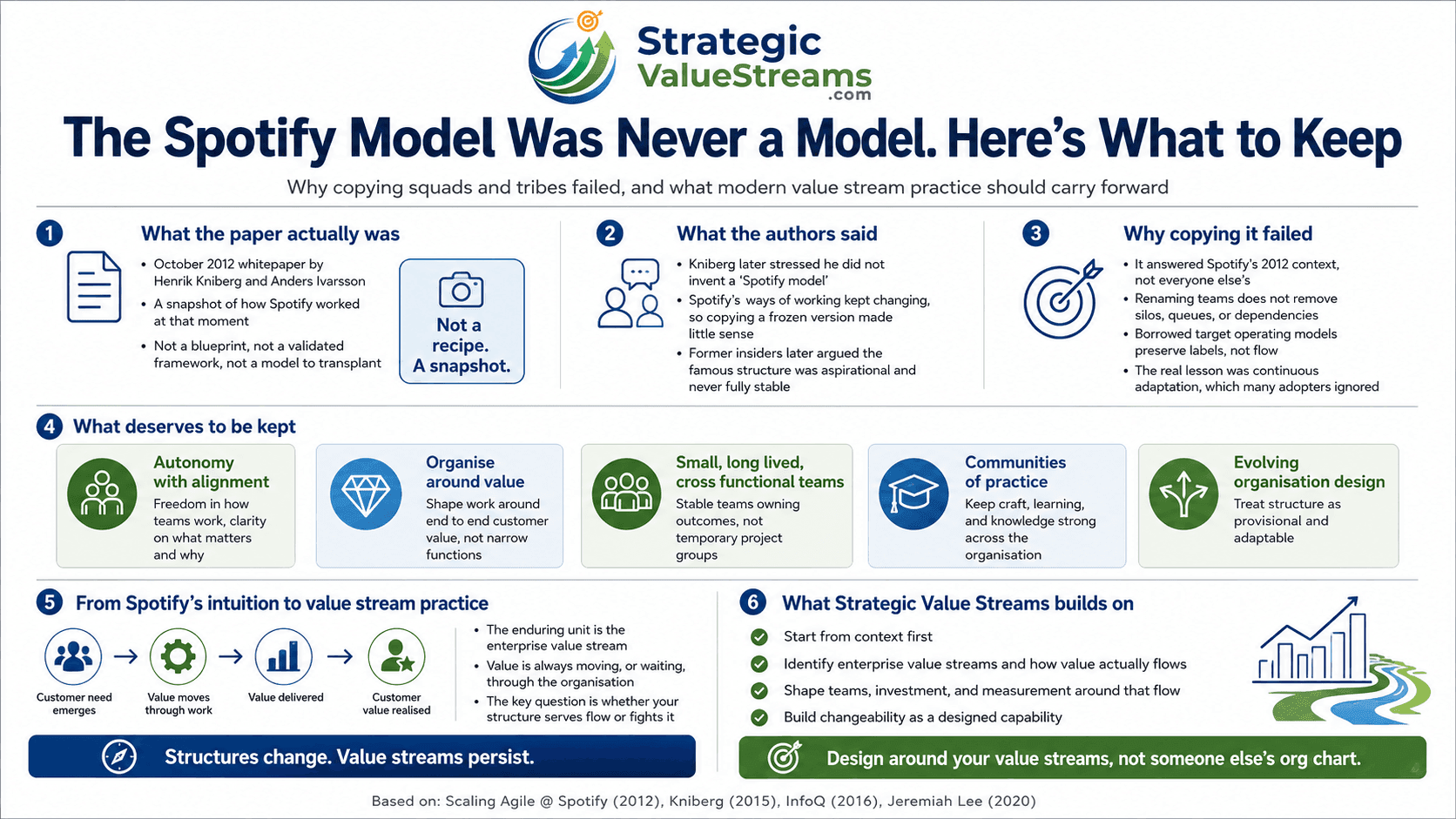
In October 2012, Henrik Kniberg and Anders Ivarsson published a short whitepaper called Scaling Agile @ Spotify. It described how Spotify, then roughly six years old, with around 30 teams building a single product, had organised itself. Squads as small autonomous teams. Tribes as collections of squads. Chapters connecting people with the same skills. Guilds as voluntary communities of interest.
The paper carried a disclaimer that almost everyone skipped. "This is not a recipe. It is a snapshot of what we are doing right now." The authors called it "a journey in progress, not a journey completed."
It was a retrospective account. A description of what one young, fast-growing, single-product music streaming company in Stockholm happened to be doing at that moment. It was never designed as a model, never validated as a framework, and never intended for transplant.
What the authors said
The strongest critics of "the Spotify model" have always been the people closest to it.
In 2015, Kniberg wrote a post titled No, I didn't invent the Spotify model. He was an embedded coach documenting practices that had emerged from many people. Even the supposed author disclaims authorship, because there was never a model to author. By 2016 he was telling audiences directly not to copy it. Spotify's way of working changed constantly, he explained, so any copy would be a copy of something that no longer existed. Feel free to be inspired by any company, he said, but adapt it to your own context.
Then in 2020, former Spotify employee Jeremiah Lee published Spotify's Failed #SquadGoals. Drawing on his own experience and that of other insiders, he reported that the famous structure was largely aspirational, was never fully implemented, and buckled as the company tripled in size. The uncomfortable punchline has been repeated ever since. Spotify doesn't use the Spotify model, and it arguably never did.
The Spotify model timeline
| Date | Event | Why it matters |
|---|---|---|
| October 2012 | Kniberg and Ivarsson publish Scaling Agile @ Spotify | A snapshot of ~30 teams at one young company, labelled "not a recipe" |
| 2014 | Spotify Engineering Culture videos go viral | The snapshot becomes a brand and spreads far beyond its context |
| June 2015 | Kniberg publishes "No, I didn't invent the Spotify model" | The documenter disclaims authorship of any model |
| 2016 | Kniberg tells audiences not to copy it | Spotify's way of working had already changed, any copy was outdated |
| 2020 | Jeremiah Lee publishes Spotify's Failed #SquadGoals | Insiders reveal the structure was aspirational and didn't survive growth |
Why copying it failed everywhere
Squads, tribes, chapters, and guilds were answers to Spotify's 2012 questions. A young company. One product. Explosive growth. An engineering-led culture that predated the structure. Remove any of those conditions and the answers stop fitting.
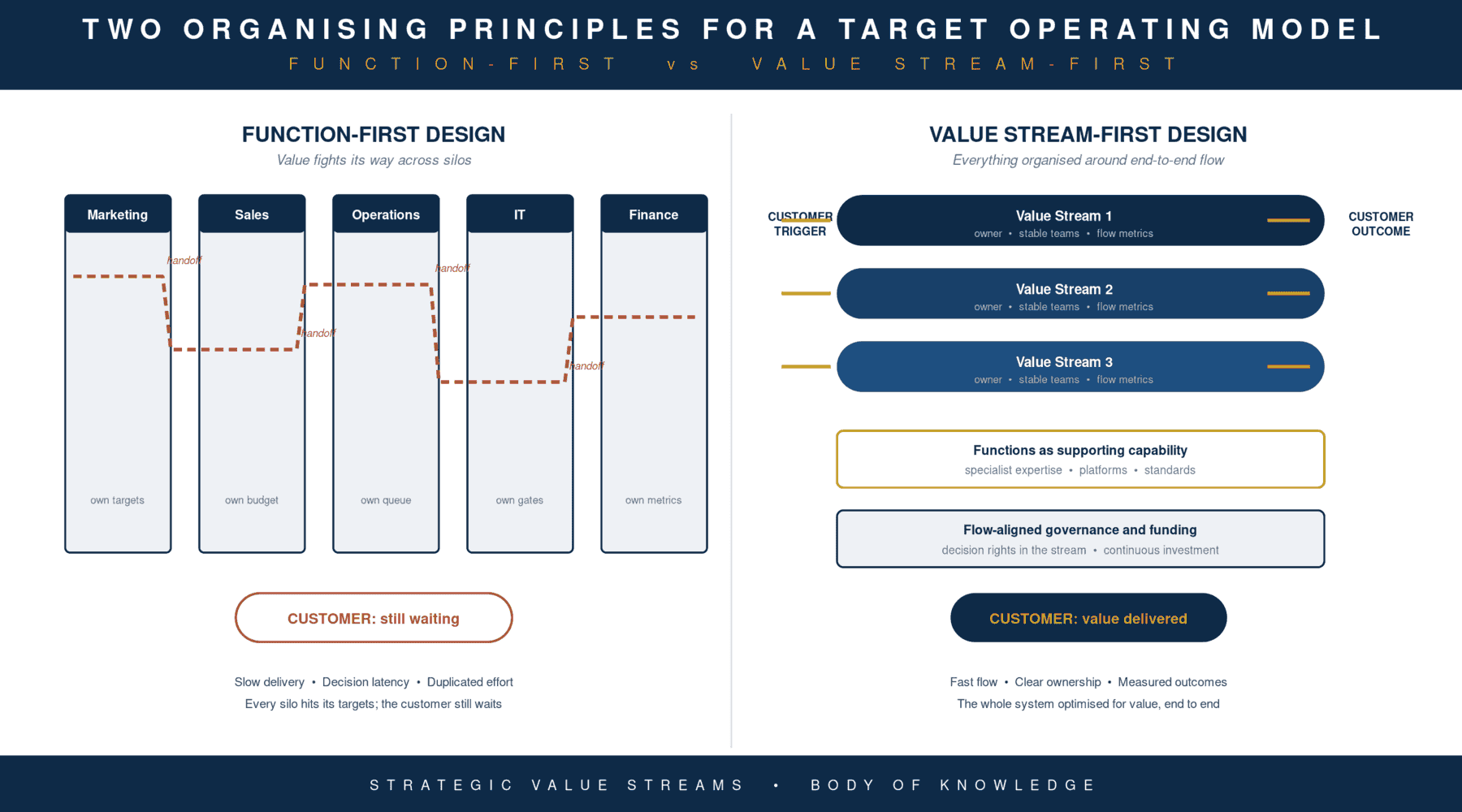
Yet for a decade the Spotify model was written into agile transformation roadmaps and target operating model slides as if it were a destination. Organisations that adopted the vocabulary discovered the problem quickly. Renaming teams changes what things are called, not how value moves through the organisation. The functional silos remain, the dependencies remain, the queues remain. Meanwhile the structure itself is frozen at the moment of adoption, which is precisely the thing Spotify never did. Their defining habit was continuous change. Copying a snapshot of a company that refuses to stand still is a contradiction in terms.
This is the general failure mode of every installed framework, agile or otherwise. A target operating model copied from another company is the residue of someone else's thinking. What you need is the thinking.
What deserves to be carried forward
Here is where the story turns, because dismissing the Spotify paper entirely would throw away real insight. Strip off the vocabulary and several principles underneath it have aged very well.
Autonomy with alignment. Teams free to decide how they work, tightly aligned on what matters and why. The paper's best diagram was never the org chart, it was the quadrant showing high autonomy paired with high alignment.
Organising around value, not functions. Squads were built to own something a customer cares about from end to end, so that value never sits waiting on a functional silo. That instinct, to shape the organisation around the movement of value toward the customer, was ahead of its time.
Small, long-lived, cross-functional teams. Stable teams that own outcomes, rather than temporary project groups assembled and disbanded around funding cycles.
Communities of practice. Guilds and chapters answered a real question, how to keep craft and knowledge strong across an organisation once functions no longer dominate. That question doesn't go away, and their answer remains a good one.
The organisation as something that evolves. The snapshot framing was not a caveat, it was the point. Spotify treated its own structure as permanently provisional. This is the principle almost every adopter ignored, and it is the most important one.
From Spotify's intuition to value stream practice
Spotify intuited something that value streams later made explicit. The unit that matters in an operating model is not the team structure. It is the enterprise value stream, the continuous movement of value from a customer trigger through to value in the customer's hands.
Flow is not something Spotify invented and not something any framework grants you. Flow physically occurs in every organisation, right now, whether anyone attends to it or not. Value is moving, or waiting, through your organisation today. The real question is whether your structure serves that flow or fights it. Spotify's squads were one company's attempt, in one context, to serve it. Your context will demand a different answer, and the only reliable way to find that answer is to start from your own streams of value rather than someone else's org chart.
This also reframes the timeline problem. A structure adopted in 2012 stopped fitting Spotify by 2015 because the company changed. Structures always stop fitting. Value streams persist. Customers still trigger them, value still flows through them, however the boxes above are redrawn. That makes the value stream, not the structure, the stable foundation to design around.
What Strategic Value Streams builds on
Strategic Value Streams is a body of knowledge and certification framework, and it begins exactly where the Spotify paper pointed and where the copying failed. Context first.
Where the Spotify paper gave one company's answer, Strategic Value Streams gives you the means to derive your own. It equips practitioners to identify their organisation's enterprise value streams, to see how value actually flows through them today, and then to shape teams, investment, and measurement around that flow. The structure becomes an output of understanding your value streams, never an input copied from elsewhere.
It treats value streams as the substrate through which strategy is delivered. Strategies shift, markets shift, structures get redrawn, and the value streams carry the organisation's intent through all of it. This is the direct answer to the problem that sank every Spotify copy, the moment the context changed, the borrowed structure stopped fitting.
And it makes changeability a designed property rather than a cultural accident. Spotify's real advantage was never squads and tribes. It was the capacity to keep evolving how it worked. Strategic Value Streams builds that capacity in deliberately, so the organisation adapts continuously around its streams of value instead of lurching between imported operating models.
From the Spotify snapshot to Strategic Value Streams
| Spotify's 2012 answer | The durable principle | The Strategic Value Streams practice |
|---|---|---|
| Squads | Small, stable, cross-functional teams owning outcomes | Teams shaped around how value flows through your enterprise value streams |
| Tribes | Related work grouped for alignment | Alignment drawn from the value stream, not from a copied grouping |
| Chapters and guilds | Communities of practice keeping craft strong | Capability development sustained across the organisation while value streams remain the organising unit |
| Autonomy with alignment | Freedom in how, clarity on what and why | Strategy delivered through value streams as its substrate, teams adapt within that intent |
| "A journey in progress" | The organisation continuously evolves | Changeability designed in, structure treated as an output of understanding your streams |
Delivering value through a stream has no finish line. It is ongoing, adapting as customer needs change. A target operating model built on value streams doesn't expire the way a copied snapshot does, because the target is the capacity to adapt, not a fixed structure.
Which value stream certification fits your role?
If you searched for "the Spotify model"
You were asking the right question. How should we organise so that value flows to customers and the organisation can keep adapting? The 2012 snapshot can inspire you. Its authors have been clear for over a decade that it cannot answer for you.
Strategic Value Streams exists to help you build your own answer, grounded in how value actually flows through your organisation. Explore the body of knowledge and certification, and start from your context, not someone else's photograph.
Sources: Scaling Agile @ Spotify, Kniberg & Ivarsson, 2012 · No, I didn't invent the Spotify model, Kniberg, 2015 · Don't Copy the Spotify Model, InfoQ, 2016 · Spotify's Failed #SquadGoals, Jeremiah Lee, 2020
FAQs
What is the Spotify model?
The Spotify model is the name given to a 2012 whitepaper, Scaling Agile @ Spotify, which described how Spotify organised its engineering teams into squads, tribes, chapters, and guilds at that time. It was written as a snapshot of one company's way of working, not as a model or framework, and its authors explicitly said it was not a recipe to follow.
Who created the Spotify model?
Agile coaches Henrik Kniberg and Anders Ivarsson documented it in October 2012. Kniberg later published a post titled "No, I didn't invent the Spotify model," explaining that the practices emerged from many people at Spotify and were never designed as a transferable model.
Does Spotify still use the Spotify model?
No. Former employees have reported that the structure was largely aspirational, was never fully implemented, and was left behind as the company grew. Spotify's defining habit was continuous change, so the 2012 snapshot stopped describing the company within a few years.
Why does copying the Spotify model fail?
Squads, tribes, chapters, and guilds were answers to the questions facing one young, single-product company in 2012. Adopting the vocabulary changes what teams are called, not how value moves through the organisation, and it freezes a structure that Spotify itself treated as permanently provisional. Structures copied from another context stop fitting the moment your context changes.
What should organisations do instead of copying the Spotify model?
Keep the principles, autonomy with alignment, teams organised around the flow of value, and the capacity to keep evolving, then derive a structure from your own context. Strategic Value Streams is a body of knowledge and certification framework that equips practitioners to identify their enterprise value streams, understand how value flows through them, and shape teams, investment, and measurement around that flow.