
Table of Contents
- What Is Organisational Change? Definition and Context
- The Core Elements of Any Organisational Change Definition
- Forces of Change in Organisational Change
- Why No Single Definition Has Won Out
- The Four Change Models Compared
- Comparing the Four Models: Strengths, Weaknesses, and Best Fit
- Scope: Team-Level vs. Enterprise-Wide Change
- Governance, Funding, and Flow: What Most Models Miss
- Change as the Exception, Not the Routine
- How to Choose the Right Organisational Change Framework
- Prove Your Expertise: Value Stream Certification for Change Leaders
- FAQs
What Is Organisational Change? Definition and Context
Organisational change is any deliberate shift in how an enterprise is structured, how it operates, or how it delivers value. That single sentence is a workable organisational change definition, and in plain terms it describes the work of moving an organisation from how it functions today to how it needs to function tomorrow. That shift can be small, such as adjusting a single team's process, or sweeping, such as reorganising an entire enterprise around its customers.
The relevance of organisational change has never been higher. Enterprises face compressed product cycles, shifting regulation, new competitors, and customers who expect continuous improvement rather than periodic upgrades. Change is no longer an occasional project with a start and an end. It is a permanent condition of doing business, and the organisations that thrive treat it as a capability rather than an event.
Yet ask ten leaders to define organisational change and you will get ten different answers. Some describe it as a psychological transition for employees. Others frame it as a structural reorganisation, a leadership challenge, or a systems problem. Each definition carries a different theory of what actually needs to move. Understanding those differences is the first step to choosing an approach that fits your context, which is why this article compares the four most influential change models side by side, and shows where a strategy-to-value operating model fits alongside them.
The Core Elements of Any Organisational Change Definition
Despite their differences, credible attempts at an organisational change definition tend to share the same building blocks. The first is people. No structure changes until the humans inside it think, decide, and behave differently. The second is structure, meaning the reporting lines, teams, and boundaries that determine who does what and who answers to whom.
The third element is process, the repeatable ways work moves from idea to outcome. The fourth, and the one most often overlooked, is strategy alignment. Change that is not connected to a clear strategic intent tends to produce motion without progress. When these four elements move together, people, structure, process, and strategy, change tends to hold. When one is neglected, the effort usually stalls or quietly reverts. The models that follow can largely be understood by which of these elements they emphasise and which they assume will take care of themselves.
Forces of Change in Organisational Change
Any useful organisational change definition has to account for what actually drives change, and those forces are partly outside the organisation and partly within it. External forces include market shifts, new technology, regulatory pressure, economic conditions, and rising customer expectations. A new entrant with a faster delivery model, a change in data privacy law, or a step change in what customers consider acceptable can each force an enterprise to adapt whether it wants to or not.
Internal forces are just as significant. Leadership transitions, mergers, growing operational complexity, talent shortages, and the accumulated cost of legacy systems all push organisations toward change from the inside. In practice the two sets of forces interact. An external threat exposes an internal weakness, and the response requires the organisation to reconfigure how it works. Naming these forces honestly matters, because a change effort built on a misread of what is actually driving it rarely lands.
Why No Single Definition Has Won Out
Competing definitions persist because each was built for a different problem in a different era. Lewin was theorising social behaviour, Kotter was studying large corporate transformations, McKinsey was diagnosing organisational health, and Prosci was focused on individual adoption. Each is genuinely useful within its own frame, so none has fully displaced the others. The result is a field where practitioners talk past each other because any single organisational change definition tends to reflect the problem its author set out to solve.
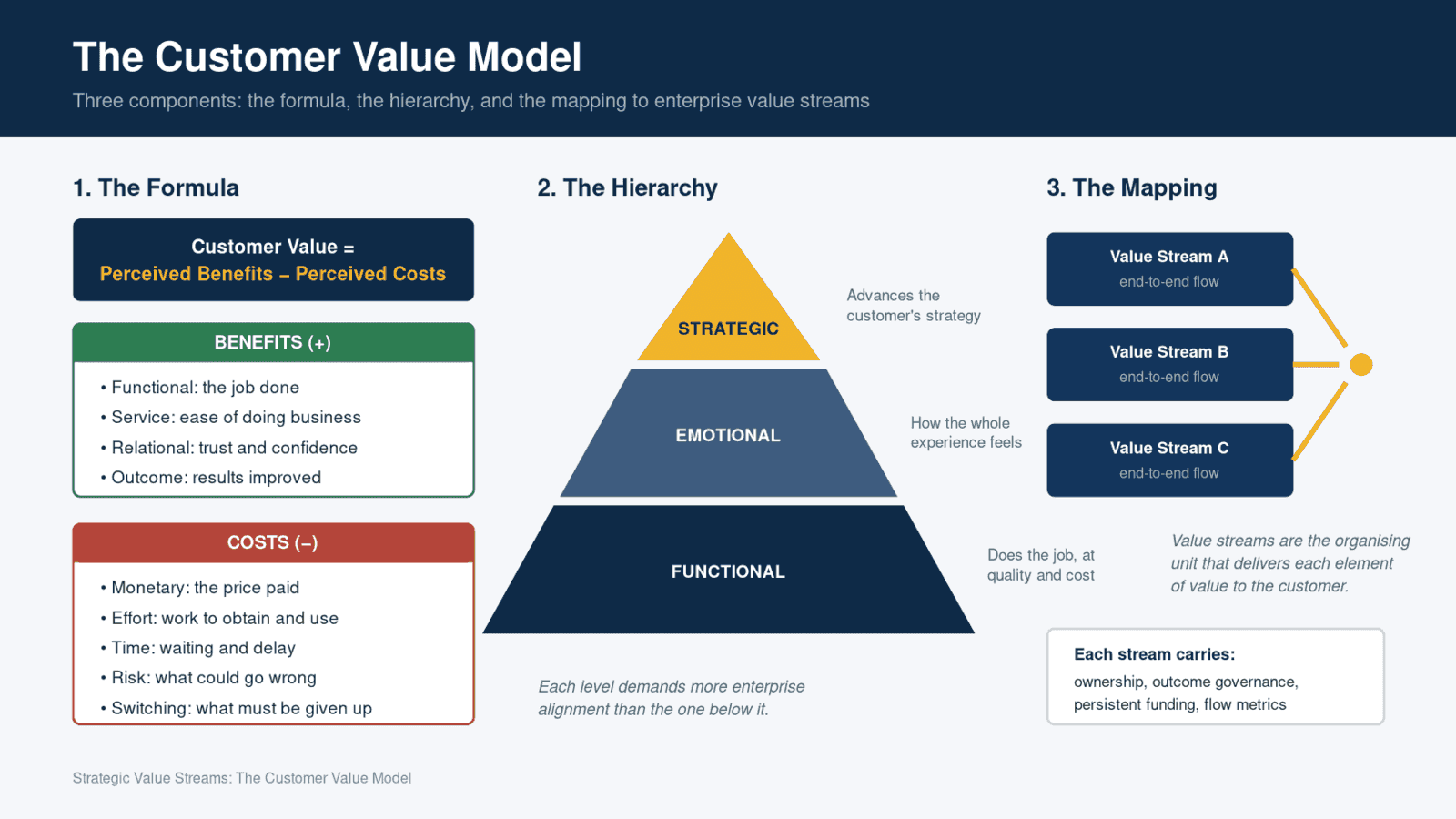
It also helps to separate two different questions. The four models above are all forms of organisational change management, or OCM. They describe how you move an organisation from one state to another. They say nothing about the state you are moving toward. That is a different question, and it is the one Strategic Value Streams answers. A value stream operating model, built around the flow of strategy to value, is not a method of change but a destination for it. Change models are the how; the operating model is the what. For that reason this article references Strategic Value Streams throughout but does not treat it as a fifth change model, and does not place it in the comparison.
The Four Change Models Compared
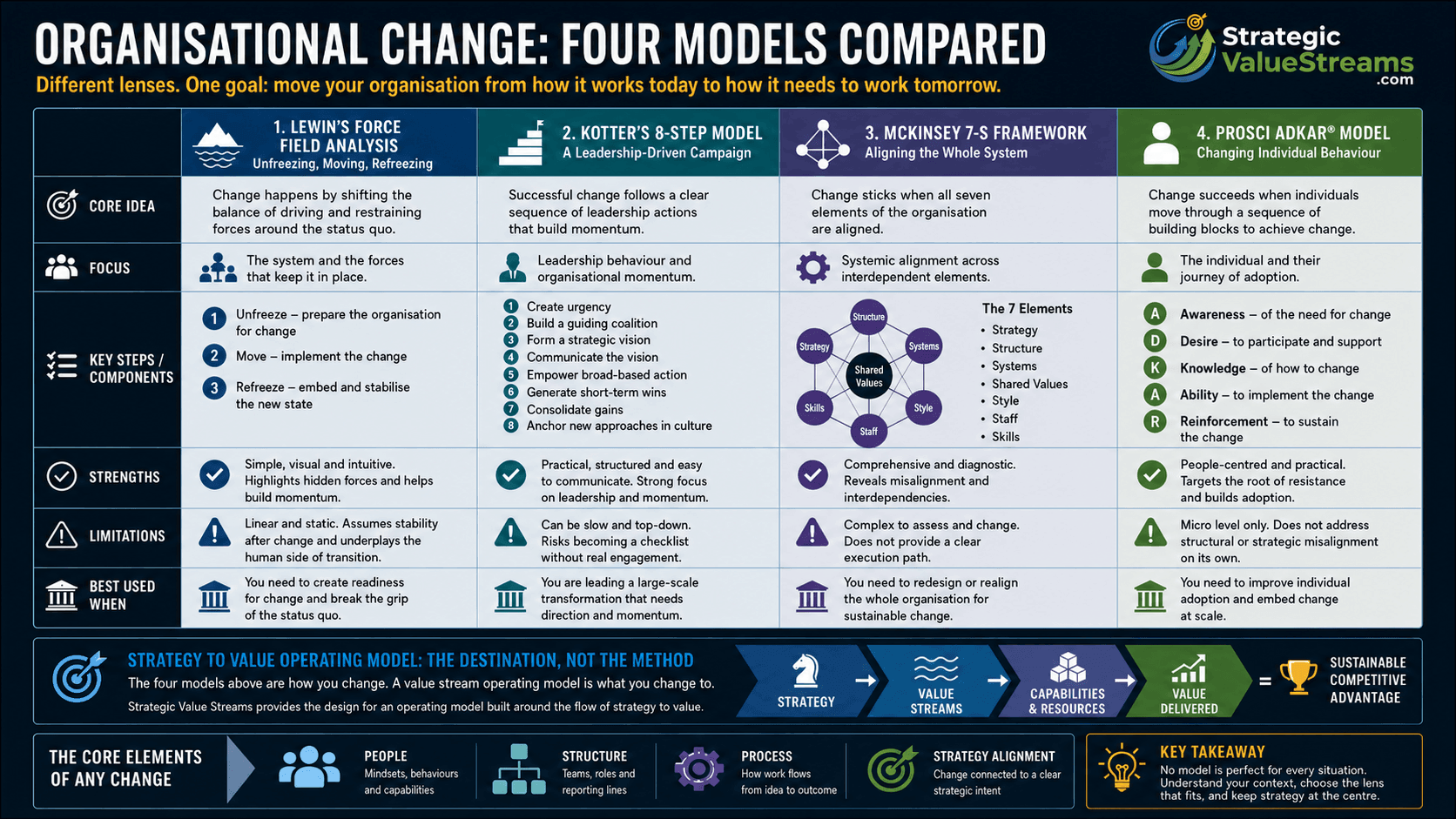
The four models below have shaped how a generation of leaders thinks about organisational change management. Lewin's Force Field Analysis frames change as a contest of opposing forces. Kotter's 8-Step Model treats it as a sequential, leadership-driven campaign. The McKinsey 7-S Framework defines it as systemic alignment across interdependent elements. And Prosci's ADKAR model defines it as a shift in individual behaviour. Each contributes something distinct, and each has a boundary beyond which it strains.
1. Lewin's Force Field Analysis: Unfreezing, Moving, Refreezing
Kurt Lewin described change as a three-stage process. First you unfreeze the current state by challenging the beliefs and habits that hold it in place. Then you move to a new way of working. Finally you refreeze, embedding the new state so it becomes the norm. Underneath sits force field analysis, the idea that any situation is held in equilibrium by driving forces pushing for change and restraining forces holding it back.
Its strength is clarity. It forces leaders to name what is pushing for change and what is resisting it, which surfaces obstacles early. Its limitation for modern enterprises is that it treats change as episodic, something you unfreeze, adjust, and refreeze. In an environment of continuous change, there is rarely a stable state to refreeze into, and the model says little about how to execute at scale.
2. Kotter's 8-Step Model: Change as a Sequential Process
John Kotter framed change as a sequence of eight steps, beginning with establishing a sense of urgency and building a guiding coalition, then developing a vision, communicating it, empowering action, generating short-term wins, consolidating gains, and anchoring the change in the culture. Its defining idea is that transformation is driven by leadership and momentum, and that skipping steps or declaring victory too early is what causes change to fail.
The model excels at large, deliberate transformations where a clear mandate and strong sponsorship exist. It is unmatched for generating urgency and sustaining energy. Where it falls short at enterprise scale is its linear, top-down nature. Continuous change does not proceed in eight tidy steps, and organisations running many parallel changes cannot restart the sequence each time. It also assumes leadership attention that is hard to sustain across a whole enterprise.
3. McKinsey 7-S Framework: Change as Systemic Alignment
The McKinsey 7-S Framework defines change through seven interdependent elements: strategy, structure, systems, shared values, style, staff, and skills. Its core insight is that these elements are connected, so changing one without adjusting the others creates misalignment that pulls the organisation back toward its old state. Change, in this view, is the work of realigning all seven so they reinforce a new direction.
The framework's value is diagnostic. It is excellent for understanding why a change effort is stalling, because it exposes the element that is out of step with the rest. Its limitation is that it describes a state of alignment rather than prescribing a sequence of actions. It tells you what needs to be true but not how to get there, so leaders often pair it with a more action-oriented model to actually drive the change.
4. Prosci / ADKAR: Change as Individual Behaviour Shift
Prosci's ADKAR model defines change as something that happens one person at a time. Its five stages, Awareness, Desire, Knowledge, Ability, and Reinforcement, map the journey an individual must complete to adopt a new way of working. The premise is that organisational change is simply the sum of many individual transitions, so if you help each person move through the stages, the collective change follows.
This people-first focus is ADKAR's great contribution. It makes adoption concrete and measurable, and it stops leaders from mistaking a launched system for a change that has actually taken hold. Its gap appears when the change is structural or strategic. ADKAR manages how people absorb a change, but it does not decide what the change should be, how work should be reorganised, or how funding and governance should shift. For enterprise transformation it is a necessary layer, not a complete answer.
Comparing the Four Models: Strengths, Weaknesses, and Best Fit
Seen together, the four models are less rivals than lenses, each sharp on a different facet of change and each implying its own organisational change definition. The table below summarises where each is strongest, where it strains, and the context it suits best.
Model | Strengths | Weaknesses | Best fit |
Lewin's Force Field | Simple, intuitive, surfaces resistance early | Treats change as episodic; light on execution detail | Framing a single, contained change |
Kotter's 8-Step | Strong on urgency, leadership and momentum | Linear and top-down; slow for continuous change | Large one-off transformations |
McKinsey 7-S | Diagnoses systemic misalignment across the firm | Descriptive, not a sequence of actions | Assessing why change stalls |
Prosci / ADKAR | People-first; makes adoption measurable | Weak on structure, funding and strategy | Driving individual adoption |
The pattern is telling. Each model owns a piece of the puzzle: resistance, leadership, systemic fit, and individual adoption. None of them, though, addresses how work is funded, governed, and flowed toward value, which is where the limits of OCM as a discipline begin to show and where a strategy-to-value perspective becomes relevant.
Scope: Team-Level vs. Enterprise-Wide Change
Scope is the fastest way to sort these models. Lewin and ADKAR shine at the team or individual level, where the unit of change is a specific process or a defined group of people making a defined transition. They are practical, quick to apply, and well suited to a single contained initiative.
Kotter and 7-S reach further, into organisation-wide transformation, but they still tend to treat change as a bounded programme with a beginning and an end. Enterprise-wide change is different in kind, not just in size. It is continuous, it runs many initiatives in parallel, and it must hold strategy and delivery together across the whole organisation over time. At that scale the limits of any single change model start to show, and how an enterprise connects its strategy to value, its operating model, matters as much as the change method it picks.
Governance, Funding, and Flow: What Most Models Miss
The most consequential gap in the traditional models is that they largely assume governance and funding as fixed background conditions. They tell you how to motivate people, sequence leadership actions, or align organisational elements, but they say little about how work is funded or how decisions are made, even though those two forces often determine whether change survives. A transformation can do everything Kotter or ADKAR prescribes and still fail because annual project funding and stage-gate governance quietly pull the organisation back toward its old shape.
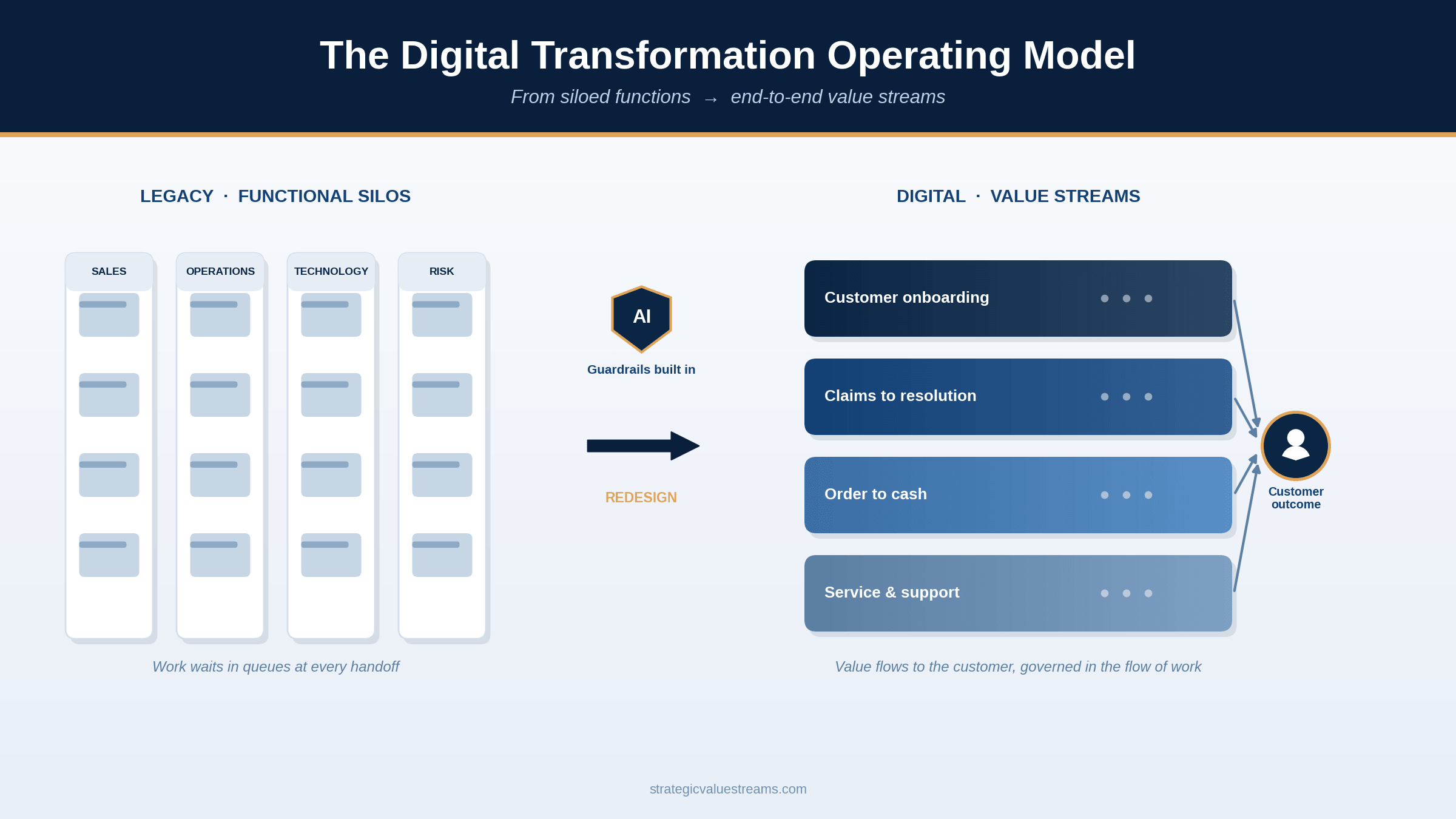
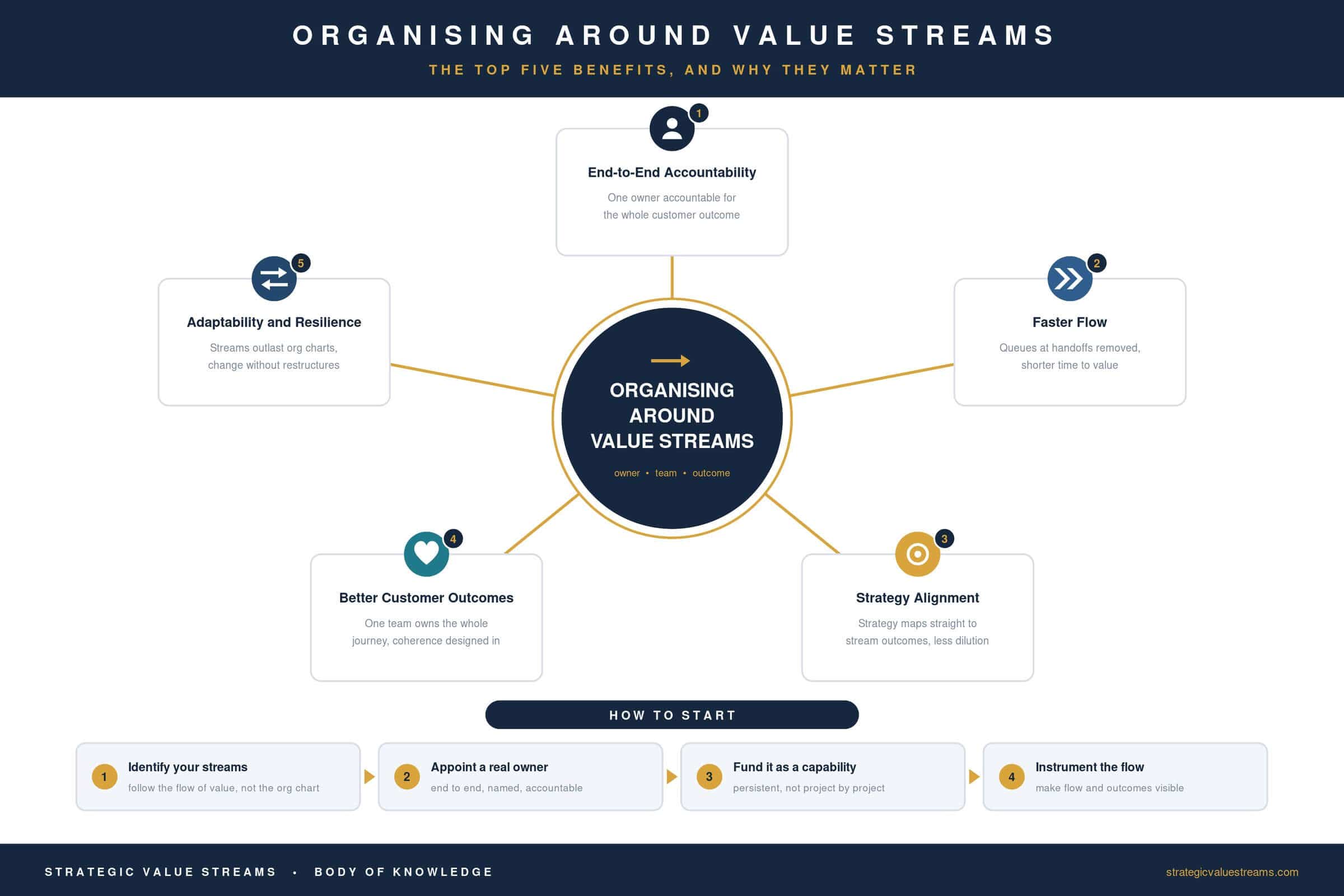
This is where a strategy-to-value perspective earns its place, not as another change model but as a way of shaping the operating environment change has to run in. A strategy-to-value operating model treats funding, governance, and flow as things to be designed rather than inherited. Strategic Value Streams, for example, funds value streams rather than temporary projects, so investment follows outcomes instead of resetting each year; moves governance closer to the flow of work, so decisions keep pace with delivery; and treats flow, the smooth movement of value to the customer, as a primary measure of health. None of that replaces OCM. It addresses the levers the four models leave untouched.
Change as the Exception, Not the Routine
Change will always be necessary, and change models will always be needed. A merger, a demerger, an acquisition, a sudden regulatory or market shock: events like these demand a deliberate, whole-organisation change effort, and this is exactly where OCM models earn their keep. The problem is not change itself. It is when grand, enterprise-wide change becomes the normal way of doing business, with a major reorganisation every few years. That cycle is usually a symptom rather than a strategy. It signals an operating model that cannot adapt without being torn up and rebuilt.
A value stream operating model breaks the cycle by building changeability into the way of working. When the enterprise is organised around the flow of value, and funding and governance move with that flow, adaptation becomes continuous and incremental rather than periodic and traumatic. Change models still matter, but they are held in reserve for the genuine step-changes, while the everyday adjustment the business needs happens as a matter of course. The aim is not to change more often. It is to make the next grand transformation unnecessary.
How to Choose the Right Organisational Change Framework
No single organisational change definition fits every situation, so the right framework depends on scope, maturity, and goals. For a single, contained change, Lewin gives you a fast way to frame the forces at play. For driving adoption of a defined new way of working, ADKAR keeps the focus on the people who have to make it real. For a large, sponsored transformation with clear leadership backing, Kotter supplies urgency and momentum, while 7-S helps you diagnose why an effort is stalling.
For enterprise-wide change, no single one of these models is sufficient on its own, and the choice is less either/or than layered. You might use ADKAR to manage adoption, borrow Kotter's urgency to launch a shift, and lean on 7-S to diagnose misalignment. What determines whether those efforts hold, though, is often the operating model underneath them: how strategy connects to value, and how funding and governance are set up. A strategy-to-value approach such as Strategic Value Streams speaks to that layer. Choose your change model for the change you face, and pay equal attention to the operating model it has to run on.
Prove Your Expertise: Value Stream Certification for Change Leaders
For change leaders who want to work at the enterprise level, understanding the organisational change definition each of these models offers is the starting point, not the destination. The next step is demonstrating that you can put an operating model that aligns strategy to value into practice, so that whatever change method you use has firm ground to stand on. Strategic Value Streams is a body of knowledge and certification framework built for exactly this. It sets out how to design, fund, govern, and run value streams, and its certification pathway lets change leaders formally validate that expertise.
If you are leading change beyond the boundaries of a single team, a recognised credential signals that you can operate at the level where strategy, governance, funding, and flow come together. Explore the Strategic Value Streams certification pathway to prove your command of the strategy-to-value operating model that modern enterprise change depends on.
FAQs
What is organisational change?
It is any deliberate shift in how an enterprise is structured, operates, or delivers value: the work of moving an organisation from how it functions today to how it needs to function tomorrow. That shift can be small, like adjusting one team's process, or enterprise-wide, like reorganising around customer value.
What are the main organisational change models?
The four most influential are Lewin's Force Field Analysis (change as opposing forces), Kotter's 8-Step Model (change as a sequential, leadership-driven campaign), the McKinsey 7-S Framework (change as systemic alignment), and Prosci's ADKAR (change as individual behaviour). Each is a way of describing how you move an organisation from one state to another.
Which change model is best?
None is best in every case. Lewin suits a single contained change, ADKAR drives individual adoption, Kotter fits large one-off transformations, and 7-S is strongest for diagnosing why change stalls. The right choice depends on your scope, maturity, and goals, and complex change often layers more than one.
How is Strategic Value Streams different from a change model?
Change models are the how; Strategic Value Streams is the what. It is not a fifth model competing with Lewin or Kotter, but the destination: a value stream operating model built around the flow of strategy to value. It defines the state you are changing into, rather than the method for getting there.
Does adopting value streams remove the need for change management?
No. Change and change models will always be needed, especially for genuine step-changes like mergers, demergers, acquisitions, or major shocks. What a value stream operating model changes is the frequency of upheaval: by building changeability into the way of working, it makes adaptation continuous and breaks the cycle of a whole-organisation reorg every few years.