
Table of Contents
- What Is Customer Value & Why Enterprises Must Own It
- What Is Customer Value? Definition and Meaning
- Customer Value Meaning in Marketing
- Customer Value Meaning in Operations and Organisational Design
- Why the Definition of Customer Value Matters at Enterprise Scale
- The Customer Value Formula
- Breaking Down the Benefits Side of the Equation
- Understanding the Full Cost to the Customer
- Limitations of the Customer Value Formula
- The Customer Value Hierarchy
- How the Customer Value Hierarchy Informs Enterprise Prioritisation
- Customer Value Examples: From Theory to Enterprise Practice
- Customer Value Model Example in Digital Transformation
- B2B Customer Value Examples Across Sectors
- What Customer Value Examples Reveal About Operating Model Design
- Why Enterprises Fail to Deliver Customer Value Consistently
- What Is a Customer Value Model?
- Designing a Customer Value Model for Your Organisation
- Connecting the Customer Value Model to Strategy
- Aligning the Enterprise Operating Model Around Customer Value
- Value Streams as the Organisational Unit of Customer Value Delivery
- Value Stream Ownership: Who Is Accountable for Customer Value?
- Governance and Funding Structures That Enable Value Flow
- Measuring Customer Value: Flow Metrics and Performance Indicators
- From Agile Delivery to Enterprise Business Agility
- How to Build Professional Expertise in Customer Value and Value Stream Management
- Can This Be Used as a Customer Value PDF?
- FAQ: What Is Customer Value?
- Key Takeaways
- FAQs
What Is Customer Value & Why Enterprises Must Own It
What is customer value? In simple terms, it is the customer’s judgement that the benefit they receive from a product, service or relationship is worth the full cost and sacrifice required to obtain, use and sustain it.
That sounds straightforward, but the difficulty begins as soon as an enterprise tries to organise itself around the idea. Marketing may use customer value to describe the proposition that persuades a customer to buy. Product teams may use it to justify features. Operations teams may use it to describe the removal of waste. Finance may connect it to willingness to pay, retention or margin. Strategy teams may use it to explain why the organisation deserves to win.
None of those interpretations is wrong, but each is incomplete.
The real enterprise question is not only what is customer value, but whether the organisation is designed so that customer value can flow from strategic intent to the customer outcome without being lost in handoffs, governance, funding cycles, functional silos or fragmented accountability.
That is why customer value is not just a marketing idea. It is an operating model question.
What Is Customer Value? Definition and Meaning
The most useful customer value definition is this:
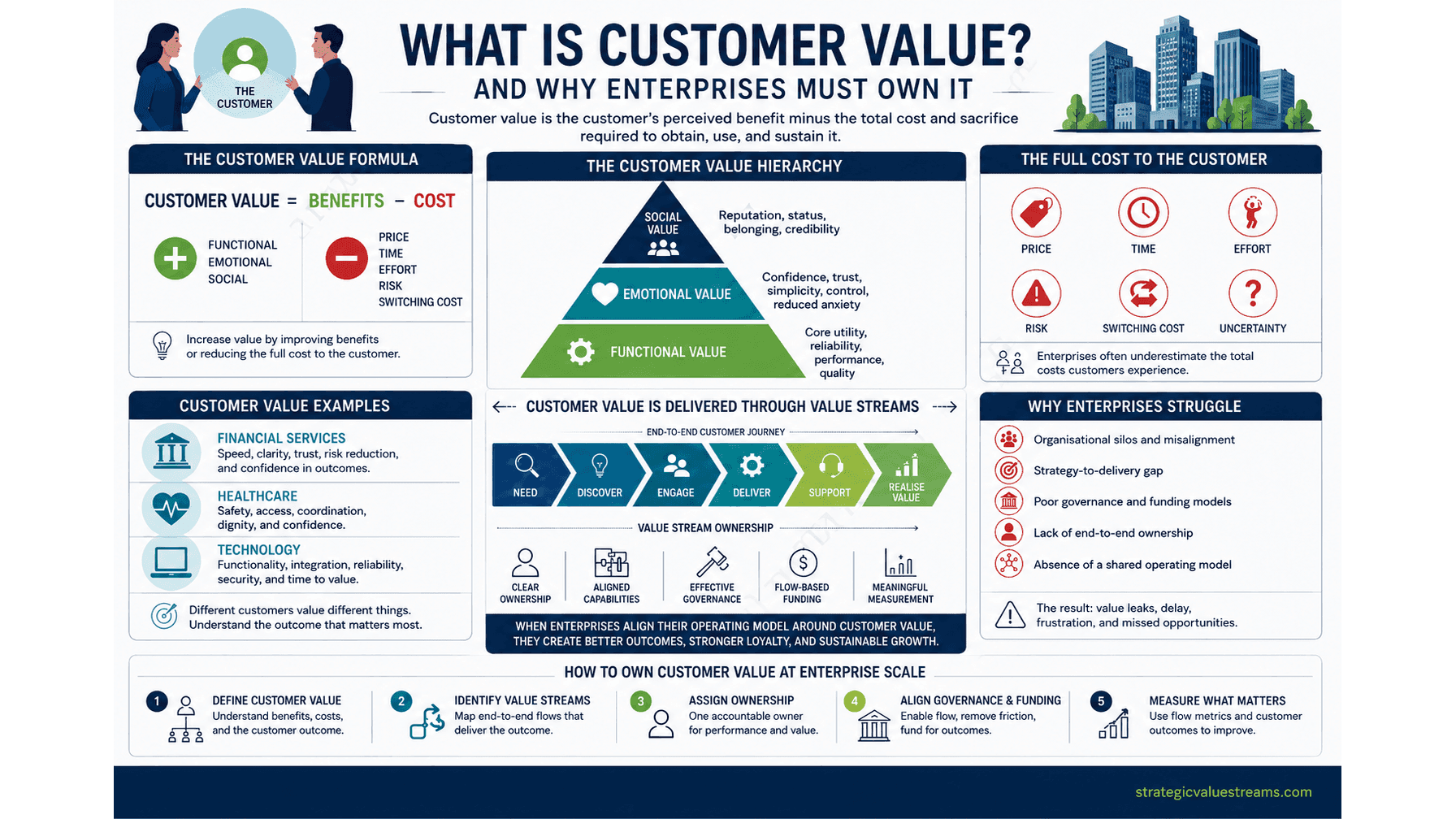
Customer value is the perceived benefit received by the customer, less the total cost and sacrifice required from the customer.
This definition matters because it contains three important ideas.
First, customer value is perceived. The organisation may believe it has delivered value, but the customer makes the final judgement. A bank may process an application, a software company may deploy a platform, a consultancy may deliver a recommendation, and a healthcare provider may complete an appointment, but the customer decides whether the result was useful, coherent, timely and worth the effort.
Second, customer value includes benefits and costs. It is not enough to increase functionality, add channels, launch features or digitise a process if the customer still experiences delay, confusion, repeated effort, uncertainty or risk.
Third, customer value is contextual. The same offering can create different levels of value for different customers because their needs, alternatives, constraints and expectations differ.
This is why the customer value meaning should not be reduced to price, product quality or customer satisfaction. Price is only one part of the cost. Product quality is only one part of the benefit. Customer satisfaction may be one outcome of value, but it is not the whole value equation.
So, when someone asks what is customer value, the answer should not stop at “benefits minus price”. It should include the full customer judgement of whether the outcome was worth the total sacrifice.
Customer Value Meaning in Marketing
The customer value meaning in marketing is usually centred on the value proposition.
Marketing asks why a customer would choose one offering over another, why they would trust a particular brand, why they would pay a premium, and why the offer feels relevant to their situation. In this sense, customer value in marketing is about preference, belief and choice.
A strong value proposition makes clear:
the problem the customer has;
the outcome the customer wants;
the benefit the product or service provides;
the reason the offer is different from alternatives;
and the confidence the customer can have in the promise.
This is a legitimate and necessary view of customer value, because if the customer cannot recognise the value proposition, the organisation may never get the opportunity to deliver anything at all.
But there is a risk.
The marketing promise can become detached from the enterprise reality behind it. A brand may promise simplicity while the operating model creates complexity. It may promise speed while governance creates delay. It may promise partnership while the customer is passed from sales to onboarding to support to billing with no single owner of the outcome.
That is why customer value in marketing is only the beginning. Marketing defines the promise of value, but the operating model determines whether that promise survives contact with the customer.
Customer Value Meaning in Operations and Organisational Design
In operations and organisational design, customer value means something more structural.
It asks how the organisation must work so that the customer receives the promised outcome consistently, economically and with the least necessary friction.
This is where the question what is customer value changes from a definition into a design problem.
Customers do not experience organisations as collections of departments. They experience the flow, or lack of flow, from need to outcome. A mortgage customer does not experience product, credit risk, underwriting, technology, legal, operations and servicing as separate functions. They experience whether they can obtain a mortgage decision with reasonable speed, clarity and confidence.
The same pattern appears in most sectors. Patients do not experience healthcare as a neat operating model. They experience referral, triage, diagnostics, treatment, follow-up and communication as one journey. Enterprise technology buyers do not experience sales, implementation, security review, customer success, support and renewal as separate internal structures. They experience whether the provider helps them realise the business outcome they bought.
This is why customer value is created across the seams of the organisation.
It depends on capabilities, systems, policies, controls, data, decision rights, funding, governance and leadership routines all working together. The customer experiences the combined effect, not the internal justification for separating the work.
At enterprise scale, customer value is therefore not just something to be understood. It is something the organisation must be designed to deliver.
Why the Definition of Customer Value Matters at Enterprise Scale
The definition of customer value matters more as organisations become larger, because complexity increases the distance between customer promise and customer outcome.
In a small organisation, customer value can often be held together through proximity. People know each other. Leaders see the customer problems directly. Decisions can be made informally. The same people may sell, deliver and support the customer.
In a large enterprise, that proximity disappears.
The organisation becomes divided into portfolios, products, platforms, geographies, functions, systems, programmes, risk owners, budget holders and governance forums. Each area may be well managed locally, but the customer outcome depends on how those areas interact.
If the enterprise does not define customer value clearly, each function creates its own substitute measure. Sales may optimise conversion. Technology may optimise velocity. Operations may optimise utilisation. Finance may optimise budget control. Risk may optimise evidence of compliance. Product may optimise roadmap delivery. Marketing may optimise campaign performance.
Each measure can be rational in isolation, while the total customer value gets worse.
That is why what is customer value is not a junior marketing question. It is a senior enterprise question, because without a shared definition of customer value, the organisation cannot align strategy, funding, governance, delivery and measurement around the same outcome.
The Customer Value Formula
The familiar customer value formula is:
Customer Value = Benefits − Cost
This formula is useful because it forces leaders to look at both sides of the equation. Customer value can be increased by improving the benefits the customer receives, or by reducing the total cost and sacrifice required from the customer.
The problem is that many enterprises focus on the benefit side while underestimating the cost side.
They add features, services, channels, dashboards, digital journeys and service layers, but do not always reduce effort, delay, uncertainty or risk. The customer may receive more functionality, but still experience less value because the total burden of dealing with the organisation has increased.
A better enterprise version of the customer value formula is:
Customer Value = functional, emotional and social benefits − price, time, effort, risk and switching cost.
This version is more realistic because customers are not simply buying a product or service. They are trying to achieve an outcome under conditions of uncertainty, constraint and choice.
In consumer markets, that may involve convenience, affordability, identity, enjoyment and confidence. In B2B markets, it may involve performance, resilience, implementation certainty, internal credibility, stakeholder confidence and risk reduction.
The customer value formula should therefore be treated as a management model rather than a precise calculation. It helps leaders ask whether an initiative improves something the customer actually values, reduces a cost the customer actually experiences, or merely improves something the organisation prefers to measure.
Breaking Down the Benefits Side of the Equation
The benefits side of the customer value formula is broader than product functionality.
Functional value is the practical utility of the product or service. It answers the basic question: does this offering do the job the customer needs it to do?
A payment must clear. A claim must be processed. A software product must help work get done. A logistics provider must deliver reliably. A professional learning product must help the learner build useful capability. Functional value is the baseline, because if the core offering does not work, everything else becomes decoration.
But customers also perceive emotional value. They value confidence, reassurance, simplicity, control, trust and reduced anxiety. This is especially important where the purchase is complex, the stakes are high, the outcome is uncertain or the buyer is exposed if the decision goes wrong.
This is why emotional value matters in B2B markets, even though B2B organisations often describe themselves as rational. Enterprise buyers still want to avoid embarrassment, reduce implementation risk, protect their reputation, make decisions they can defend and work with providers who will not disappear when delivery becomes difficult.
There is also social value. This includes status, reputation, belonging and the way a choice is seen by others. In enterprise settings, social value may relate to the buyer’s internal credibility, the organisation’s market reputation, the confidence of senior stakeholders or the visible adoption of a respected standard.
Bain’s Elements of Value work makes this broader point clearly: value includes functional, emotional and higher-order elements, and in B2B markets the relevant elements include table stakes, functional value, ease of doing business, individual value and inspirational value.
For enterprise leaders, the implication is simple. Customer value is not only about whether the product works. It is also about whether the customer feels confident, whether the decision feels defensible, and whether the relationship reduces or increases the customer’s burden.
Understanding the Full Cost to the Customer
The cost side of customer value is where many enterprises underestimate their impact on the customer.
Price is visible, but it is rarely the whole cost.
Customers also experience time cost, which includes waiting, chasing, onboarding, implementation, resolution and renewal. They experience effort cost, which includes form filling, repeated explanation, internal persuasion, learning, configuration and avoidable administration. They experience risk cost, which includes the possibility of failure, disruption, compliance exposure, reputational harm or personal accountability for a poor decision.
They may also experience switching cost, integration cost, cognitive cost and political cost. In enterprise markets, these costs can be substantial.
A customer may accept a higher price from a provider who reduces uncertainty, lowers implementation risk, simplifies integration and makes the buying decision easier to defend internally. Equally, a cheaper provider may offer poor value if the customer must carry more effort, more risk and more operational burden.
This is why cheaper is not always better value.
A low-cost offer can become expensive if it creates hidden effort. A premium offer can represent strong value if it reduces customer risk and accelerates the customer’s own outcome.
The challenge for enterprises is that the customer’s cost is often distributed across the journey. Sales sees acquisition. Implementation sees onboarding. Operations sees service. Finance sees billing. Support sees incidents. Product sees usage. The customer sees the whole thing.
Unless the enterprise is organised to see the whole thing as well, it will keep underestimating the total cost it imposes.
Limitations of the Customer Value Formula
The customer value formula is helpful, but it should not be treated as reality itself.
Customer value is subjective. Two customers may use the same product and experience different value because their situations, expectations, alternatives and constraints differ. A feature that matters deeply to one segment may be irrelevant to another. A low price may matter most in one context, while confidence, speed or risk reduction may matter more in another.
Customer value is also dynamic. The reasons customers buy are not always the reasons they renew. A customer may buy because of functionality, implement because of trust, expand because of adoption and renew because the provider has become part of their own operating model.
In B2B environments, customer value is further complicated because the customer is rarely one person. The economic buyer, users, procurement team, risk function, technology function, operational teams and executive sponsor may all judge value differently.
That is why a serious organisation will not rely on the formula alone. It will combine it with customer interviews, journey analysis, service blueprinting, behavioural data, complaints analysis, win-loss insight, value stream mapping and the practical knowledge of frontline teams who see where customers struggle.
The point is not to reduce customer value to a spreadsheet. The point is to make it explicit enough that the enterprise can organise around it.
The Customer Value Hierarchy
The customer value hierarchy is a useful way to understand the layers of value a customer may experience.
At the base is functional value. The product or service must do what it is supposed to do. Without functional value, there is no durable customer value.
Above that is emotional value. The customer wants confidence, reassurance, clarity, control and trust. In complex markets, emotional value can be the difference between a customer feeling supported and a customer feeling exposed.
Above that is social value. The customer wants the decision to strengthen reputation, credibility, identity or status. In B2B environments, this may involve the buyer’s own credibility with colleagues, the confidence of senior stakeholders or the organisation’s visible association with a trusted approach.
This customer value hierarchy matters because enterprises often overinvest in functionality and underinvest in the emotional and social dimensions of value. They assume that if the product works, the value has been delivered. In practice, customers may also be buying confidence, reduced anxiety, lower risk and a decision they can defend.
When leaders ask what is customer value, they should therefore ask the question at all three levels: what does the customer get, how does the customer feel, and what does the customer’s choice allow them to signal or protect?
How the Customer Value Hierarchy Informs Enterprise Prioritisation
The customer value hierarchy is not just a descriptive model. It should influence enterprise prioritisation.
Every enterprise has limited capacity, capital, leadership attention and tolerance for change. It therefore needs a way to decide which work matters most.
Some investments protect the functional baseline. These may include resilience, security, accuracy, compliance, service reliability and process quality. They may not be exciting, but without them the value proposition collapses.
Some investments reduce customer cost. These remove effort, delay, rework, confusion, uncertainty or unnecessary dependency on the organisation. These improvements may look operational from the inside, but from the customer’s perspective they can be highly valuable.
Some investments create differentiation. These may increase trust, confidence, status, simplicity or strategic relevance. They may be harder to quantify, but they often explain preference, loyalty, renewal and advocacy.
This is why prioritisation should not be trapped inside departmental backlogs. The better question is whether the work improves the part of the customer value equation that matters most to the customer and to the organisation’s strategy.
That question requires an end-to-end view of the value stream.
Customer Value Examples: From Theory to Enterprise Practice
Customer value examples are useful because they show that value is rarely created by one team, one product or one system. It is created by the way the enterprise works across boundaries.
Porter’s value chain remains relevant because it treats competitive advantage as something created through activities and the fit between activities. Modern value stream thinking develops that logic further by asking how those activities, decisions and capabilities should be organised around outcomes.
A customer value example is therefore not simply a description of a benefit. It should show how the customer outcome is enabled or weakened by the operating model behind it.
Customer Value Model Example in Digital Transformation
A common customer value model example appears in digital transformation.
Consider a bank redesigning digital onboarding for a mortgage, business account or lending product. The organisation may say the transformation will improve customer value because the journey is becoming digital. But digitisation alone does not guarantee value.
If the customer still has to provide the same information repeatedly, wait for unclear decisions, chase progress, interpret confusing messages and move between disconnected teams, the channel may be digital while the value remains weak.
A stronger customer value model would define:
the customer outcome, such as obtaining a decision with clarity and confidence;
the functional value, such as accurate eligibility, secure verification and reliable fulfilment;
the emotional value, such as reduced anxiety and greater certainty;
the full customer cost, including time, effort, waiting, risk and repeated administration;
and the value stream, from intent through application, verification, decisioning, fulfilment and activation.
The operating model question is then clear: does the enterprise own this value stream end to end, or has it simply digitised fragments of a broken journey?
B2B Customer Value Examples Across Sectors
B2B customer value examples make the same point in different settings.
In financial services, customer value may involve trust, speed, accuracy, transparency and risk reduction. A corporate banking customer may value a lending product not only because of price, but because of certainty of decision, responsiveness, covenant clarity and the bank’s ability to support future growth.
In healthcare, customer value may involve safety, access, coordination, dignity and confidence. A patient values the clinical outcome, but also the clarity of communication, the reduction of waiting and the feeling that the pathway is coherent.
In technology, customer value may involve functionality, integration, security, reliability and time to value. A software product may have excellent features but still create poor value if implementation is slow, adoption is difficult or support is fragmented.
In professional services, customer value may involve judgement, credibility, speed to insight, stakeholder confidence and the client’s ability to act. A consulting engagement does not create value simply by producing a report. It creates value when the client can make better decisions, align stakeholders and move the organisation forward.
These customer value examples reveal a common pattern: the value proposition is rarely delivered by one function acting alone.
What Customer Value Examples Reveal About Operating Model Design
Customer value examples reveal that operating model design can either enable or destroy value.
It enables value when teams are aligned around end-to-end outcomes, ownership is clear, funding supports durable streams of work, governance removes friction rather than adding delay, and measurement shows whether value is actually improving.
It destroys value when departments optimise locally, work passes through excessive handoffs, funding is locked into temporary projects, decision rights are unclear, risk controls are separated from delivery reality, and no one owns the customer value stream from beginning to end.
This is why customer value is not simply a matter of customer centricity. Many organisations are sincere about customer centricity and still fail to deliver customer value consistently because the structure of the organisation works against the outcome it claims to want.
Why Enterprises Fail to Deliver Customer Value Consistently
Enterprises usually do not fail to deliver customer value because they lack ambition. They fail because they are not designed around the value they claim to deliver.
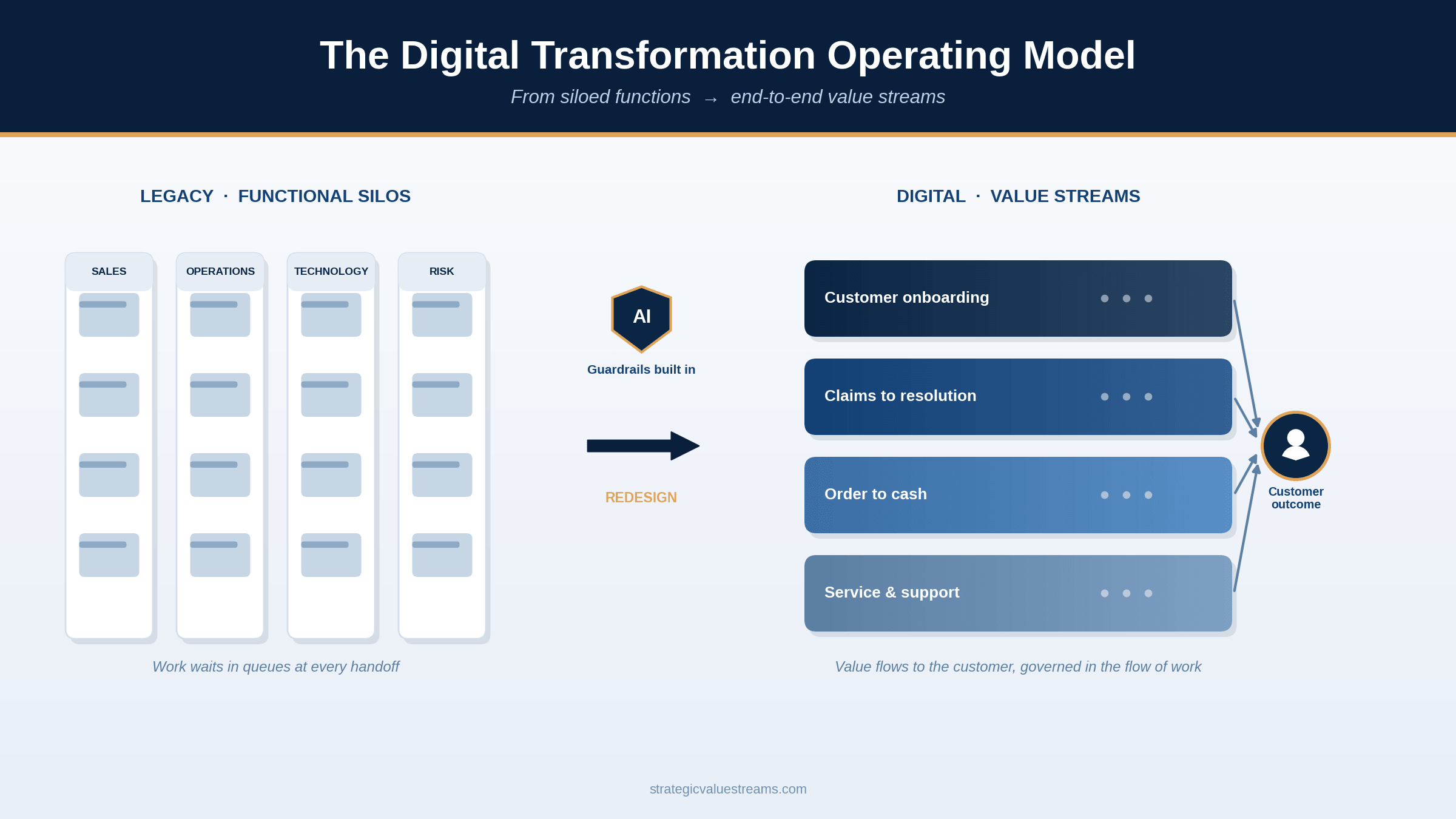
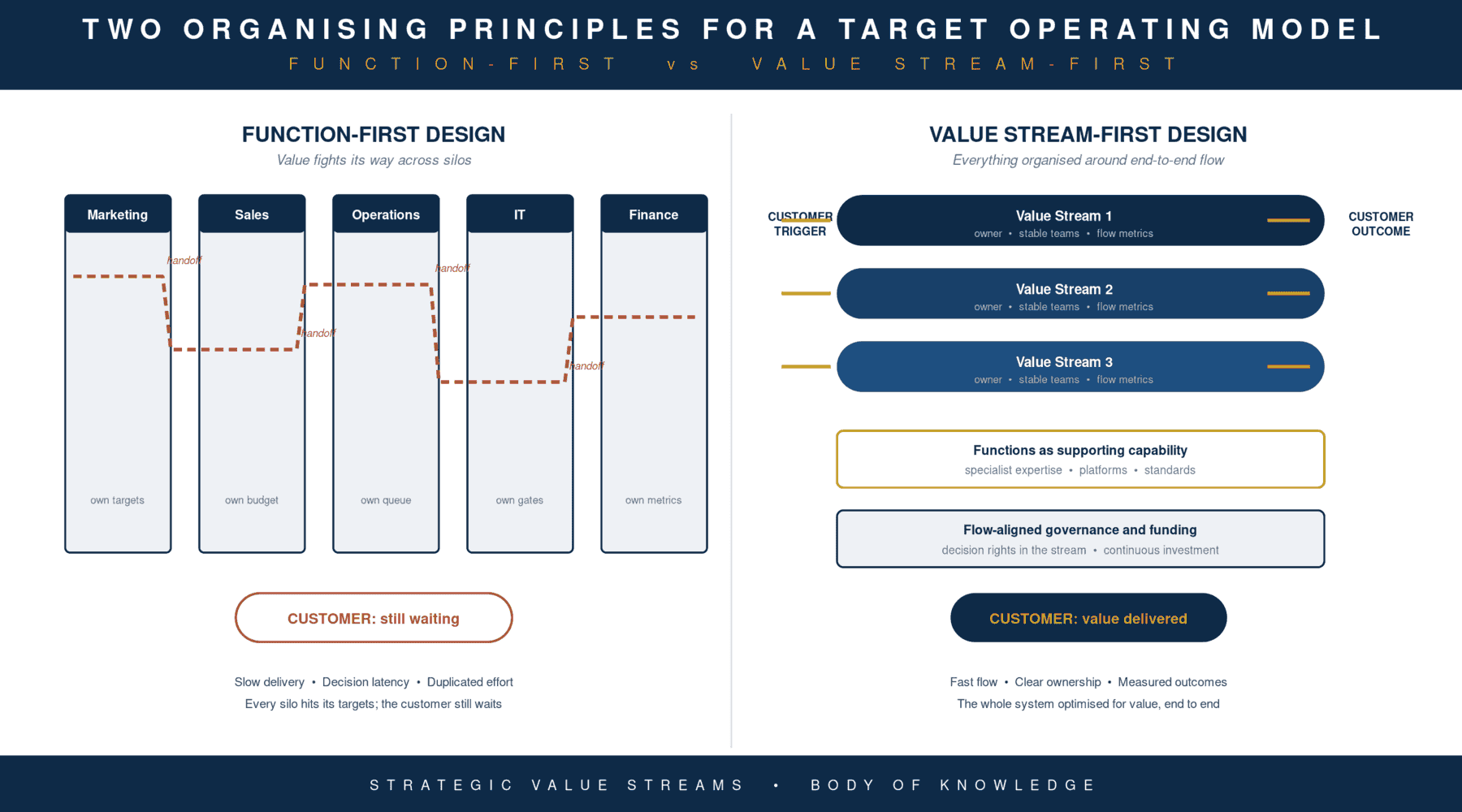
The first failure mode is organisational silos. Functions are necessary, but when they become the dominant unit of optimisation, they fragment the customer outcome. Each area improves its own performance while the customer experiences the delays, contradictions and handoffs between them.
The second failure mode is the strategy-to-delivery gap. Senior leaders may define a strategy around customer intimacy, digital leadership, simplicity, innovation or service excellence, but delivery teams may receive that strategy as disconnected programmes, projects, targets and backlogs.
The third failure mode is governance that controls activity rather than enabling value. Traditional governance often asks whether the project is on time, on budget and compliant with process. Those questions matter, but they do not necessarily reveal whether customer value is flowing.
The fourth failure mode is funding. Project funding is designed around temporary effort, while customer value is usually continuous. Customers do not stop needing value when the project closes. Markets continue to move, systems continue to age, competitors continue to improve and the organisation continues to learn.
The fifth failure mode is the absence of a shared operating model. Teams may have agile practices, product roles, portfolio processes, architecture standards and customer metrics, but these elements may not form a coherent system. When that happens, customer value depends on escalation, goodwill and local heroics rather than deliberate design.
What Is a Customer Value Model?
A customer value model is a structured way of explaining how customer value is created, recognised, measured and improved for a particular customer or customer segment.
A useful customer value model should define the customer segment, the outcome the customer wants, the benefits that matter, the full costs and sacrifices the customer experiences, the value stream that delivers the outcome, the points where value is created or destroyed, and the measures that indicate whether value is improving.
The important point is that a customer value model should change decisions.
If it does not influence investment, prioritisation, governance, accountability or operating model design, it is simply a descriptive artefact. It may be useful in a workshop, but it is not doing management work.
A strong customer value model helps the enterprise move from saying “we are customer-centric” to deciding how it will actually allocate capacity, funding, authority and leadership attention around the outcomes customers value.
Designing a Customer Value Model for Your Organisation
The best way to design a customer value model is to start with the customer outcome rather than the internal structure.
First, define the customer segment, because different customers value different things. Enterprise customers, small businesses, consumers, patients, partners and internal stakeholders may all have different value equations.
Second, define the outcome in the customer’s language. “Complete onboarding with confidence” is more useful than “process application”, because the first phrase describes the value the customer needs and the second describes the work the organisation performs.
Third, identify the functional, emotional and social benefits that matter. The enterprise should know which benefits are basic expectations and which create differentiation.
Fourth, identify the full cost to the customer, including price, time, effort, risk, switching cost, cognitive load, integration burden and uncertainty.
Fifth, map the value stream that delivers the outcome. This should include the teams, systems, decisions, controls, data flows and handoffs that create or destroy value.
Sixth, define measures that show whether value is improving. These should include customer outcomes, flow, quality, risk and economics.
A customer value model is only useful when it connects customer understanding to operating model decisions.
Connecting the Customer Value Model to Strategy
Customer value must be connected to strategy, otherwise the organisation may improve experiences that do not strengthen its competitive position.
Not all customer value is strategically equal. Some value is required simply to remain credible in the market. Some creates differentiation. Some reduces churn. Some supports premium pricing. Some lowers cost to serve. Some opens future growth.
Strategy should therefore clarify which customers matter, which outcomes matter, where the organisation must differentiate, where it must be efficient, where it must reduce customer cost and where it must build capabilities that competitors will find difficult to match.
This is where the question what is customer value becomes strategically important. The answer should not be generic. It should be specific to the organisation’s chosen customers, chosen position and chosen way of winning.
An enterprise that cannot connect customer value to strategy will struggle to decide which value streams deserve the most investment, which capabilities matter most and which trade-offs are acceptable.
Aligning the Enterprise Operating Model Around Customer Value
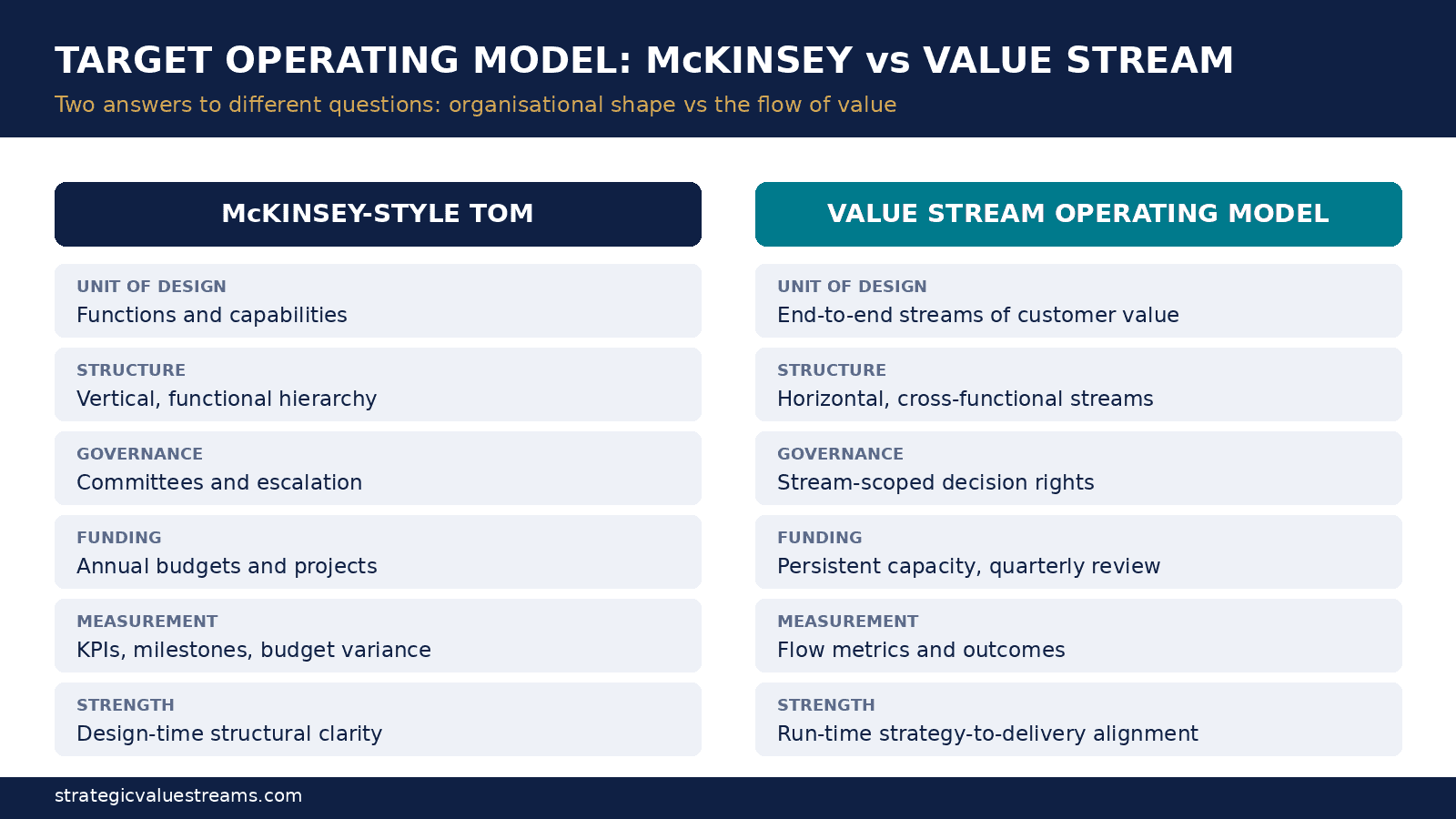
To align an operating model around customer value, the enterprise must move beyond functions as the only organising logic.
Functions still matter. Finance, risk, compliance, technology, operations, marketing, HR and architecture all provide essential capabilities. But customer value flows across them.
A customer-value-aligned operating model therefore needs durable value streams, clear ownership, cross-functional capability alignment, governance that supports flow, funding aligned to outcomes, decision rights close to the work, architecture guardrails that enable safe autonomy, and measures that show flow, quality, risk and customer outcome together.
This is not simply an agile transformation. It is an enterprise operating model shift.
The Strategic Value Streams perspective is that value stream operating models need to cover ownership, governance, funding, flow and measurement as a coherent system, not as disconnected improvement initiatives. See the Strategic Value Streams Body of Knowledge for the full reference guide to value stream operating model design.
Value Streams as the Organisational Unit of Customer Value Delivery
A value stream is the end-to-end sequence of activities, decisions and capabilities through which value is delivered to a customer or stakeholder.
That definition is broader than a process map, workflow diagram, agile release train or technology pipeline. Those may all be useful, but they are not sufficient. At enterprise level, a value stream should be treated as a durable organising construct with ownership, funding, governance, measurement and continuous improvement designed around the flow of value.
Lean value stream mapping defines a value stream as the set of actions, both value-creating and non-value-creating, required to bring a product or service to the customer. In enterprise operating model design, the same logic has to be extended beyond mapping into accountability.
A value stream should make clear:
who the customer or stakeholder is;
what outcome the stream exists to deliver;
where the stream starts and ends;
which capabilities are required;
which teams, systems and controls contribute;
who owns the stream;
how the stream is funded;
how decisions are governed;
and how flow, quality, risk and customer value are measured.
Without that clarity, value streams remain diagrams. With it, they become part of the operating model.
Value Stream Ownership: Who Is Accountable for Customer Value?
Customer value needs ownership, but in many enterprises it does not have it.
Product may own the roadmap. Technology may own the systems. Operations may own fulfilment. Marketing may own acquisition. Risk may own controls. Finance may own budgets. Service may own complaints. But the customer experiences the combined outcome.
The role of value stream ownership is to close that accountability gap.
A value stream owner should be accountable for the performance, health and improvement of the stream. That does not mean personally managing every person or controlling every decision. It means holding a mandate to align the stream around customer value, surface constraints, manage trade-offs, connect strategic intent to operational reality and make visible where value is flowing or blocked.
This is different from project sponsorship. A project sponsor is often accountable for temporary change. A value stream owner is accountable for a continuing system of value delivery.
That distinction matters because customer value is not temporary.
Governance and Funding Structures That Enable Value Flow
Governance should help the organisation make better decisions about customer value.
Traditional governance often asks whether a project has a business case, whether milestones are being met, whether budget is under control and whether risks have been recorded. Those questions are not wrong, but they are insufficient.
Value stream governance asks whether the stream is improving the customer outcome, whether work is flowing, whether customer cost is reducing, whether strategic priorities are receiving enough capacity, whether risks are managed in context and whether leadership attention is being applied to the constraints that matter most.
Funding has to change as well.
If value is continuous, then funding models built only around temporary projects will always create friction. They require teams to be assembled and disbanded, benefits to be predicted too early, knowledge to be repeatedly transferred and accountability to be reset each cycle.
Funding value streams does not mean abandoning financial control. It means applying financial control to enduring streams of customer value rather than to temporary containers of work.
Measuring Customer Value: Flow Metrics and Performance Indicators
Customer value cannot be managed through one metric.
Revenue may show that customers are buying, but not necessarily that they are receiving value. Satisfaction may show sentiment, but not necessarily business outcome. Delivery velocity may show output, but not necessarily customer benefit. Cost reduction may improve margin while damaging service.
A serious measurement system has to combine several perspectives.
Customer outcome measures might include retention, renewal, adoption, task completion, complaints, customer effort, satisfaction, advocacy and time to value.
Flow measures might include lead time, cycle time, throughput, work in progress, ageing work, rework, handoff delay and blocked demand.
Quality and risk measures might include defects, incidents, service failures, control exceptions, operational resilience and customer harm indicators.
Financial measures might include cost to serve, margin, lifetime value, acquisition cost and value stream economics.
The purpose is not to create another dashboard. Most enterprises already have more dashboards than they can use. The purpose is to create a better management conversation, one that shows whether customer value is improving, where it is slowing down, where it is being eroded and which decisions would most improve the customer’s total value equation.
From Agile Delivery to Enterprise Business Agility
Agile delivery can help organisations improve customer value, but agile alone cannot own customer value at enterprise scale.
This is because customer value is not created only inside delivery teams. It depends on strategy, funding, governance, architecture, data, operations, risk, service, leadership and organisational structure.
A team can be agile inside a slow funding model. A product owner can manage a backlog inside unclear strategy. A squad can deliver quickly into a value stream full of handoffs. A programme can use agile ceremonies while decision rights, controls and architecture still prevent value from flowing.
The question is therefore not simply whether teams are agile.
The better question is whether the enterprise is designed so that customer value can move from strategic intent to customer outcome with the least necessary organisational friction.
That is the shift from agile delivery to enterprise business agility, and from business agility as a cultural aspiration to business agility as an operating model capability.
How to Build Professional Expertise in Customer Value and Value Stream Management
If customer value is an enterprise operating model concern, then the required professional capability is broader than product management, agile delivery or process improvement alone.
Leaders and practitioners need to understand how customer value is defined, how value streams are identified, how ownership works, how funding should be aligned, how governance affects flow, how architecture enables or constrains value, how metrics shape behaviour and how strategy is translated into operating model choices.
This is the territory Strategic Value Streams is concerned with.
It is not value stream mapping in the narrow sense, and it is not DevOps value stream management in the toolchain sense. Those disciplines can be useful, but the enterprise question is larger. The question is how organisations should be designed around durable streams of value so that strategy, delivery, governance, funding, flow and measurement reinforce one another.
For practitioners building this capability, the Strategic Value Streams Certification Pathway provides a structured route from Foundation to Practitioner and Fellow, while the Foundation syllabus and Practitioner syllabus set out the knowledge and applied judgement expected at each level.
The point is not credentialism for its own sake. The point is that customer value at enterprise scale requires a level of operating model literacy that many organisations still lack.
Can This Be Used as a Customer Value PDF?
Many people search for a customer value PDF because they want a portable model they can use in a workshop, leadership discussion or internal briefing.
The danger is that a customer value PDF becomes another static artefact. It may define benefits, costs, segments and journeys, but unless it changes how the organisation makes decisions, it will not improve customer value.
A better use of a customer value PDF is to support a structured conversation about the operating model. It should help leaders ask whether the enterprise understands the customer outcome, whether the value stream is visible, whether ownership is clear, whether funding supports flow and whether governance improves value or slows it down.
If you need a starting point for that conversation, the free Value Stream Operating Models introduction is a useful companion because it connects value thinking to the structure of the organisation.
FAQ: What Is Customer Value?
What is customer value in simple terms?
Customer value is the customer’s judgement that the benefit they receive is worth the full cost and sacrifice required. It includes what the customer gains, but also what they give up in price, time, effort, risk and uncertainty.
What is customer value in marketing?
Customer value in marketing is the reason a customer chooses one offering over another. It is usually expressed through the value proposition, which explains the customer problem, the promised benefit and the reason the offering is different or better than alternatives.
What is the value of customer to you?
The phrase “what is the value of customer to you” is often used loosely, but the better enterprise question is different: what value does the customer receive from the organisation, and how valuable is that customer relationship to the organisation over time? A mature enterprise understands both sides, because it must create value for customers while building economically sustainable relationships.
What is a customer value model?
A customer value model is a structured way of explaining how value is created, measured and improved for a customer or segment. It should include the customer outcome, benefits, costs, value stream, measures and operating model implications.
What is a customer value model example?
A customer value model example in digital transformation would be a bank redesigning mortgage onboarding around the customer outcome of receiving a clear, confident and timely decision. The model would include functional benefits, emotional benefits, customer costs, operational handoffs and the value stream required to deliver the outcome.
Why does customer value matter to enterprise operating models?
Customer value matters to enterprise operating models because the customer outcome is usually created across functions, systems, controls, funding decisions and governance forums. If the operating model is not aligned around value, the enterprise may be busy, efficient and well governed locally while still failing to deliver the outcome customers need.
Key Takeaways
So, what is customer value? It is the customer’s perceived benefit, less the full cost and sacrifice required to receive that benefit.
In marketing, customer value explains why customers choose. In operations, it explains how work must flow. In organisational design, it explains how the enterprise must be structured, funded, governed and measured if the promise made to the market is to become an outcome experienced by the customer.
The customer value formula is useful, but only when it is treated as a prompt for judgement rather than a false calculation. Benefits include functional, emotional and social value. Costs include price, time, effort, risk, switching cost, integration burden and uncertainty.
At enterprise scale, customer value fails when organisations remain trapped in silos, temporary projects, disconnected governance and unclear ownership. It succeeds when the enterprise is deliberately designed around value streams, with clear accountability, aligned funding, appropriate governance, meaningful measures and leadership routines that manage the whole system rather than its individual parts.
Customer value is therefore not just something the enterprise promises.
It is something the enterprise must be designed to deliver.
FAQs
What is customer value?
Customer value is the customer’s judgement that the benefit they receive from a product, service or relationship is worth the full cost and sacrifice required to obtain, use and sustain it. It includes the obvious benefits of the offer, but also the customer’s experience of time, effort, risk, uncertainty and confidence.
What is customer value in marketing?
In marketing, customer value is the reason a customer chooses one offer over another. It is usually expressed through the value proposition, which explains the customer’s problem, the promised benefit, the difference from alternatives, and why the customer should believe the promise.
What is the customer value formula?
The simple customer value formula is Customer Value = Benefits − Cost. For enterprise use, a more useful version is Customer Value = functional, emotional and social benefits − price, time, effort, risk and switching cost, because customers judge value through the total experience, not just through price.
What is a customer value model?
A customer value model is a structured way of explaining how value is created, recognised, measured and improved for a customer or customer segment. It should define the customer outcome, the benefits that matter, the costs the customer experiences, the value stream that delivers the outcome, and the measures used to manage improvement.
Why does customer value matter at enterprise scale?
Customer value matters at enterprise scale because the customer outcome is usually created across many functions, systems, teams and governance forums. If those parts are not aligned around the same outcome, the organisation can be busy, efficient and well managed locally while still failing to deliver value from the customer’s point of view.
How do value streams help organisations deliver customer value?
Value streams help by giving customer value an end-to-end organisational home. Instead of treating value as the responsibility of separate departments, a value stream makes the flow of work, ownership, funding, governance, measurement and improvement visible around the customer outcome the organisation exists to deliver.