
Table of Contents
- What Is Value Stream Flow?
- How Flow Works Inside a Value Stream Model
- Why Poor Flow Is Holding Your Enterprise Back
- Key Flow Metrics Every Value Stream Practitioner Should Know
- How to Start Improving Value Stream Flow
- Value Streams as a Stable Foundation for Strategy
- Next Steps for Building Flow Into Your Enterprise Operating Model
- FAQs
What Is Value Stream Flow?
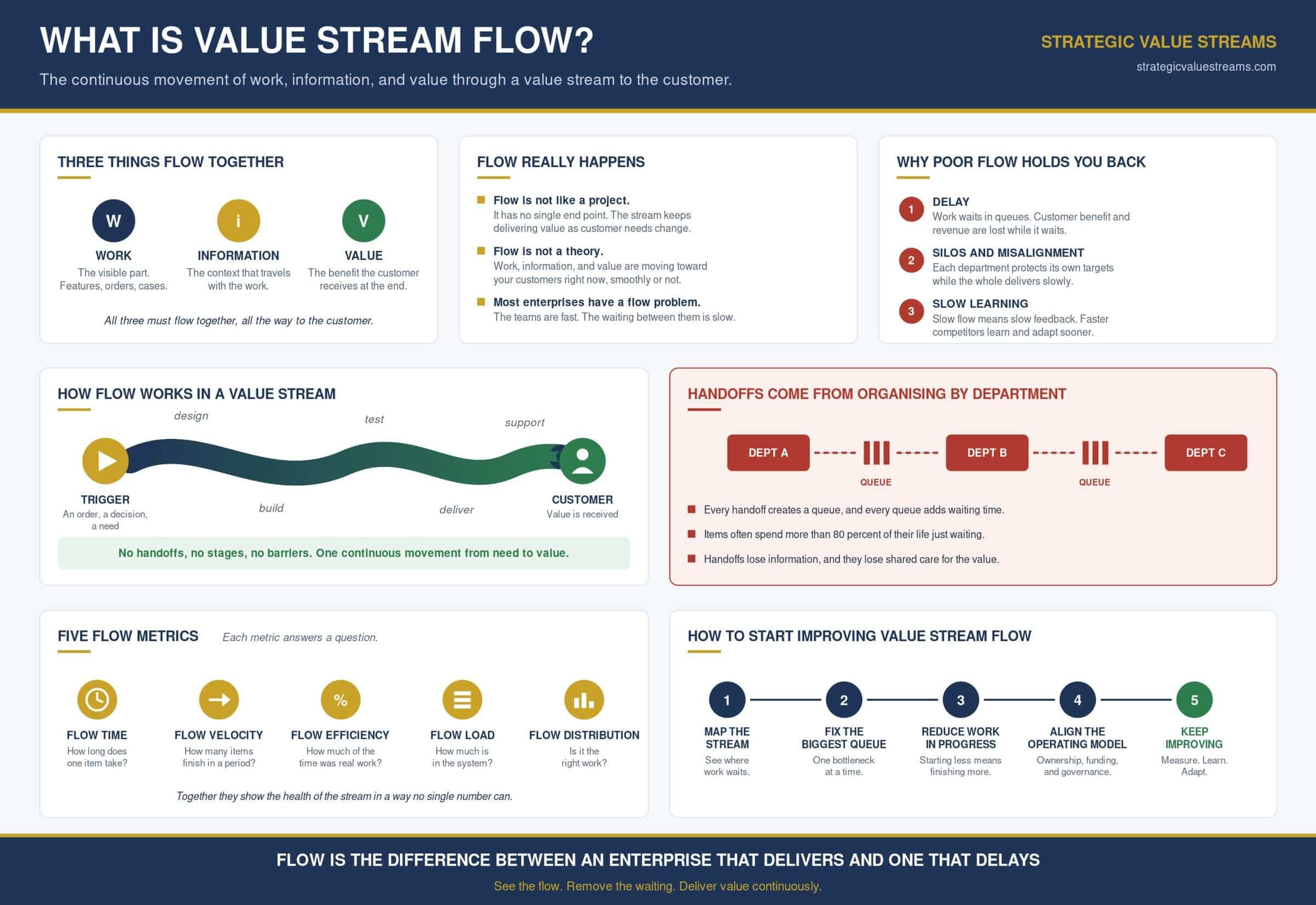
Value stream flow is the continuous movement of work, information, and value through a value stream to the customer. Flow is not like a project. It has no single end point. Individual pieces of work finish, but the stream keeps delivering value, and it adapts as customer needs change over time.
Flow is not a theory or a management idea. It is something that really happens, in every value stream, all the time. Work, information, and value are moving toward your customers right now, smoothly or not. The question is never whether flow exists. The question is how well it runs.
This matters because most enterprises do not have a speed problem. They have a flow problem. The people are capable, and most teams work fast. What is slow is the structure around them, left over from organising by department. Work waits at handoffs, at approvals, and in queues for someone else's attention. When you pay attention to value stream flow, you can see these blockers clearly, and you can change them.
Three things move through a value stream, and all three must flow together. Work is the visible part. It includes the features, orders, cases, or changes moving through the stream. Information is the context that travels with the work, such as the customer need, the requirements, and the decisions already made. Value is the point of it all. It is the benefit the customer receives at the end. A stream can move work quickly and still fail, if information gets lost along the way, or if what comes out no longer meets the customer need. Managing flow means caring for all three, from the start of the stream to the customer.
This article explains how flow works inside a value stream model, why poor flow is so costly, which metrics show it, and how to start improving it.
How Flow Works Inside a Value Stream Model
A value stream model describes everything an enterprise does to deliver an outcome to a customer, shown as one continuous movement of value from the first need to the customer. Flow happens through the stream whether anyone manages it or not. The model simply helps you see where flow runs smoothly and where it is blocked. And the stream itself never "finishes". It is a long-lived part of the enterprise. Value flows through it continuously, and its shape changes as customer needs change.
Every stream works the same way. A trigger starts an item flowing. It might be a customer order, a business decision, an incident, or a market opportunity. From there the work moves in one continuous movement toward the customer. Along the way, people add what the customer values, such as design, build, testing, delivery, and support. These activities blend into each other. They are not separate stages with barriers between them. And the people of the stream carry the item through the whole movement together.
This shared care is the defining feature of a value stream. There are no handoffs. Nobody throws work over a wall to the next team. Everyone in the stream shares one goal, that the value is actually delivered to the customer.
Handoffs come from a different way of organising. In an enterprise built around departments, the path to the customer is cut into pieces. Each boundary is a handoff. That is the point where one team passes the work on and stops being responsible for it. Every handoff creates a queue, because the next department has its own backlog and its own priorities. Every queue adds waiting time. In most knowledge work, waiting takes far more time than working. It is common for an item to spend more than eighty percent of its life just sitting in queues. Handoffs also lose information, because the next team has to rebuild the context the last team already had. Handoffs are not a natural part of delivering value. They are a side effect of organising by department.
This is why flow belongs to the whole stream, not to any one team inside it. A value stream model shows the current reality. It shows the whole movement of value, any handoffs left over from the old departmental structure, and the dependencies at the edges of the stream, such as shared specialists, outside suppliers, and approval gates. When the model shows a handoff or a barrier, the goal is to remove it, not to manage it better. In a well-designed stream, one owner is accountable for flow from end to end, everyone shares responsibility for the outcome, and the work follows the flow of value, not department boundaries.
Why Poor Flow Is Holding Your Enterprise Back
Poor value stream flow rarely calls itself poor flow. It shows up as complaints most organisations have learned to live with. Everything takes months. Nobody can say where a piece of work actually is. Teams are overloaded and waiting at the same time. Things customers asked for arrive after they stopped mattering. Behind all of these is one cause. Work spends most of its life waiting in the gaps between teams.
The first cost is delay. Every week an item waits in a queue is a week of customer benefit not delivered and revenue not earned. Most of this waiting is invisible, so nobody is accountable for it. Leaders react to slowness by starting more work, and this makes things worse. More work in the system means longer queues, and longer queues mean slower delivery. This is the trap of poor flow. The natural response to it deepens it.
The second cost is silos and misalignment. When flow is poor, each department protects its own targets and its own backlog, because that is all it can control. Each part looks efficient while the whole delivers slowly. Strategy suffers too. By the time an idea from leadership has passed through all the queues and re-planning on its way to delivery, it often looks very different from what leaders decided. The enterprise is fully busy, but only loosely aligned.
The third cost grows over time. Slow flow means slow feedback, and slow feedback means slow learning. An enterprise that needs eighteen months to get an idea to a customer will always lose to a competitor that needs eight weeks, because the faster enterprise learns sooner and gets more chances to correct course. Money sits locked in unfinished work. Good people leave, tired of never finishing what they start. Poor value stream flow is not a small operational problem. It is a limit on how fast the whole enterprise can learn, adapt, and compete.
Key Flow Metrics Every Value Stream Practitioner Should Know
You cannot improve value stream flow by feel alone, because the biggest losses are invisible. Queues do not appear on org charts, and waiting time does not appear on status reports. Measurement makes flow visible and discussable. Five metrics form the core, and each answers a different question. The table below shows them at a glance.
| Metric | The question it answers | What it tells you |
|---|---|---|
| Flow time | How long does one item take? | The customer's experience of the stream, including all waiting |
| Flow velocity | How many items finish in a period? | The real output of the stream, best read as a trend |
| Flow efficiency | How much of the time was real work? | How much of an item's life is spent waiting |
| Flow load | How much is in the system right now? | An early warning that delivery is about to slow down |
| Flow distribution | Is it the right work? | Whether capacity goes to new value or to rework and firefighting |
Flow time answers "how long does it take?" It measures the total time for one item to move through the stream, including all the waiting, not just the active work. Flow time is what the customer experiences, so it is the most honest measure of flow. Look at the spread of flow times, not just the average. A stream that delivers in two weeks or twelve, depending on luck, has a problem the average will hide.
Flow velocity answers "how much is getting done?" It counts how many items finish in a given period. Velocity is most useful as a trend. If work in progress keeps rising but velocity stays flat, the stream is filling up with queues, not output.
Flow efficiency answers "how much of the time was real work?" It is active work time divided by total flow time, as a percentage. This is often the most uncomfortable number of the five. Many streams discover their efficiency is below fifteen percent, meaning items spend over eighty-five percent of their life waiting. That is actually good news, because it means the fastest way to improve is to remove waiting, and removing waiting costs far less than adding people.
Flow load answers "how much is in the system?" It counts the work in progress across the stream right now. Load is the early warning signal. When it rises, flow times will rise a few weeks later. It is also the number leaders control most directly, because load grows every time a new piece of work starts without an old one finishing.
Flow distribution answers "is it the right work?" It shows the mix of work in the stream, such as new value, bug fixes, risk and compliance work, and technical debt. A stream can look fast on every other metric while spending most of its capacity on rework and firefighting. Distribution shows whether the stream is fast at the things that matter.
Together, these five metrics describe the health of a stream in a way no single number can. A practitioner who can link rising flow load to next quarter's slower delivery, or explain why removing waiting beats working harder, is doing the real work of value stream management.
How to Start Improving Value Stream Flow
Improving value stream flow does not start with a reorganisation or a new tool. It starts with seeing the stream as it really is, and then removing the biggest sources of waiting, one at a time.
First, make the stream visible. Map it from the first trigger to the customer outcome. Record the activities, every point where work still changes hands, and how long work waits at each point. Map what really happens, not the official process. The result usually surprises people. Work waits a long time in just a few places, almost always at handoffs left over from the old departmental structure. Those queues, not the effort inside the activities, are the opportunity.
Next, fix the biggest queue, not every queue. Flow improvement fails when you try to fix everything at once. Find the place where items wait longest. Understand why the queue forms there. It may be a capacity gap, an approval gate, a shared specialist, or work moving in large batches. Then redesign that one point. Wherever possible, remove the handoff completely by bringing shared responsibility for the value inside the stream. Do not settle for managing the handoff better. Measure again, and move to the next queue. Streams improve one bottleneck at a time.
Then, reduce work in progress on purpose. This is the least intuitive step and the most powerful. Starting less means finishing more, because every item you remove from the system shortens the queues for everything else. Set clear limits on work in progress, run initiatives one after another instead of all at once, and treat "we will start it next quarter" as a healthy answer that protects flow.
Finally, align the operating model to the flow. Lasting gains come when the structures around the stream stop working against it. Give the stream one end-to-end owner who is accountable for flow time. Fund the stream as a lasting capability, not through project-by-project business cases, so work does not queue at annual funding gates. Move approvals to the level of stream outcomes, so individual items no longer wait for committee meetings. And review the flow metrics above wherever decisions are made.
None of this needs a big transformation programme to begin. A mapped stream, one removed bottleneck, and a visible limit on work in progress will show measurable improvement within a quarter. That evidence earns you the mandate to go further.
Value Streams as a Stable Foundation for Strategy
Under every strategy sits a question that is rarely asked. What will actually deliver this strategy? Strategies are written with care, but they are delivered through whatever structure the enterprise already has. In an enterprise organised by department, that structure resists. The strategy must first be translated into departmental plans, budgets, and projects, and every translation delays it and waters it down. Worse, the structure was built for yesterday's conditions. When conditions change, and they always change, the structure has to be rebuilt before the new strategy can move through it. This is why so many enterprises answer every strategic shift with a restructure, and why the strategy is often out of date by the time the restructure settles.
Value stream ways of working offer something different. They form a substrate for strategy, a stable foundation that can deliver strategy through changing conditions. Value streams are anchored to lasting customer needs, not to the current internal structure, so they stay stable while strategies change around them. A new strategy does not require a new structure. It is expressed through the streams that already exist, as changes in the outcomes they pursue, the work they prioritise, and the investment they receive. The people of the stream, who already share care for the value delivered, take in the new direction and adjust what flows.
Flow is what makes this foundation live. Because value flows continuously, strategy delivery is continuous too. A change in direction takes effect in the work moving toward customers today, not in a transformation programme that finishes in two years. Feedback returns the same way. The streams carry back evidence of how the strategy is landing with customers, so direction, delivery, and learning all run through the same system.
This is the deeper reason to build flow into your operating model. An enterprise with healthy value stream flow has not just become faster at delivery. It has gained a lasting ability to pursue whatever strategy its situation demands next. Adaptability stops being a programme and becomes a property of the organisation itself.
Next Steps for Building Flow Into Your Enterprise Operating Model
Fixing value stream flow in one stream proves the point. Sustaining it across an enterprise means making flow a core property of the operating model, so that structure, funding, governance, and measurement all support value moving through streams. That means organising around value streams rather than departments, appointing accountable stream owners, funding streams as lasting capabilities, governing by stream outcomes, and treating the flow metrics in this article as standing management information, not a one-time exercise.
It also means sharing a common language. Flow improvement stalls when every leader means something different by value stream, flow time, or work in progress, because every conversation restarts from definitions. This is where the Strategic Value Streams body of knowledge earns its place. It gives one shared reference for how enterprise value streams are identified, designed, owned, measured, and improved, from the board to the delivery teams.
For practitioners who want to formalise this capability, the Strategic Value Streams certification framework provides a recognised pathway built on the body of knowledge. Foundation certification establishes command of the core ideas, including value streams, flow, ownership, and the metrics covered here, and gives an enterprise its shared vocabulary. Practitioner certification validates the ability to apply the framework in real organisations. That includes mapping streams, diagnosing flow, redesigning governance and funding around it, and leading the change. If your next step is to move from understanding flow to being recognised as someone who can build it into an operating model, the certification pathway is the route to take.
FAQs
What is value stream flow in simple terms?
Value stream flow is the continuous movement of work, information, and value through a value stream to the customer. It is not a theory. It is something that really happens in every enterprise, all the time. The question is how well it runs.
How do you measure value stream flow?
Five metrics form the core. Flow time measures how long an item takes to move through the stream, including waiting. Flow velocity counts how many items finish in a period. Flow efficiency shows how much of the time was real work. Flow load counts the work in progress. Flow distribution shows the mix of work types. Together they give a full picture of the health of the stream.
What is a good flow efficiency?
Most streams start below fifteen percent, which means items spend over eighty-five percent of their life waiting. Anything above forty percent is very strong. The exact number matters less than the trend. If flow efficiency is rising, waiting is being removed and value stream flow is improving.
How do you improve value stream flow?
Start by mapping the stream from trigger to customer outcome, so you can see where work waits. Fix the biggest queue first, and remove any handoffs left over from the old departmental structure rather than managing them better. Reduce work in progress, because starting less means finishing more. Then align ownership, funding, and governance to the stream, so the operating model supports the flow.
How do I get certified in value stream flow and management?
The Strategic Value Streams certification framework, built on the Strategic Value Streams body of knowledge, offers two tiers. Foundation certification covers the core ideas, including value streams, flow, ownership, and the flow metrics in this article. Practitioner certification validates the ability to apply the framework in real organisations, from mapping streams to redesigning governance and funding around flow.